What it is
Bill proposes job rights for people recovering from serious illness
It is a members’ bill. Introduced by parliamentary groups, the Senate, regional governments or citizens. It was introduced on 12 May 2022. Introduced by: Senado.
Official title: Private member's bill to improve the social and labor protection of persons diagnosed with a serious illness or carcinoma.
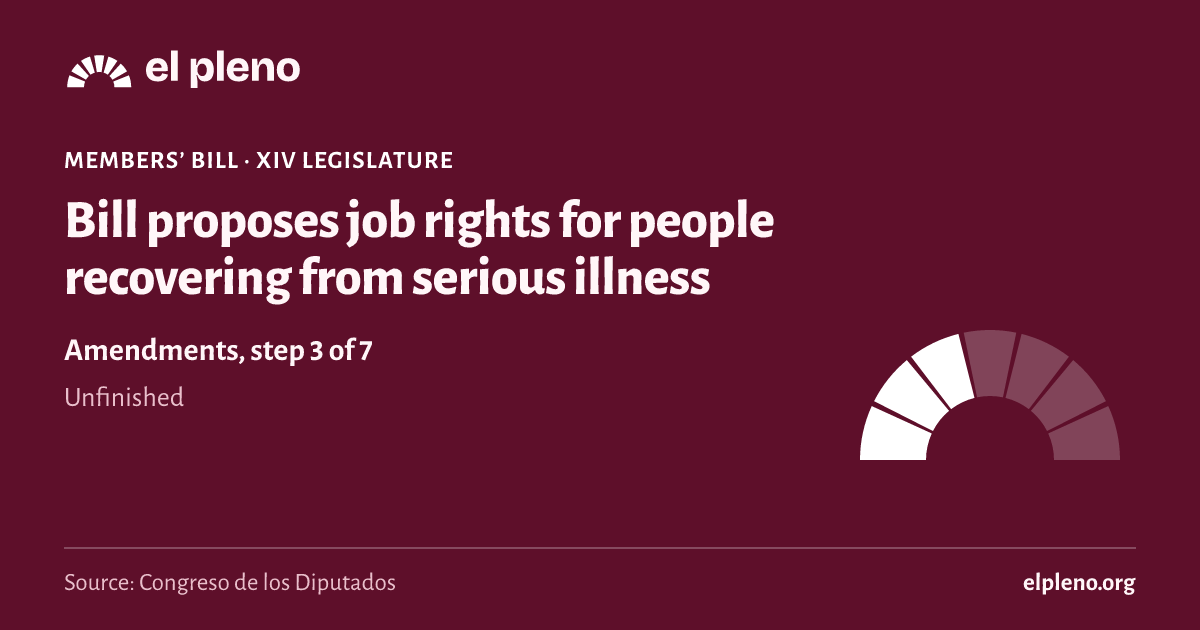
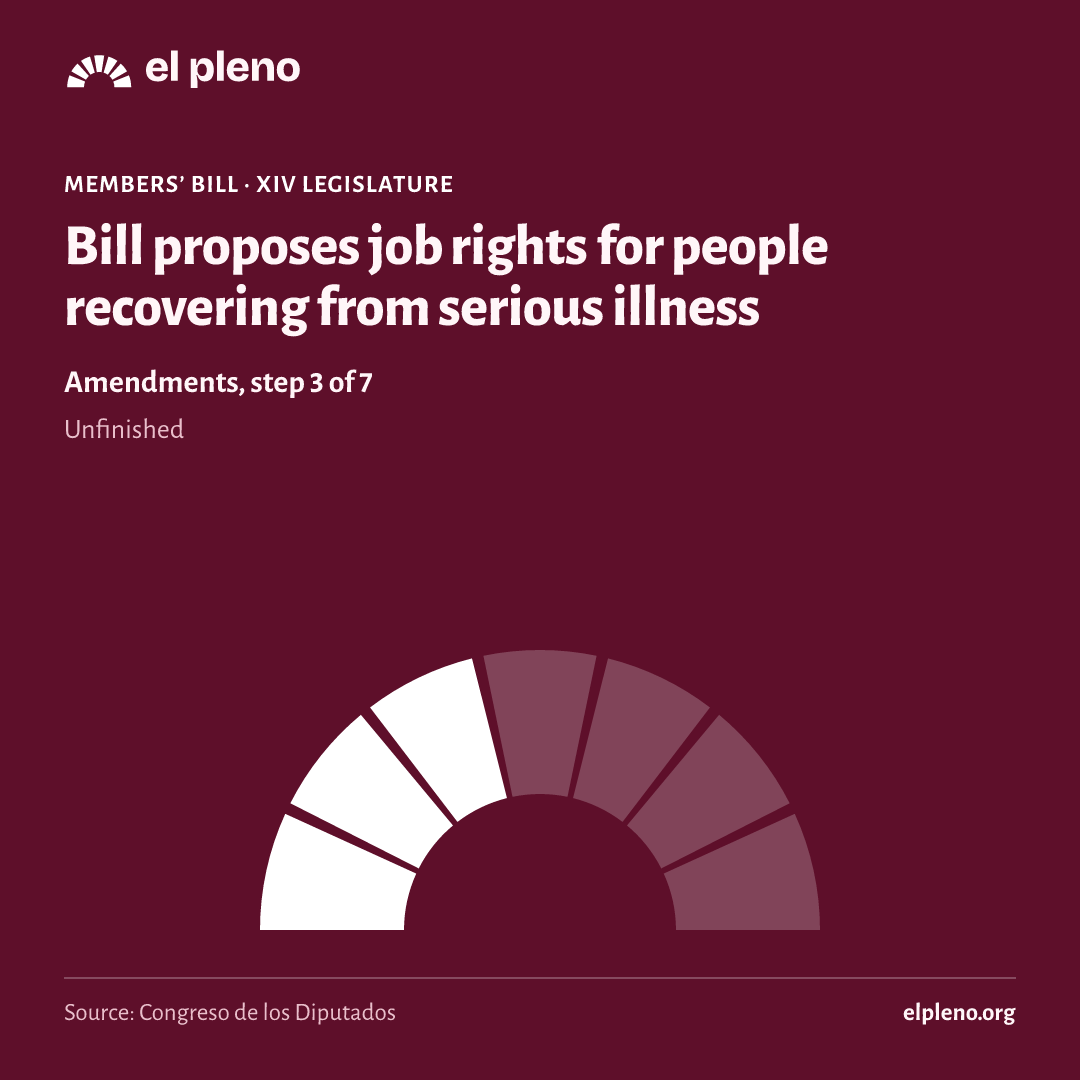
Source: Congreso de los Diputados, file 124/000012· updated 11 Nov
Automatic summary, not yet reviewed
- The bill would give people discharged after temporary or permanent disability due to a serious illness or carcinoma the right to reduce their working hours with lower pay for one year and to work remotely for six months, if the job allows it. The company could only refuse for technical impossibility or serious harm to its organization or production.
- Workers who return after overcoming a serious illness and show physical or psychological deterioration that prevents them from doing their previous duties would have preferential right to fill another vacant position in the same professional group.
- Job protection for people with a total or permanent disability or severe disability, when improvement is expected, would go from two to four years. Public employees would have the same reduced-hours and remote-work rights as other workers.
- The Government would have to take several steps within six months to one year: expand the disability evaluation team, publish data on temporary disability, update the guide for primary care doctors, create training programs for unemployed people affected, and speed up access to the Minimum Vital Income for people with a serious and incurable illness.
Who it affects
- People discharged after temporary or permanent disability due to a serious illness or carcinoma.: They could reduce their working hours for one year and work remotely for six months after returning to work.
- Workers with after-effects that prevent them from returning to their previous job.: They would have preferential right to another vacant position in the same professional group.
- People with total or permanent disability or severe disability when improvement is expected.: Their job would be protected for four years instead of two.
- Public employees who have overcome a serious illness or carcinoma.: They would have the same reduced-hours and remote-work rights.
- People with a serious and incurable illness.: Their applications for the Minimum Vital Income would be processed on a priority basis.
Words worth knowing
- Incapacidad temporal (temporary disability)
- A situation where a person cannot work temporarily due to illness or accident and receives a benefit while recovering.
- Incapacidad permanente (permanent disability)
- Official recognition that a person cannot work, fully or partially, for health reasons. It can be total, absolute, or severe disability (gran invalidez).
- Reserva de puesto de trabajo (job protection)
- The right to get your job back when the disability situation ends, without the company having filled it permanently.
- Ingreso Mínimo Vital (Minimum Vital Income)
- A state benefit for people and families with low income.
- Convenio colectivo (collective agreement)
- An agreement between companies and worker representatives that sets working conditions for a sector or company.
It summarizes the text as it was introduced. It is written by artificial intelligence and may contain mistakes: the official text is what counts. Read the official text · How we make summaries
Where it stands
How far did it get?
It took 3 of 7 steps. It reached Amendments, and today it is unfinished.
- Introduced12 May 2022Someone registers the text in the Congreso.
- Admitted17 May 2022The Bureau of the Congreso accepts it and, for a members’ bill, the plenary decides whether to consider it.
- Amendments20 May 2022Groups propose changes.
- Committeenot reachedA committee goes through the text in detail.
- Plenarynot reachedAll 350 deputies vote.
- Senatenot reachedThe Senate can pass it, amend it or veto it.
- BOEnot reachedIt is published in the Official State Gazette (BOE) and comes into force.
See the 5 official steps on a timeline
Was there a plenary vote?
We have no plenary vote linked to this law in the Congreso’s data.
What happens next
What happens now?
The legislature ended before it finished. To go on, someone would have to introduce it again in the new Cortes.
It has not been presented again yet.
The same initiative in the other chamber:
Sources
Where does all this come from?
- Congreso de los Diputados, file 124/000012
Official title, type, author, dates and stage.
Retrieved 11 November 2026
- The data comes from the open files of the Congreso, the Senate and the BOE, unaltered.
- Each deputy’s province is the one of their seat on the day of the vote.
- We only say “passed” or “rejected” when the majority needed is certain; otherwise we say which side had more votes.