What it is
Bill proposing full legal protection for whistleblowers in Spain
It is a members’ bill. Introduced by parliamentary groups, the Senate, regional governments or citizens. It was introduced on 11 December 2019. Introduced by: Baldoví Roda, Joan y 15 Diputados.
Official title: Private member's bill on the comprehensive protection of whistleblowers.
Source: Congreso de los Diputados, file 123/000003· updated 11 Nov
Automatic summary, not yet reviewed
- The bill would establish measures to protect people who reveal information about irregularities, violations or wrongdoing that harms the general interest, in both the public and private sectors, and would regulate the channels for receiving such reports.
- It protects not only the person who reports, but also facilitators: people or entities such as NGOs, unions, journalists or lawyers who help pass the alert along.
- Whistleblowers and facilitators would be guaranteed safety, anonymity and confidentiality, access to information about the procedure, and free legal aid.
- Workplace and economic retaliation would be banned: anyone fired could choose between reinstatement or compensation for unfair dismissal, and self-employed people forced to stop working would get six months with their social security contributions suspended.
- A whistleblower would only need a reasonable belief that the information is reliable; verifying the facts falls to the investigating body. Someone reporting wrongdoing they took part in would benefit from a mitigating factor that reduces the sentence by one or two degrees.
- Public administrations, companies with more than 50 employees and other entities would have to set up anonymous and secure reporting channels, and the whistleblower could freely choose which channel to use, without having to go through the internal one first.
- It would create an Independent Authority for the Protection of Whistleblowers and Facilitators, which would act as an external channel, legally represent whistleblowers, provide legal aid and sanction violations.
- Very serious violations, such as revealing the identity of an anonymous whistleblower or retaliating against them, would carry fines of up to €300,000 and bans of up to three years.
Who it affects
- Employees and public workers who witness wrongdoing at their organization: They could report anonymously and with protection, without facing workplace retaliation.
- Private companies with more than 50 employees: They would have to create internal anonymous and secure reporting channels.
- Public administrations and public entities: They would have to set up internal and external reporting channels and cooperate with the new Authority.
- NGOs, unions, journalists and lawyers: They would be protected as facilitators when they help spread an alert.
- Those who retaliate against whistleblowers: They would face fines of up to €300,000 and the duty to compensate for damages.
Words worth knowing
- Alertador
- A person who reveals or reports information about violations or wrongdoing that harms the general interest (a whistleblower).
- Facilitador
- A person or entity that helps the whistleblower reveal or make the information public, such as a journalist or an NGO.
- Indemnidad
- A guarantee that no one can harm or retaliate against the person who reports.
- Represalia
- Any act that harms someone for having reported, such as firing, sanctions or threats.
- Proposición de ley
- A bill introduced by members of Congress; it is not yet an approved law.
It summarizes the text as it was introduced. It is written by artificial intelligence and may contain mistakes: the official text is what counts. Read the official text · How we make summaries
Where it stands
How far did it get?
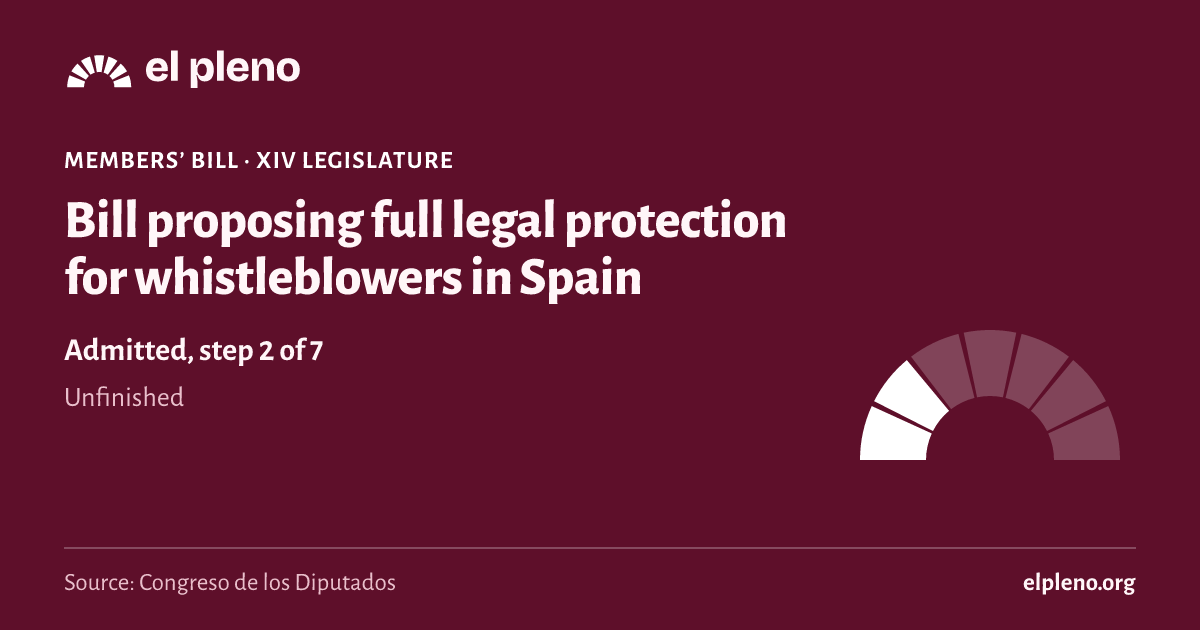
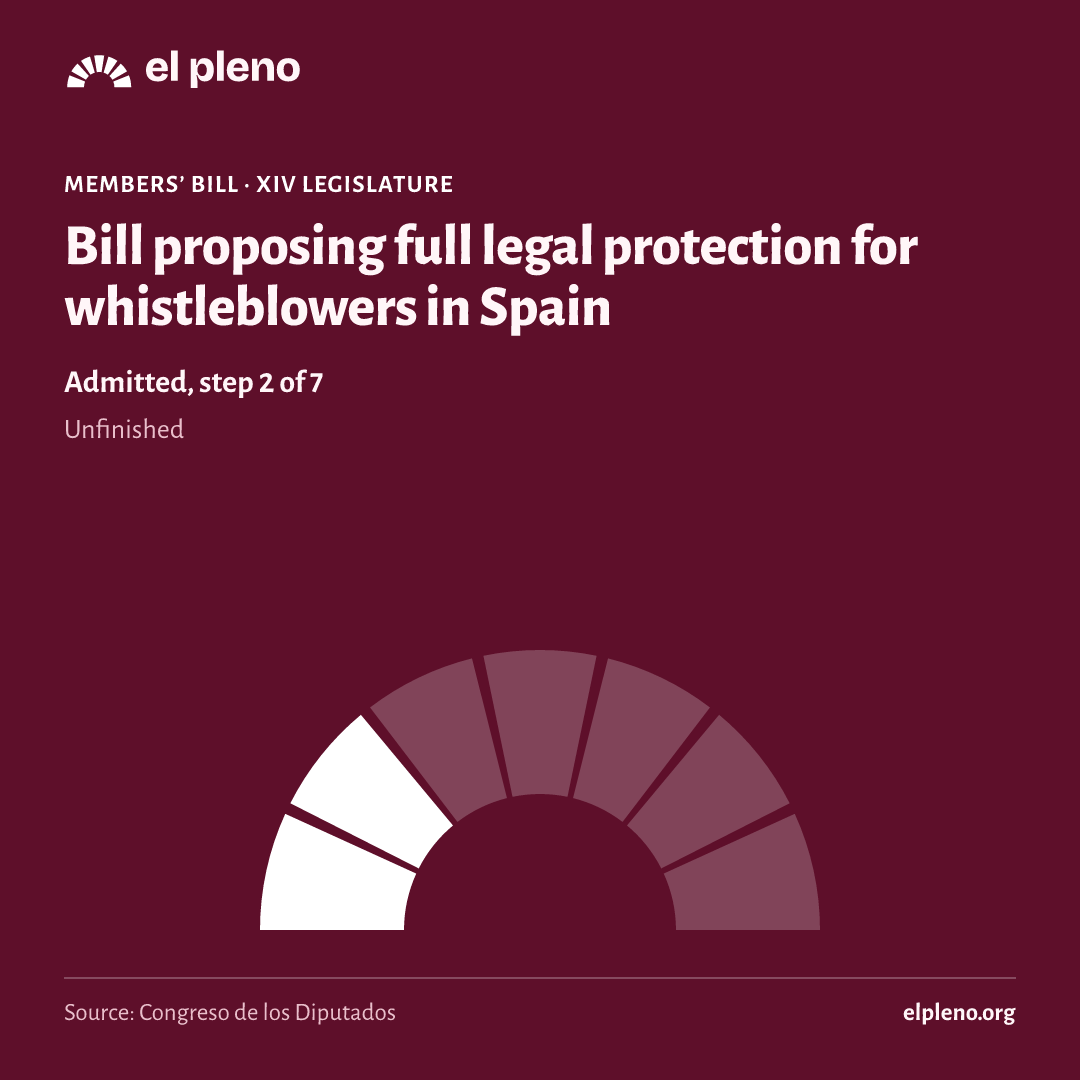
It took 2 of 7 steps. It reached Admitted, and today it is unfinished.
- Introduced11 December 2019Someone registers the text in the Congreso.
- Admitted13 December 2019The Bureau of the Congreso accepts it and, for a members’ bill, the plenary decides whether to consider it.
- Amendmentsnot reachedGroups propose changes.
- Committeenot reachedA committee goes through the text in detail.
- Plenarynot reachedAll 350 deputies vote.
- Senatenot reachedThe Senate can pass it, amend it or veto it.
- BOEnot reachedIt is published in the Official State Gazette (BOE) and comes into force.
See the 6 official steps on a timeline
Was there a plenary vote?
We have no plenary vote linked to this law in the Congreso’s data.
What happens next
What happens now?
The legislature ended before it finished. To go on, someone would have to introduce it again in the new Cortes.
It has not been presented again yet.
Presented before in:
- XIII Legislature, Congreso de los Diputados· Unfinished Bill proposes protection for people reporting corruption and wrongdoing
Sources
Where does all this come from?
- Congreso de los Diputados, file 123/000003
Official title, type, author, dates and stage.
Retrieved 11 November 2026
- The data comes from the open files of the Congreso, the Senate and the BOE, unaltered.
- Each deputy’s province is the one of their seat on the day of the vote.
- We only say “passed” or “rejected” when the majority needed is certain; otherwise we say which side had more votes.