What it is
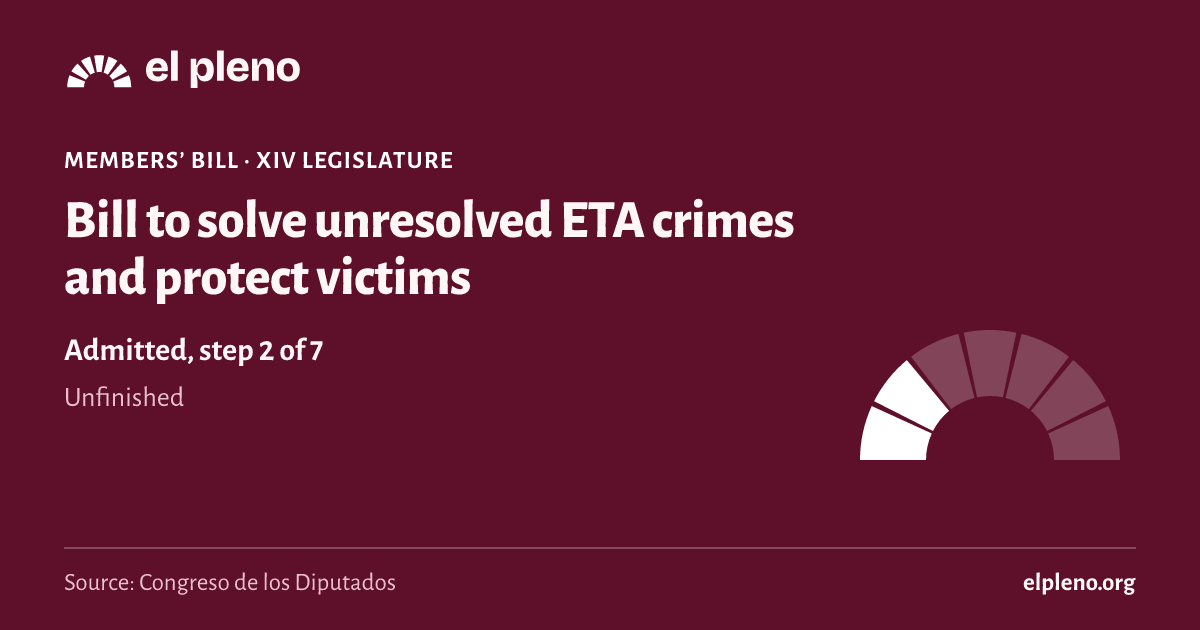
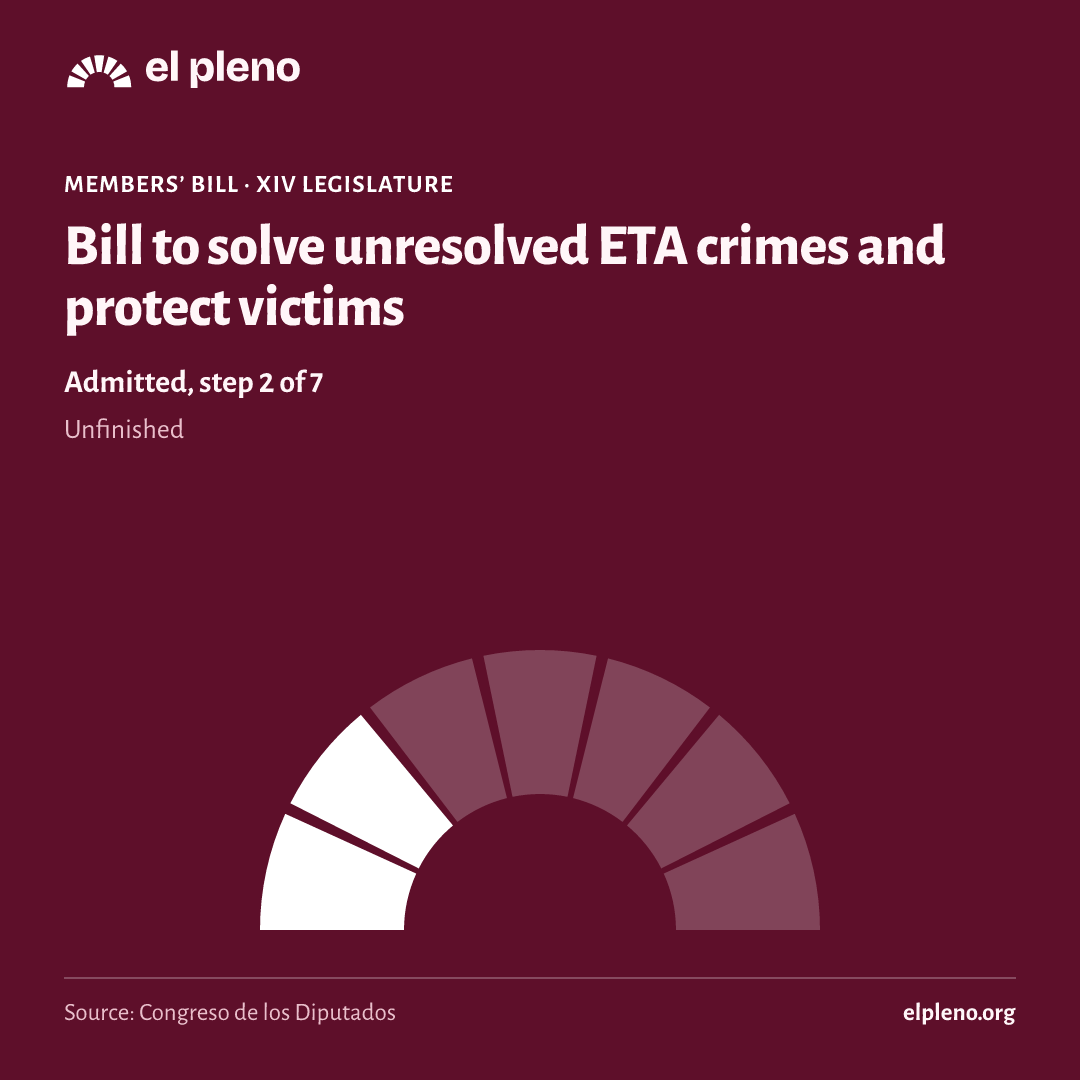
Bill to solve unresolved ETA crimes and protect victims
It is a members’ bill. Introduced by parliamentary groups, the Senate, regional governments or citizens. It was introduced on 20 April 2023. Introduced by: Grupo Parlamentario Popular en el Congreso.
Official title: Private member's bill for an Organic Law on unresolved ETA crimes and their victims to comply with the report of April 21, 2022, of the European Parliament Committee on Petitions (PE702.917v03-00).
Source: Congreso de los Diputados, file 122/000323· updated 11 Nov
Automatic summary, not yet reviewed
- The bill would implement the April 21, 2022 report by the Petitions Committee of the European Parliament, which points to 379 unresolved ETA murders and makes fifteen recommendations to the Spanish authorities.
- It would amend the terrorism victims law to ban monuments, plaques and mentions that glorify terrorism, push for their removal, and let Government Delegates ban tributes to convicted terrorists. It would also state that ETA's activity was a widespread and systematic attack on the civilian population, and set duties to investigate unresolved cases, including a panel of jurists and a call for anonymous tips.
- The authorities could ban gatherings and demonstrations that might humiliate terrorism victims, such as tributes to convicted terrorists. City councils could not help hold banned events, responsible officials would personally answer for fines, and organizing them would be a very serious offense.
- Prison benefits, progression to open regimes and parole for convicted terrorists would require paying civil liability, renouncing terrorism, cooperating with justice, and making a credible apology to victims. It would also toughen penalties for glorifying terrorism and for acts that humiliate victims.
- The bill is framed as an organic law A law on fundamental rights, the electoral system or other matters the Constitution reserves. It needs an absolute majority in the Congreso: 176 votes. for most of its content and would take effect the same day it is published in the Boletín Oficial del Estado (official state gazette).
Who it affects
- Families of the 379 victims of unresolved ETA murders: They would receive personal updates on their cases and the cases would be investigated.
- Convicted terrorists: They would only get prison benefits if they cooperate with justice and apologize to victims.
- People organizing tributes to terrorists: Their events could be banned and would be a very serious offense.
- City councils and their officials: They could not help hold banned events and would personally answer for fines.
- Public administrations: They would have to remove monuments and mentions glorifying terrorism and could lose public subsidies if they fail to.
Words worth knowing
- Ley orgánica (organic law)
- A stricter type of Spanish law that needs an absolute majority of the Congress of Deputies to pass.
- Beneficio penitenciario (prison benefit)
- Advantages the law gives a prisoner, such as early release or a lighter prison regime.
- Prescripción (statute of limitations)
- When a crime can no longer be tried or punished because too much time has passed.
- Victimización secundaria (secondary victimization)
- Extra harm suffered by a victim from later acts, such as humiliation or tributes to the attacker.
- Responsabilidad civil (civil liability)
- The duty to pay the victim reparation or compensation for the harm caused.
- organic law
- A law on fundamental rights, the electoral system or other matters the Constitution reserves. It needs an absolute majority in the Congreso: 176 votes.
It summarizes the text as it was introduced. It is written by artificial intelligence and may contain mistakes: the official text is what counts. Read the official text · How we make summaries
Where it stands
How far did it get?
It took 2 of 7 steps. It reached Admitted, and today it is unfinished.
- Introduced20 April 2023Someone registers the text in the Congreso.
- Admitted27 April 2023The Bureau of the Congreso accepts it and, for a members’ bill, the plenary decides whether to consider it.
- Amendmentsnot reachedGroups propose changes.
- Committeenot reachedA committee goes through the text in detail.
- Plenarynot reachedAll 350 deputies vote.
- Senatenot reachedThe Senate can pass it, amend it or veto it.
- BOEnot reachedIt is published in the Official State Gazette (BOE) and comes into force.
See the 5 official steps on a timeline
Was there a plenary vote?
We have no plenary vote linked to this law in the Congreso’s data.
What happens next
What happens now?
The legislature ended before it finished. To go on, someone would have to introduce it again in the new Cortes.
It was presented again:
- XV Legislature, Congreso de los Diputados· Rejected Proposal to solve unresolved ETA crimes and protect victims
Sources
Where does all this come from?
- Congreso de los Diputados, file 122/000323
Official title, type, author, dates and stage.
Retrieved 11 November 2026
- The data comes from the open files of the Congreso, the Senate and the BOE, unaltered.
- Each deputy’s province is the one of their seat on the day of the vote.
- We only say “passed” or “rejected” when the majority needed is certain; otherwise we say which side had more votes.