What it is
Bill would let cities manage their historic port areas
It is a members’ bill. Introduced by parliamentary groups, the Senate, regional governments or citizens. It was introduced on 14 July 2022. Introduced by: Grupo Parlamentario Plural.
Official title: Private member's bill for the reform of Royal Legislative Decree 2/2011, of 5 September, approving the Consolidated Text of the Law on the Ports of the State and the Merchant Marine.
Source: Congreso de los Diputados, file 122/000245· updated 11 Nov
Automatic summary, not yet reviewed
- The bill would allow fishing and leisure marina docks to be split off from ports of general interest, if they meet conditions such as having independent infrastructure and not affecting port operations. The Government would approve the split by Royal Decree, after a report from Puertos del Estado.
- Port authorities could take part in consortia or public bodies that manage port-city interaction spaces, with a prior report from the National Markets and Competition Commission and accounting separation safeguards.
- Port land that is no longer used and is not public maritime-terrestrial domain could be given port-city uses, such as cultural or recreational facilities, as long as this does not harm the port's future.
- Consortia or public bodies managing these spaces would collect the port fees for occupancy and activity instead of the port authority, and would be considered managers of the public port domain.
- A new additional provision would regulate the management of these spaces and provide that La Marina de Valencia and other bodies already managing such spaces would be assigned them by law within a maximum of three months.
- The explanatory statement says historic ports in major cities have become obsolete for maritime trade and need to be integrated into the city through democratic, participatory management. It cites the Nuevos Viejos Puertos manifesto, written in València in 2019, as a starting point.
Words worth knowing
- Zona de servicio
- The waters and land that the law assigns to a port for its operation.
- Dominio público portuario
- Port assets, such as waters and docks, that are public and cannot be privately owned.
- Segregación
- Removing part of a port from its service area so another administration can manage it.
- Tasas portuarias
- Fees paid for occupying or using port facilities.
- Concesión
- Permission to use a public asset for a period of time, under conditions.
It summarizes the text as it was introduced. It is written by artificial intelligence and may contain mistakes: the official text is what counts. Read the official text · How we make summaries
Where it stands
How far did it get?
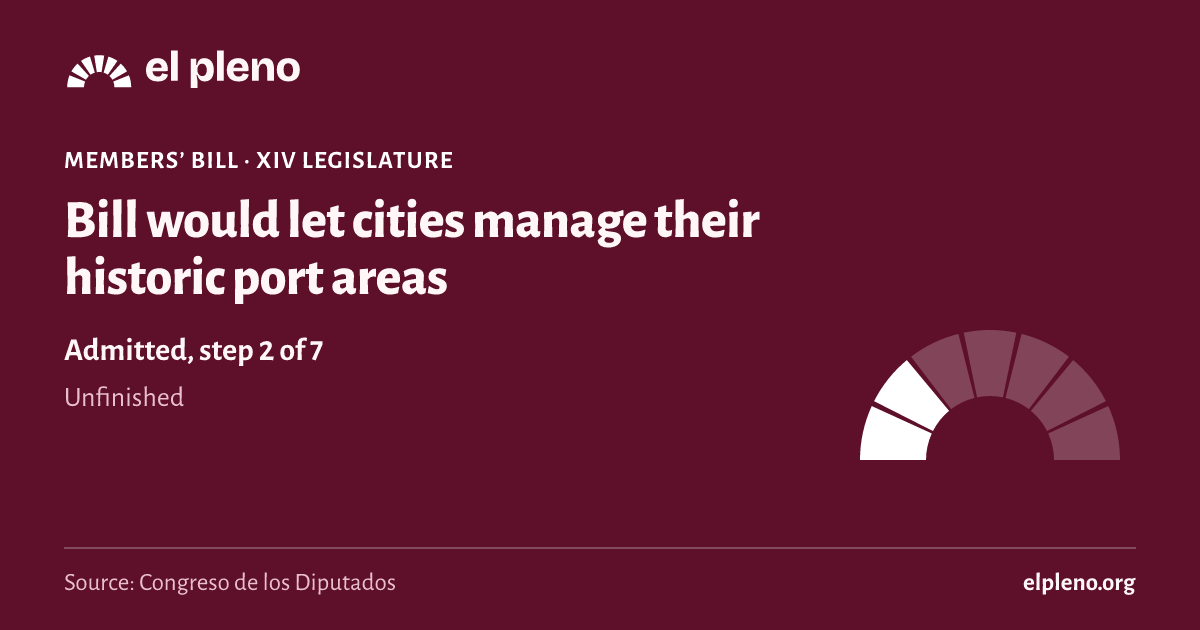
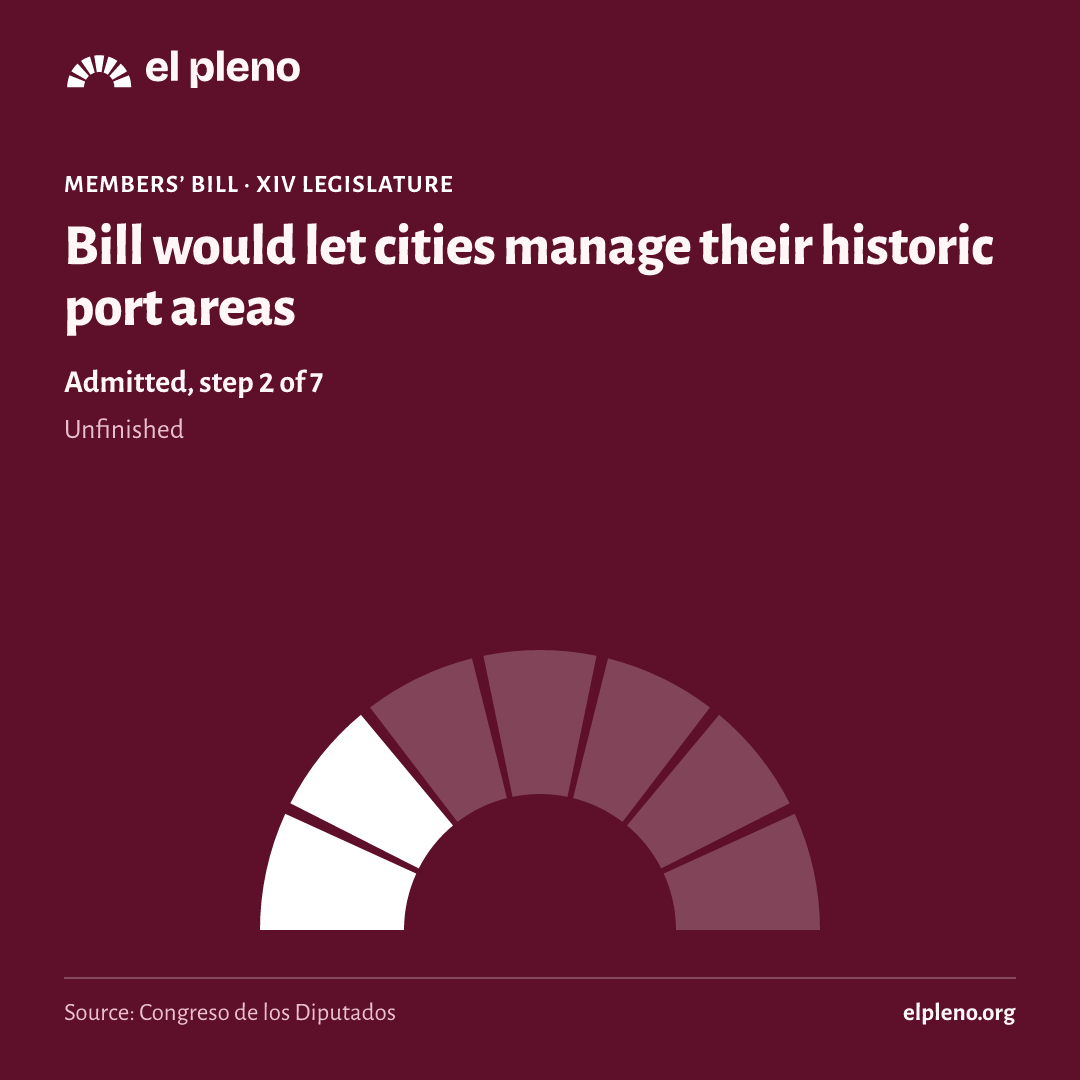
It took 2 of 7 steps. It reached Admitted, and today it is unfinished.
- Introduced14 July 2022Someone registers the text in the Congreso.
- Admitted25 August 2022The Bureau of the Congreso accepts it and, for a members’ bill, the plenary decides whether to consider it.
- Amendmentsnot reachedGroups propose changes.
- Committeenot reachedA committee goes through the text in detail.
- Plenarynot reachedAll 350 deputies vote.
- Senatenot reachedThe Senate can pass it, amend it or veto it.
- BOEnot reachedIt is published in the Official State Gazette (BOE) and comes into force.
See the 6 official steps on a timeline
Was there a plenary vote?
We have no plenary vote linked to this law in the Congreso’s data.
What happens next
What happens now?
The legislature ended before it finished. To go on, someone would have to introduce it again in the new Cortes.
It has not been presented again yet.
Sources
Where does all this come from?
- Congreso de los Diputados, file 122/000245
Official title, type, author, dates and stage.
Retrieved 11 November 2026
- The data comes from the open files of the Congreso, the Senate and the BOE, unaltered.
- Each deputy’s province is the one of their seat on the day of the vote.
- We only say “passed” or “rejected” when the majority needed is certain; otherwise we say which side had more votes.