What it is
Bill to strengthen political and judicial oversight of Spain's intelligence agency
It is a members’ bill. Introduced by parliamentary groups, the Senate, regional governments or citizens. It was introduced on 17 May 2022. Introduced by: Grupo Parlamentario Vasco (EAJ-PNV).
Official title: Private member's bill amending Law 11/2002, of 6 May, regulating the National Intelligence Center, and Organic Law 2/2002, of 6 May, regulating the prior judicial control of the National Intelligence Center.

Source: Congreso de los Diputados, file 122/000223· updated 11 Nov
Automatic summary, not yet reviewed
- The bill would have the person holding the presidency of the Government directly propose the appointment of the CNI Centro Nacional de Inteligencia: Spain's intelligence service, which gathers information to protect the State's interests.'s Secretary of State Director, creating direct political responsibility. The term would be five years, though the Council of Ministers could replace that person at any time.
- It expands political oversight: the Congress committee that oversees the CNI, the Commission for the Control of Funds Reserved for Classified Expenses, could learn about the means used in operations that already have judicial authorization.
- It strengthens judicial oversight: authorization for measures affecting the home or the secrecy of communications would be decided by three Supreme Court judges, unanimously and through a reasoned decision, within an ordinary deadline of 72 hours, reducible to 24 hours for justified urgency.
- It requires more detail in requests: the CNI Director would have to specify the means and resources to be used, with their concrete characteristics, so they can be weighed under the Principle of proportionality The idea that measures must be limited to what is necessary: no more than what is strictly needed to achieve the goal.. It also sets maximum time limits: 24 hours for entering homes and three months for intercepting communications, both renewable.
- It adds Ex post oversight A check made after the fact, here meaning informing the judges of how each authorization was carried out.: the judges must be informed of how each authorization or extension was carried out once it ends, to verify it matched its content. Material obtained that is unrelated to the purpose of the authorization must be destroyed immediately.
- It regulates how the three competent judges are appointed: the General Council of the Judiciary would propose them for five-year terms, from among Supreme Court judges with at least three years of service in that role.
Who it affects
- The CNI and its Director: They would have to request judicial authorization in more detail and account for each operation afterward.
- The President of the Government: Would directly propose the appointment of the CNI Director.
- Supreme Court judges: Three of them, appointed for five years, would unanimously decide on authorizations.
- The Congress of Deputies: Its oversight committee could learn about the means used in judicially authorized operations.
- People targeted by CNI investigations: They would get more safeguards: maximum time limits, a panel decision, and destruction of material unrelated to the authorization.
Words worth knowing
- CNI
- Centro Nacional de Inteligencia: Spain's intelligence service, which gathers information to protect the State's interests.
- Proposición de ley
- A bill introduced by a parliamentary group. It is not a law until it goes through the legislative process and is passed.
- Principle of proportionality
- The idea that measures must be limited to what is necessary: no more than what is strictly needed to achieve the goal.
- Ex post oversight
- A check made after the fact, here meaning informing the judges of how each authorization was carried out.
- Consejo General del Poder Judicial
- The General Council of the Judiciary, the body that governs judges and courts in Spain.
It summarizes the text as it was introduced. It is written by artificial intelligence and may contain mistakes: the official text is what counts. Read the official text · How we make summaries
Where it stands
How far did it get?
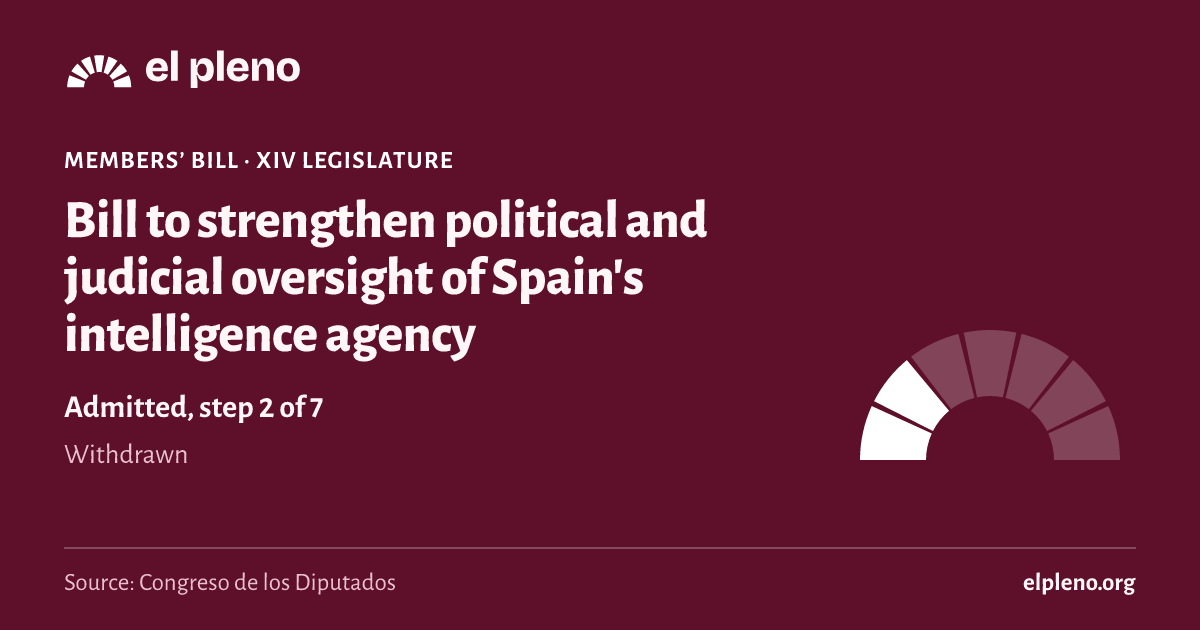
It took 2 of 7 steps. It reached Admitted, and today it is withdrawn.
- Introduced17 May 2022Someone registers the text in the Congreso.
- Admitted24 May 2022The Bureau of the Congreso accepts it and, for a members’ bill, the plenary decides whether to consider it.
- Amendmentsnot reachedGroups propose changes.
- Committeenot reachedA committee goes through the text in detail.
- Plenarynot reachedAll 350 deputies vote.
- Senatenot reachedThe Senate can pass it, amend it or veto it.
- BOEnot reachedIt is published in the Official State Gazette (BOE) and comes into force.
See the 6 official steps on a timeline
Was there a plenary vote?
We have no plenary vote linked to this law in the Congreso’s data.
What happens next
What happens now?
Whoever introduced it withdrew it, or it was merged into another one. It goes no further.
It was presented again:
- XV Legislature, Congreso de los Diputados· Unfinished Bill to strengthen political and judicial oversight of Spain's intelligence agency
Sources
Where does all this come from?
- Congreso de los Diputados, file 122/000223
Official title, type, author, dates and stage.
Retrieved 11 November 2026
- The data comes from the open files of the Congreso, the Senate and the BOE, unaltered.
- Each deputy’s province is the one of their seat on the day of the vote.
- We only say “passed” or “rejected” when the majority needed is certain; otherwise we say which side had more votes.