What it is
Proposal to tighten environmental rules for mining
It is a members’ bill. Introduced by parliamentary groups, the Senate, regional governments or citizens. It was introduced on 17 March 2022. Introduced by: Grupo Parlamentario Confederal de Unidas Podemos-En Comú Podem-Galicia en Común.
Official title: Private member's bill to amend Law 22/1973, of July 21, on Mines.
Source: Congreso de los Diputados, file 122/000206· updated 11 Nov
Automatic summary, not yet reviewed
- The bill would amend the 1973 Mining Law to align it with the European Union's environmental protection principles and with the 2030 Agenda. It also seeks to adapt the mining regime to EU law on the environment and public participation.
- Research permits, exploitation concessions and authorizations would require public information for at least 30 business days, participation activities with the affected public, and consultations with the competent authorities. They would only take effect once all other required authorizations are obtained and restoration, dismantling and closure plans, among other documents, are approved at the same time.
- Land in the Natura 2000 network and other areas with protection incompatible with mining, such as river reserves and their basins, could not be registered for mining. Exploration permits would be eliminated, and the regulation of mineral and thermal waters would be referred to water legislation.
- A tax on the value of extracted materials would be created: a 10% levy on what is extracted after the first treatment, earmarked for protecting geodiversity. The Mineral Raw Materials Supply Plan would be eliminated and the 1977 Mining Promotion Law repealed.
- Fines for very serious offenses would reach up to 10 million euros, serious ones up to 1 million, and minor ones up to 50,000 euros. Recurring coercive fines of 3,000 to 30,000 euros could also be imposed on those who fail to comply, and the fine could never be lower than the benefit obtained by the offender.
- Mining activities could not be authorized in the seabed or subsoil under Spanish jurisdiction in the marine environment until technology and scientific knowledge guarantee preventing any additional damage to those ecosystems. A public utility declaration would require proving sufficient current demand in the European market and the absence of supplies with lower environmental impact.
Who it affects
- Mining companies: They would have to meet stricter environmental and public participation procedures, guarantee their technical and financial capacity, pay a 10% levy on extracted materials, and face fines of up to 10 million euros.
- Public administrations: They would process permits with prior and binding reports from environmental, water and land planning authorities, and manage the new levy and sanctions.
- Citizens and environmental groups: They could take part in permit procedures and would be represented on a new provincial advisory body.
- Affected landowners: They would receive individual notification of projects, and public utility would be declared case by case, not automatically.
Words worth knowing
- Dominio público (public domain)
- Assets that belong to everyone and are managed by the State, not by a private person.
- Permiso de investigación (research permit)
- Authorization to carry out studies and work to find out what mineral resources exist in a plot of land.
- Concesión de explotación (exploitation concession)
- Authorization to extract and use the mineral resources of a plot of land for a set period.
- Red Natura 2000 (Natura 2000 network)
- A network of protected natural areas in the European Union.
- Multas coercitivas (coercive fines)
- Repeated fines imposed to force someone to comply with an order.
It summarizes the text as it was introduced. It is written by artificial intelligence and may contain mistakes: the official text is what counts. Read the official text · How we make summaries
Where it stands
How far did it get?
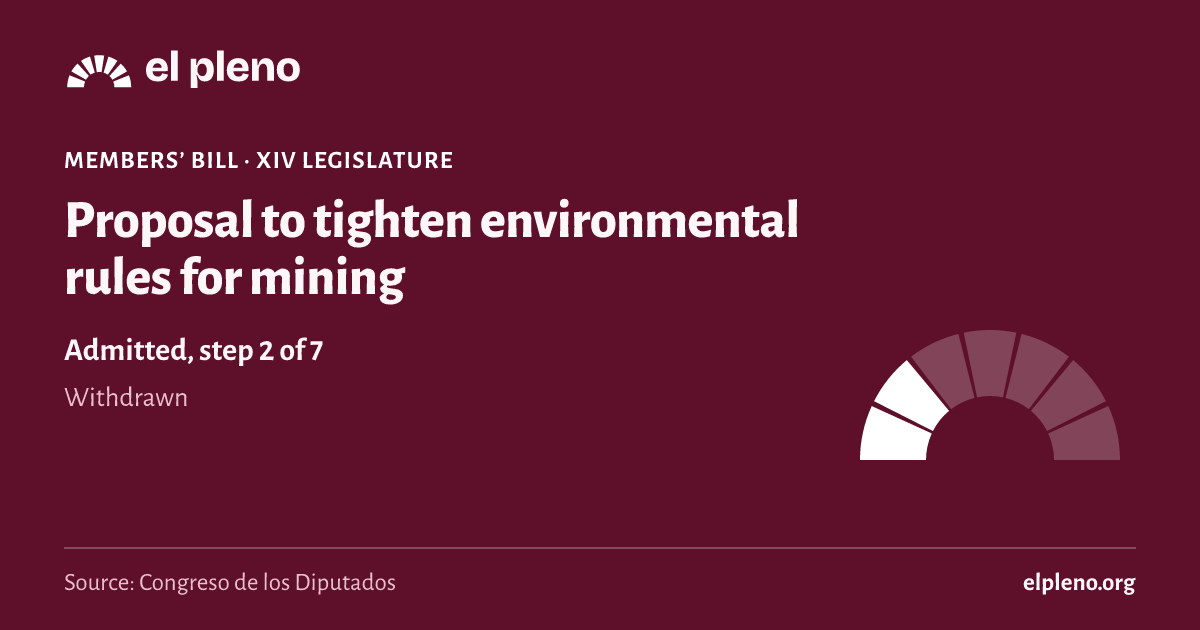
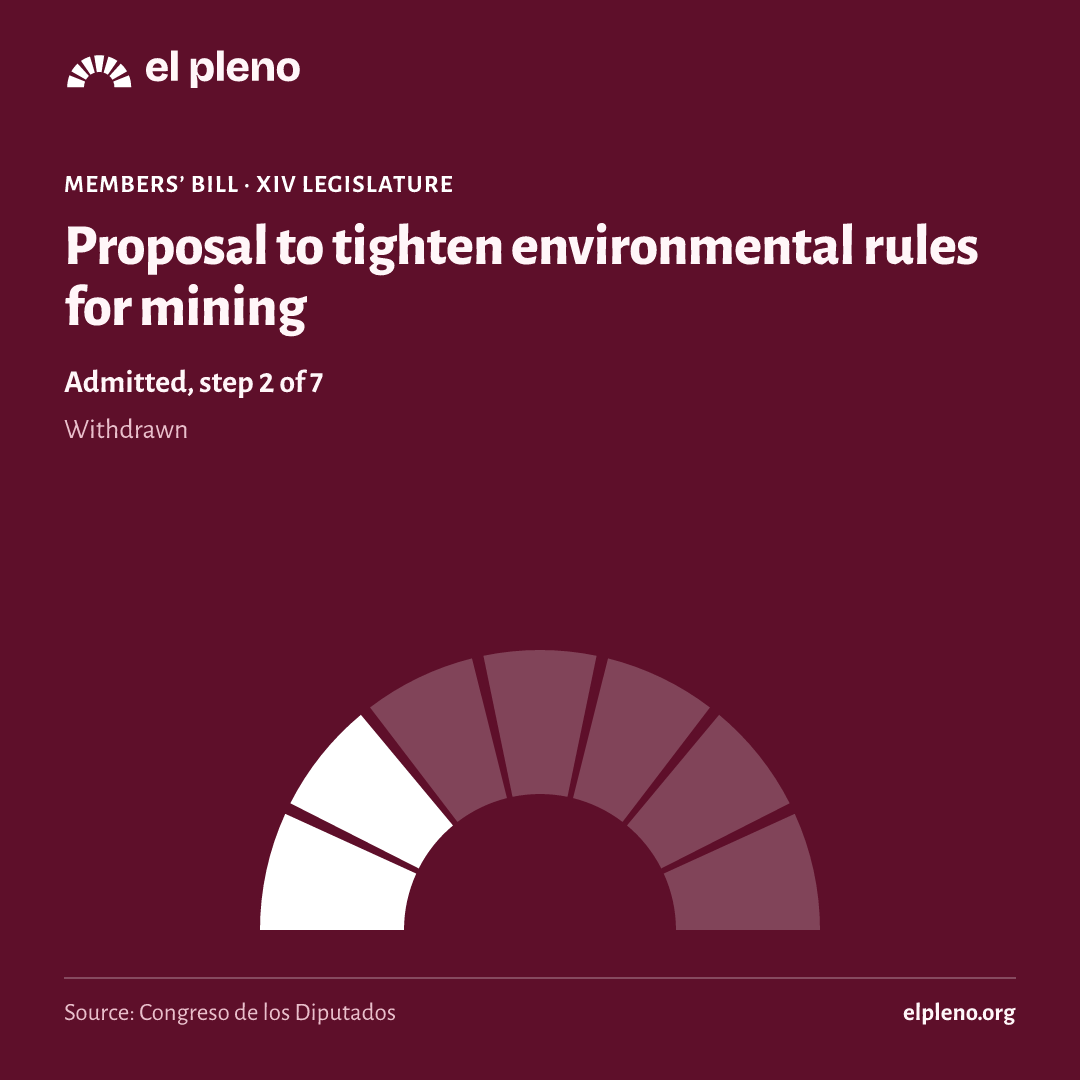
It took 2 of 7 steps. It reached Admitted, and today it is withdrawn.
- Introduced17 March 2022Someone registers the text in the Congreso.
- Admitted22 March 2022The Bureau of the Congreso accepts it and, for a members’ bill, the plenary decides whether to consider it.
- Amendmentsnot reachedGroups propose changes.
- Committeenot reachedA committee goes through the text in detail.
- Plenarynot reachedAll 350 deputies vote.
- Senatenot reachedThe Senate can pass it, amend it or veto it.
- BOEnot reachedIt is published in the Official State Gazette (BOE) and comes into force.
See the 5 official steps on a timeline
Was there a plenary vote?
We have no plenary vote linked to this law in the Congreso’s data.
What happens next
What happens now?
Whoever introduced it withdrew it, or it was merged into another one. It goes no further.
Sources
Where does all this come from?
- Congreso de los Diputados, file 122/000206
Official title, type, author, dates and stage.
Retrieved 11 November 2026
- The data comes from the open files of the Congreso, the Senate and the BOE, unaltered.
- Each deputy’s province is the one of their seat on the day of the vote.
- We only say “passed” or “rejected” when the majority needed is certain; otherwise we say which side had more votes.