What it is
Proposal to make EU court convictions count the same in Spain
It is a members’ bill. Introduced by parliamentary groups, the Senate, regional governments or citizens. It was introduced on 20 May 2021. Introduced by: Grupo Parlamentario Confederal de Unidas Podemos-En Comú Podem-Galicia en Común.
Official title: Organic Private member's bill to amend Organic Law 7/2014, of November 12, on the exchange of criminal record information and the consideration of criminal judicial decisions in the European Union.
Source: Congreso de los Diputados, file 122/000145· updated 11 Nov
Automatic summary, not yet reviewed
- The bill would make final convictions issued in other EU member states have the same legal effects in Spain as if a Spanish court had issued them, at every stage: before trial, during trial, and when serving the sentence. Three conditions would apply: the acts must be punishable under Spanish law at the time they were committed, there must be enough information about the conviction, and there must be a final conviction ruling.
- It would remove the rule that barred EU convictions from being counted when setting the maximum prison time to be served. Time served in another member state could then count toward sentence aggregation proceedings held in Spain.
- It would also delete the sole additional provision of organic law A law on fundamental rights, the electoral system or other matters the Constitution reserves. It needs an absolute majority in the Congreso: 176 votes. 7/2014, which excluded convictions issued in other member states before August 15, 2010. The explanatory statement criticizes that exclusion for breaking the equal treatment given to Spanish convictions from the same period.
- The bill keeps the rule that foreign convictions do not affect final judgments already issued in Spain and cannot trigger their review. It also keeps the rule that criminal records canceled in the Central Registry count as canceled even if they come from convictions in other states, unless the convicting state communicates otherwise.
Who it affects
- People convicted in several EU member states: Their maximum prison time could be reduced, because time served in other member states would count.
- Spanish judges and courts: They would have to give EU convictions the same effects as Spanish ones when setting sentences and maximum terms.
- People with criminal records from other EU states: Records canceled in the Central Registry would count as canceled in Spain too.
Words worth knowing
- Condena firme
- A criminal judgment that can no longer be appealed and is therefore final.
- Acumulación de condenas
- A procedure to add up several prison sentences and set a maximum time the person must serve.
- Reincidencia
- Committing a new crime after having been convicted of a previous one.
- Decisión Marco
- A European Union rule that member states must transpose into their law, here on how to take prior convictions from other countries into account.
- Registro Central
- The Spanish registry where people's criminal records are kept.
- organic law
- A law on fundamental rights, the electoral system or other matters the Constitution reserves. It needs an absolute majority in the Congreso: 176 votes.
It summarizes the text as it was introduced. It is written by artificial intelligence and may contain mistakes: the official text is what counts. Read the official text · How we make summaries
Where it stands
How far did it get?
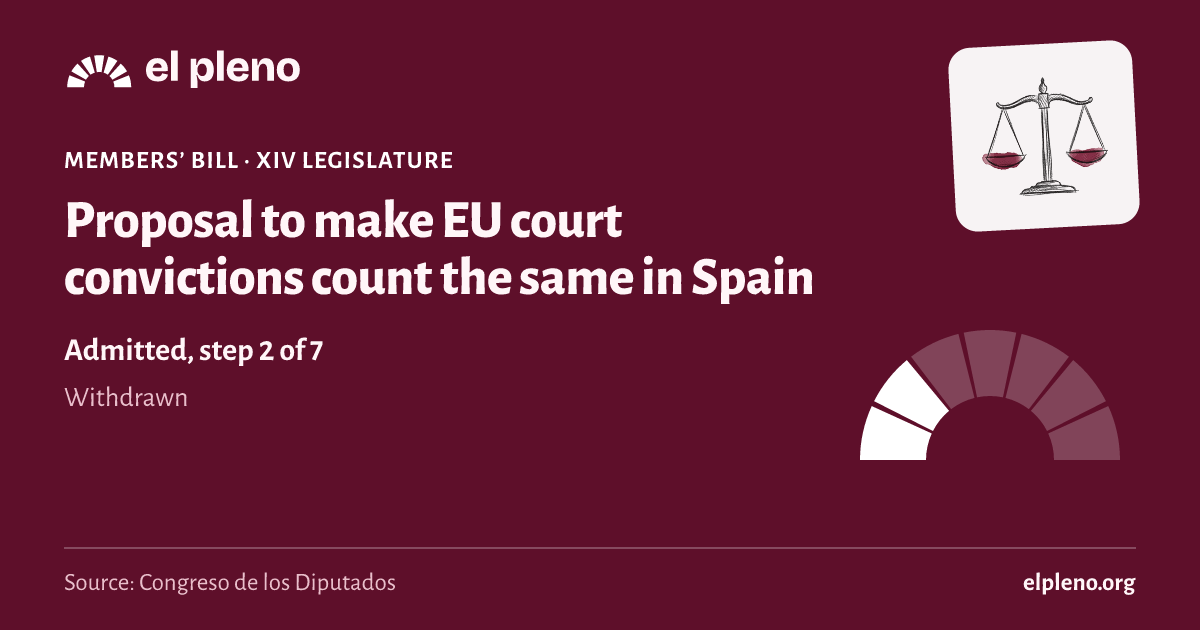
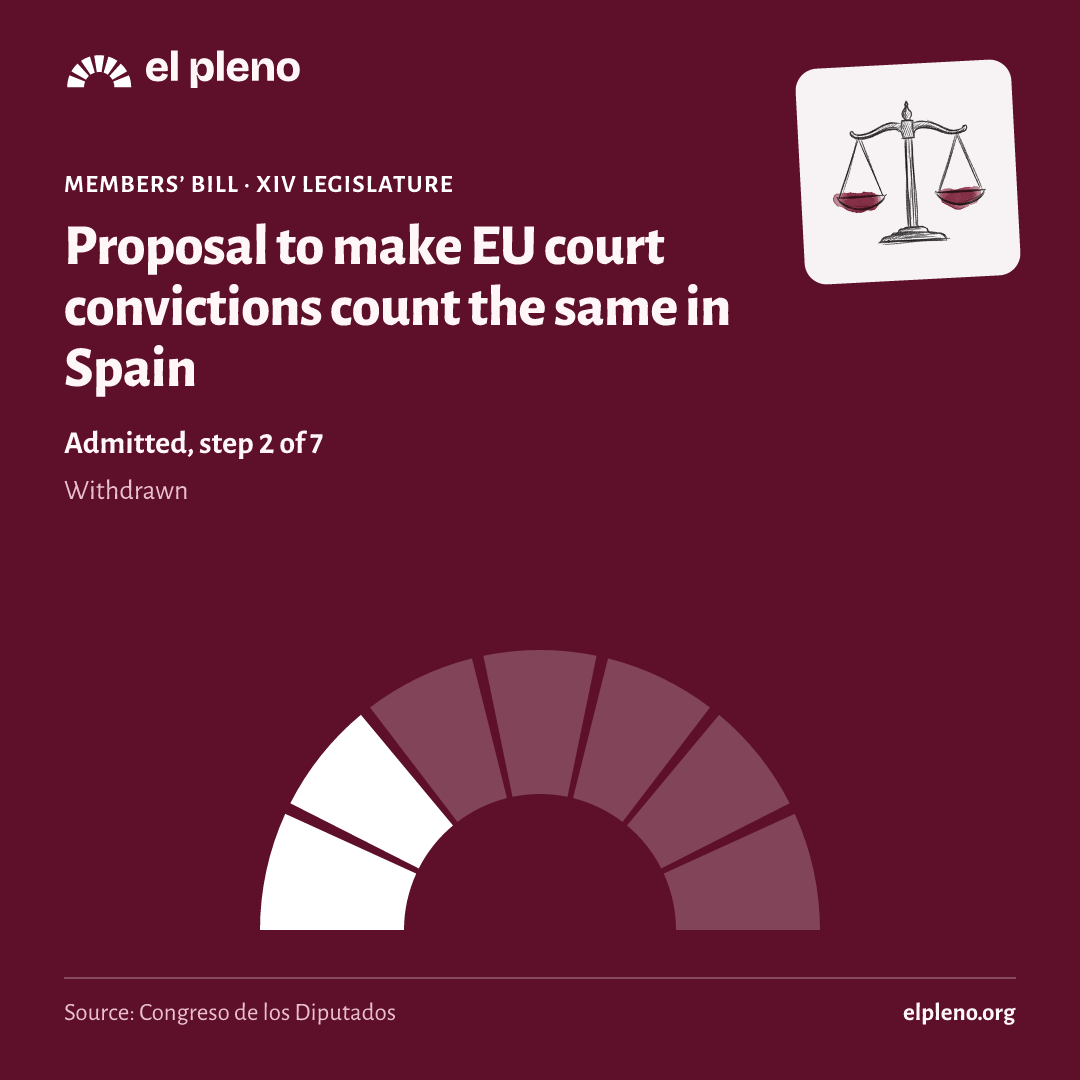
It took 2 of 7 steps. It reached Admitted, and today it is withdrawn.
- Introduced20 May 2021Someone registers the text in the Congreso.
- Admitted25 May 2021The Bureau of the Congreso accepts it and, for a members’ bill, the plenary decides whether to consider it.
- Amendmentsnot reachedGroups propose changes.
- Committeenot reachedA committee goes through the text in detail.
- Plenarynot reachedAll 350 deputies vote.
- Senatenot reachedThe Senate can pass it, amend it or veto it.
- BOEnot reachedIt is published in the Official State Gazette (BOE) and comes into force.
See the 6 official steps on a timeline
Was there a plenary vote?
We have no plenary vote linked to this law in the Congreso’s data.
What happens next
What happens now?
Whoever introduced it withdrew it, or it was merged into another one. It goes no further.
Sources
Where does all this come from?
- Congreso de los Diputados, file 122/000145
Official title, type, author, dates and stage.
Retrieved 11 November 2026
- The data comes from the open files of the Congreso, the Senate and the BOE, unaltered.
- Each deputy’s province is the one of their seat on the day of the vote.
- We only say “passed” or “rejected” when the majority needed is certain; otherwise we say which side had more votes.