What it is
Bill to make accessibility works easier in homeowners' communities
It is a members’ bill. Introduced by parliamentary groups, the Senate, regional governments or citizens. It was introduced on 8 March 2021. Introduced by: Grupo Parlamentario VOX.
Official title: Private member's bill amending the legal regime of accessibility in horizontal property matters.
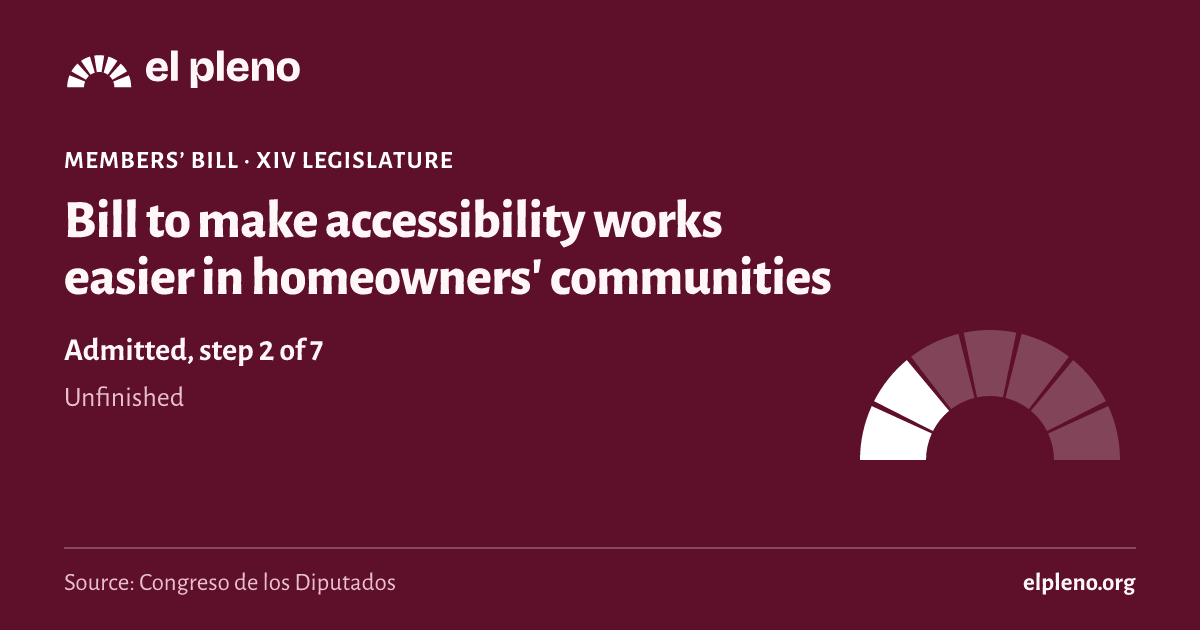
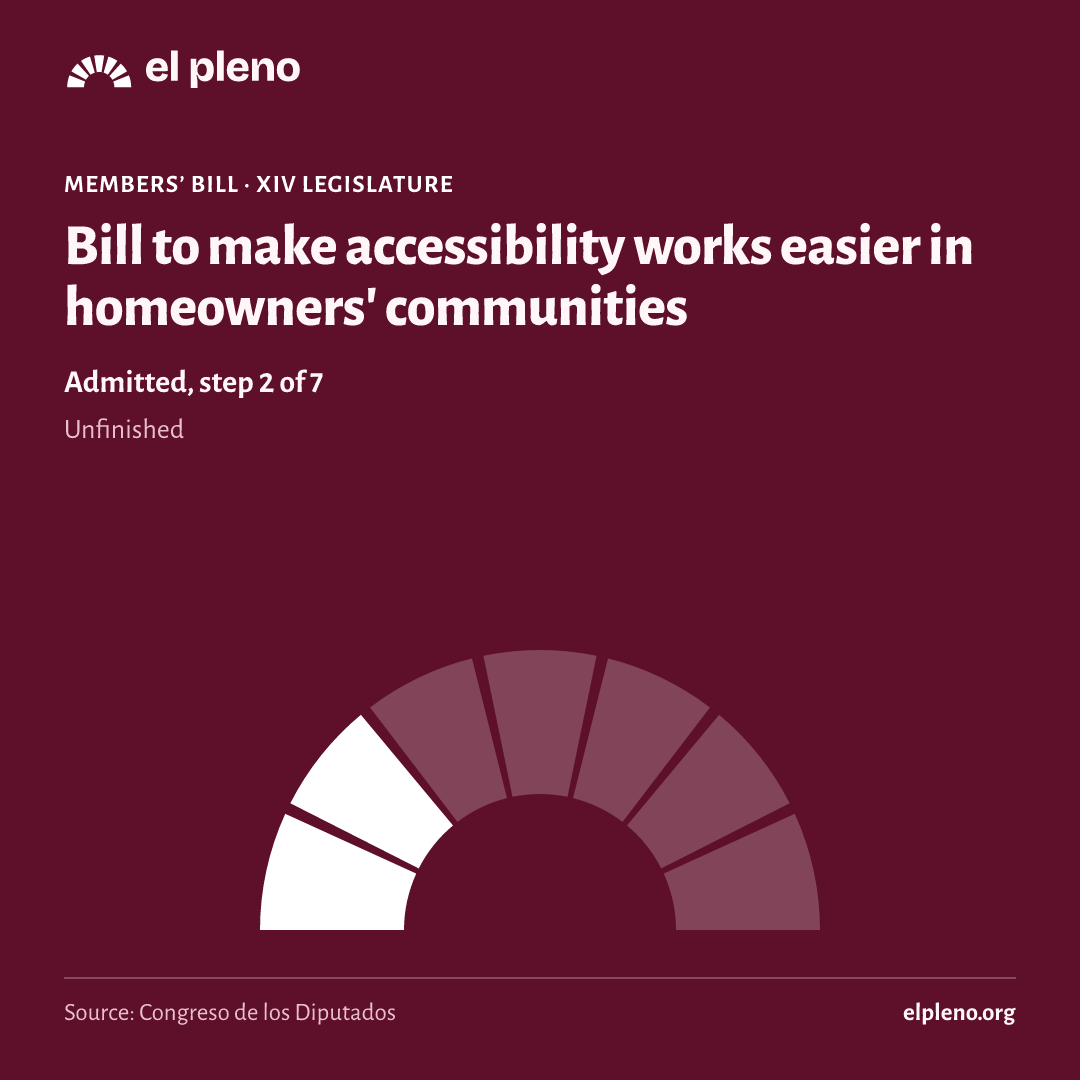
Source: Congreso de los Diputados, file 122/000129· updated 11 Nov
Automatic summary, not yet reviewed
- The bill would keep smaller accessibility works (ramps, mechanical or electronic devices other than elevators) mandatory and free from a prior homeowners' meeting vote, as long as their yearly cost, after deducting public subsidies, does not exceed twelve monthly common expense payments. The works could not start until available public subsidies have been requested.
- For larger works, such as installing elevators, the bill would require a prior vote of the homeowners' meeting by majority of owners and of ownership shares. On a second meeting call, a majority of attendees representing more than half of the shares of those present would suffice, and the community would pay the costs with no spending cap.
- The bill would amend the 1995 law on removing architectural barriers so that payment for accessibility works follows the rules of Articles 10 and 17 of the horizontal property law. It would also set that the procedure to request these works is the one in Articles 4, 5 and 6 of that same law.
- The bill would update the definitions of universal accessibility and universal design to make clear they also apply to real estate. If passed, it would take effect the day after publication in the Official State Gazette and would not affect agreements already adopted by homeowners' meetings before that date.
Who it affects
- People with disabilities living, working or volunteering in a building: They could demand accessibility works in common areas with fewer hurdles, and approving elevators would be easier on a second meeting call.
- Owners of apartments or premises (homeowners' communities): Small works would be mandatory without a prior vote, capped at twelve monthly common expense payments; large works would need a meeting vote and the community would pay with no cap.
- Owners over seventy years old: They could request accessibility works in common areas just like people with disabilities.
- Public administrations: Works could not start until the public subsidies they grant have been requested, and mandatory works may be imposed by them.
Words worth knowing
- Propiedad horizontal (horizontal property)
- The legal regime for buildings with private apartments or premises and shared common areas, such as stairs or elevators.
- Junta de propietarios (homeowners' meeting)
- Meeting of all the owners of apartments and premises in a building where decisions are made.
- Cuotas de participación (ownership shares)
- Each owner's percentage of the building, used to calculate votes and split expenses.
- Accesibilidad universal (universal accessibility)
- The condition of a space or service so that anyone can use it autonomously, safely and comfortably.
- Título constitutivo (founding deed)
- Document describing the building and its rules when the homeowners' community is created.
It summarizes the text as it was introduced. It is written by artificial intelligence and may contain mistakes: the official text is what counts. Read the official text · How we make summaries
Where it stands
How far did it get?
It took 2 of 7 steps. It reached Admitted, and today it is unfinished.
- Introduced8 March 2021Someone registers the text in the Congreso.
- Admitted16 March 2021The Bureau of the Congreso accepts it and, for a members’ bill, the plenary decides whether to consider it.
- Amendmentsnot reachedGroups propose changes.
- Committeenot reachedA committee goes through the text in detail.
- Plenarynot reachedAll 350 deputies vote.
- Senatenot reachedThe Senate can pass it, amend it or veto it.
- BOEnot reachedIt is published in the Official State Gazette (BOE) and comes into force.
See the 6 official steps on a timeline
Was there a plenary vote?
We have no plenary vote linked to this law in the Congreso’s data.
What happens next
What happens now?
The legislature ended before it finished. To go on, someone would have to introduce it again in the new Cortes.
It was presented again:
- XV Legislature, Congreso de los Diputados· Unfinished Bill to make accessibility works easier in homeowners' associations
Sources
Where does all this come from?
- Congreso de los Diputados, file 122/000129
Official title, type, author, dates and stage.
Retrieved 11 November 2026
- The data comes from the open files of the Congreso, the Senate and the BOE, unaltered.
- Each deputy’s province is the one of their seat on the day of the vote.
- We only say “passed” or “rejected” when the majority needed is certain; otherwise we say which side had more votes.