What it is
Bill to prevent child sexual abuse in schools
It is a members’ bill. Introduced by parliamentary groups, the Senate, regional governments or citizens. It was introduced on 3 March 2021. Introduced by: Grupo Parlamentario Republicano.
Official title: Private member's bill on the prevention of sexual abuse in educational centers.
Source: Congreso de los Diputados, file 122/000128· updated 11 Nov
Automatic summary, not yet reviewed
- The bill would amend the Public Employees' Basic Statute so that the statute of limitations for disciplinary offenses involving non-consensual sexual conduct with minors starts counting when the victim turns thirty. It would also extend provisional suspension from six to eight months, keep it in place until the court ruling becomes final, and remove civil servant status upon a final conviction.
- The bill would add a new ground for ending an employment contract under the Workers' Statute: a final conviction of a worker in regular contact with minors for offenses against sexual freedom and indemnity. While under investigation, the worker would be removed from their post through temporary reassignment or release from duties, keeping their salary.
- Court decisions on these offenses, when the person under investigation works in regular contact with minors, would be notified immediately to the competent public administrations, which would set up cooperation mechanisms with the courts.
- The State would create a fund, charged to the General State Budgets, to finance training for staff who work in regular contact with minors on preventing these offenses.
Who it affects
- Public employees in regular contact with minors: They would face new disciplinary rules: a longer statute of limitations, extended provisional suspension, and loss of civil servant status if convicted.
- Private-sector workers in regular contact with minors: Their contract could be terminated upon a final conviction, and they would be removed from their post during the investigation.
- Public administrations: They would receive court decisions on these offenses immediately and fund training for their staff.
- Minors: They would be the group protected by the new prevention and response measures.
Words worth knowing
- Prescripción (statute of limitations)
- The maximum period to prosecute or punish an offense. Once it passes, no action can be taken.
- Suspensión provisional (provisional suspension)
- A precautionary measure that removes an employee from their post while proceedings are underway, without being a final penalty.
- Resolución judicial firme (final court ruling)
- A ruling against which no further appeals are possible, that is, a definitive one.
- Movilidad funcional (functional mobility)
- A temporary reassignment of a worker to a different post or task than usual.
- Delitos contra la libertad e indemnidad sexual (offenses against sexual freedom and indemnity)
- A set of offenses including sexual assault and abuse, sexual harassment, indecent exposure, prostitution and sexual exploitation, corruption of minors, and human trafficking.
It summarizes the text as it was introduced. It is written by artificial intelligence and may contain mistakes: the official text is what counts. Read the official text · How we make summaries
Where it stands
How far did it get?
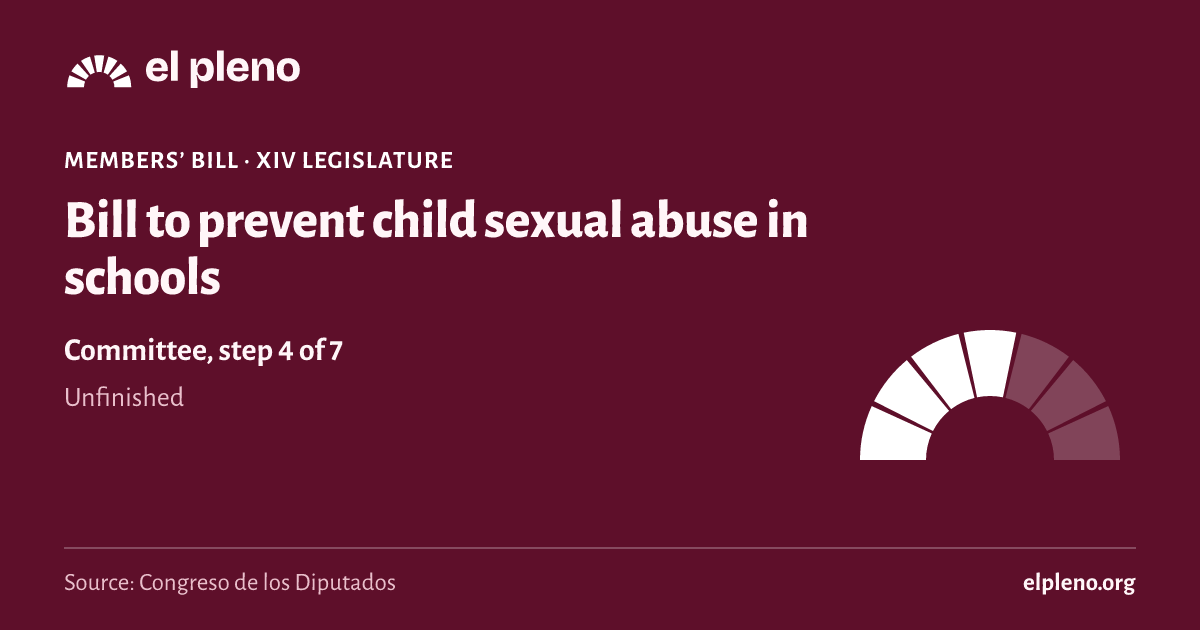
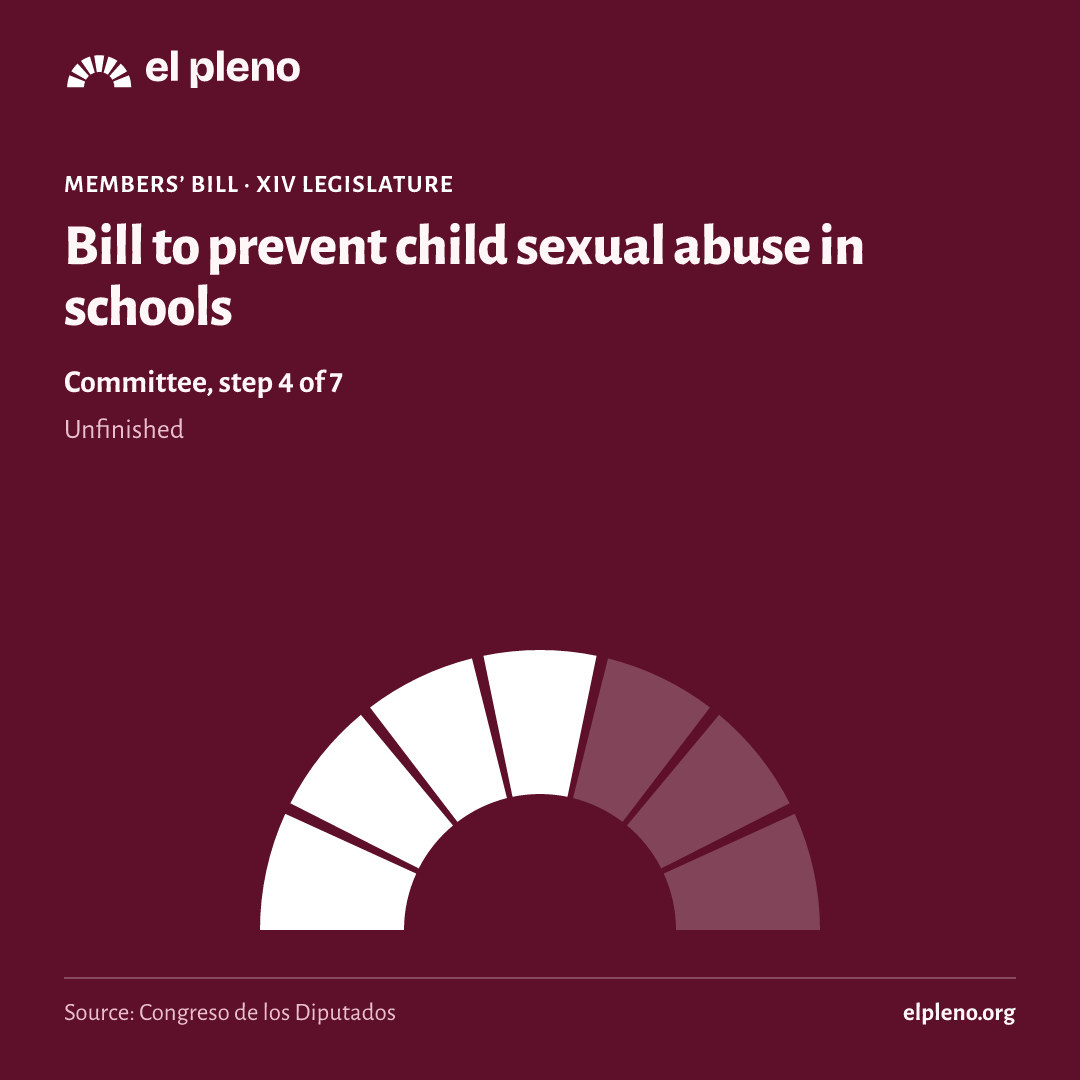
It took 4 of 7 steps. It reached Committee, and today it is unfinished.
- Introduced3 March 2021Someone registers the text in the Congreso.
- Admitted9 March 2021The Bureau of the Congreso accepts it and, for a members’ bill, the plenary decides whether to consider it.
- Amendments29 October 2021Groups propose changes.
- Committee9 February 2023A committee goes through the text in detail.
- Plenarynot reachedAll 350 deputies vote.
- Senatenot reachedThe Senate can pass it, amend it or veto it.
- BOEnot reachedIt is published in the Official State Gazette (BOE) and comes into force.
See the 10 official steps on a timeline
19 October 2021
How did the plenary vote?
Voted on: Private member's bill by the Republican Parliamentary Group, on the prevention of sexual abuse in educational centers.
Source: Congreso de los Diputados, vote 1 of sitting 125· updated 11 Nov
Each dot is a seat. Tap one, or use the arrow keys, to see who it is.
Your province
How did the deputies from your province vote?
And your senators: the Senate does not link its votes to this law in its open data, so we cannot put them side by side here.
Or see how most of each province voted
- A Coruña More votes in favour 8 yes · 0 no
- Albacete More votes in favour 3 yes · 0 no · 1 abst.
- Alicante/Alacant More votes in favour 9 yes · 0 no · 3 abst.
- Almería More votes in favour 4 yes · 0 no · 2 abst.
- Araba/Álava More votes in favour 4 yes · 0 no
- Asturias More votes in favour 6 yes · 0 no · 1 abst.
- Ávila More votes in favour 2 yes · 0 no · 1 abst.
- Badajoz More votes in favour 5 yes · 0 no · 1 abst.
- Barcelona More votes in favour 29 yes · 0 no · 2 abst.
- Bizkaia More votes in favour 8 yes · 0 no
- Burgos More votes in favour 4 yes · 0 no
- Cáceres More votes in favour 3 yes · 0 no · 1 abst.
- Cádiz More votes in favour 7 yes · 0 no · 2 abst.
- Cantabria More votes in favour 4 yes · 0 no · 1 abst.
- Castellón/Castelló More votes in favour 4 yes · 0 no · 1 abst.
- Ceuta Tie 0 yes · 0 no · 1 abst.
- Ciudad Real More votes in favour 4 yes · 0 no · 1 abst.
- Córdoba More votes in favour 5 yes · 0 no · 1 abst.
- Cuenca More votes in favour 3 yes · 0 no
- Gipuzkoa More votes in favour 6 yes · 0 no
- Girona More votes in favour 6 yes · 0 no
- Granada More votes in favour 7 yes · 0 no
- Guadalajara More votes in favour 2 yes · 0 no · 1 abst.
- Huelva More votes in favour 4 yes · 0 no · 1 abst.
- Huesca More votes in favour 3 yes · 0 no
- Illes Balears More votes in favour 6 yes · 0 no · 2 abst.
- Jaén More votes in favour 4 yes · 0 no · 1 abst.
- La Rioja More votes in favour 4 yes · 0 no
- Las Palmas More votes in favour 7 yes · 0 no · 1 abst.
- León More votes in favour 3 yes · 0 no · 1 abst.
- Lleida More votes in favour 4 yes · 0 no
- Lugo More votes in favour 4 yes · 0 no
- Madrid More votes in favour 30 yes · 0 no · 7 abst.
- Málaga More votes in favour 9 yes · 0 no · 2 abst.
- Melilla More votes in favour 1 yes · 0 no
- Murcia More votes in favour 7 yes · 0 no · 3 abst.
- Navarra More votes in favour 5 yes · 0 no
- Ourense More votes in favour 4 yes · 0 no
- Palencia More votes in favour 3 yes · 0 no
- Pontevedra More votes in favour 6 yes · 0 no
- Salamanca More votes in favour 3 yes · 0 no · 1 abst.
- Santa Cruz de Tenerife More votes in favour 6 yes · 0 no · 1 abst.
- Segovia More votes in favour 2 yes · 0 no · 1 abst.
- Sevilla More votes in favour 9 yes · 0 no · 2 abst.
- Soria More votes in favour 2 yes · 0 no
- Tarragona More votes in favour 6 yes · 0 no
- Teruel More votes in favour 3 yes · 0 no
- Toledo More votes in favour 4 yes · 0 no · 2 abst.
- Valencia/València More votes in favour 12 yes · 0 no · 3 abst.
- Valladolid More votes in favour 4 yes · 0 no · 1 abst.
- Zamora More votes in favour 2 yes · 0 no · 1 abst.
- Zaragoza More votes in favour 6 yes · 0 no · 1 abst.
More details: how each group and each province voted
The groups
Who voted in favour and who against?
In favour, most of Euskal Herria Bildu, Republicano, Socialista, Vasco (EAJ-PNV), Mixto, Ciudadanos, Gcup-ec-gc, GPlu and Popular en el Congreso. 1 deputy voted differently from their group.
By province: in 51 most voted in favour; in 0, against.
Coloured by how most of each province’s deputies voted.
- In favour: 51
- Against: 0
- Abstained: 1
| Group | Seats | How it voted |
|---|---|---|
| Euskal Herria Bildu | 5 | 5 in favour |
| Republicano | 13 | 13 in favour |
| Socialista | 120 | 120 in favour |
| Vasco (EAJ-PNV) | 6 | 6 in favour |
| Mixto | 10 | 9 in favour · 1 did not vote |
| Ciudadanos | 9 | 9 in favour |
| Gcup-ec-gc | 35 | 34 in favour · 1 did not vote |
| GPlu | 12 | 12 in favour |
| Popular en el Congreso | 88 | 87 in favour · 1 did not vote |
| VOX | 52 | 1 in favour · 51 abst. |
What happens next
What happens now?
The legislature ended before it finished. To go on, someone would have to introduce it again in the new Cortes.
It has not been presented again yet.
Sources
Where does all this come from?
- Congreso de los Diputados, file 122/000128
Official title, type, author, dates and stage.
Retrieved 11 November 2026
- Congreso de los Diputados, vote 1 of sitting 125
The count and every seat’s vote.
Retrieved 11 November 2026
- The data comes from the open files of the Congreso, the Senate and the BOE, unaltered.
- Each deputy’s province is the one of their seat on the day of the vote.
- We only say “passed” or “rejected” when the majority needed is certain; otherwise we say which side had more votes.