What it is
Bill to create an independent authority to oversee EU recovery funds
It is a members’ bill. Introduced by parliamentary groups, the Senate, regional governments or citizens. It was introduced on 23 February 2021. Introduced by: Grupo Parlamentario Popular en el Congreso.
Official title: Private member's bill regarding the creation of the Independent Authority for Economic Recovery and the improvement of the governance of the European Recovery Funds.
Source: Congreso de los Diputados, file 122/000127· updated 11 Nov
Automatic summary, not yet reviewed
- The bill would create the Independent Authority for Economic Recovery, a public body with its own legal personality that would manage the EU recovery funds independently of the Government and political parties.
- The Authority would set investment priorities, the criteria for distributing money among the central government, autonomous communities and local governments, and would oversee completed projects. It would also be the sole contact with the European Union.
- A President, appointed by the Council of Ministers, would lead it, but only if a congressional committee accepts the candidate by a two-thirds majority. The term would be six years, non-renewable, and no one could give the President instructions.
- The Recovery, Transformation and Resilience Plan would be approved by the Council of Ministers at the Authority's proposal, and then by the Congress and the Senate by a two-thirds majority. The Authority would report to Parliament every three months and to the Court of Auditors.
- The bill sets rules for groups of people or companies applying for aid linked to the plan, with joint liability among members, and for consortia carrying out projects, whose creation the Authority itself could authorize.
- The Spanish Finance Ministry unit that manages the EU funds would be transferred, with all its staff and resources, to the new Authority.
Who it affects
- The Government and public administrations: They would have to cooperate with the Authority and provide any information it requests; if they do not, the failure would be published and reported to Congress.
- Autonomous communities and local governments: They would receive funds according to the distribution criteria set by the Authority.
- Companies and entities applying for aid or running plan projects: They could form groups or consortia under specific rules.
- Congress and Senate: They would oversee management every three months and approve the plan by a two-thirds majority.
Words worth knowing
- Fondos NGEU (Next Generation EU)
- Money the European Union lends or grants to member countries to recover from the coronavirus crisis.
- PERTE
- Strategic Projects for Economic Recovery and Transformation: large public investment projects the Authority would assess and oversee.
- Ente de Derecho Público
- Spanish term for a public body with its own legal personality, meaning it can act on its own with some independence from the Government.
- Mayoría cualificada de dos tercios
- A qualified two-thirds majority: approval requires the votes of two out of every three members present, not just more yes than no votes.
- Responsabilidad solidaria
- Joint liability: if several members of a group receive aid, each one answers for the whole, not just their own share.
It summarizes the text as it was introduced. It is written by artificial intelligence and may contain mistakes: the official text is what counts. Read the official text · How we make summaries
Where it stands
How far did it get?
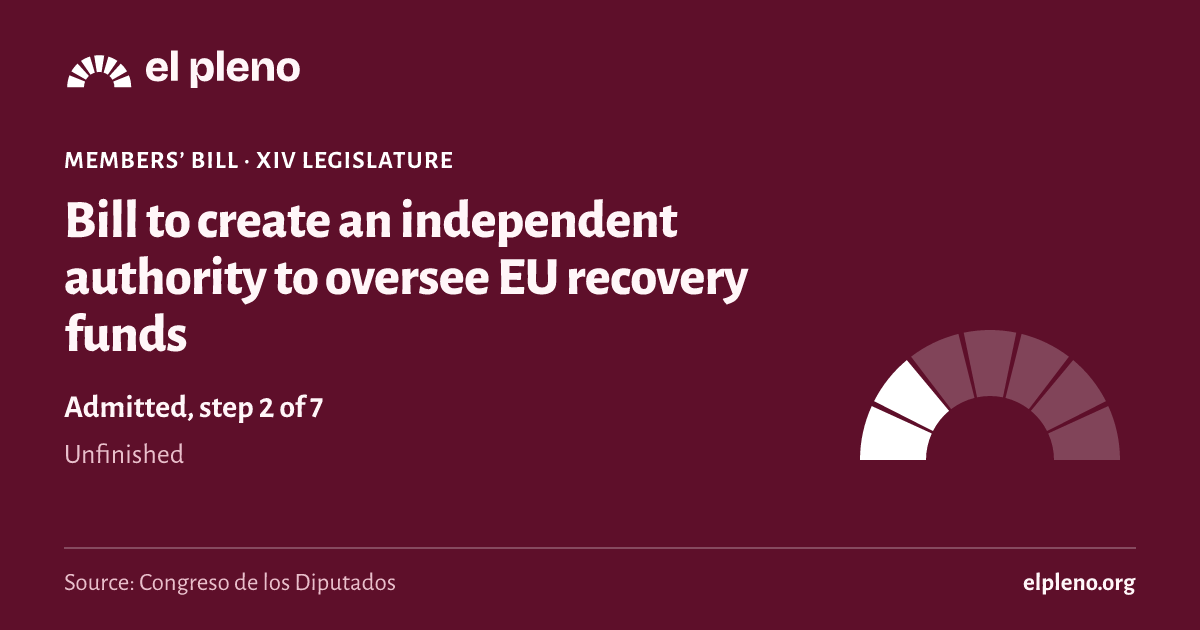
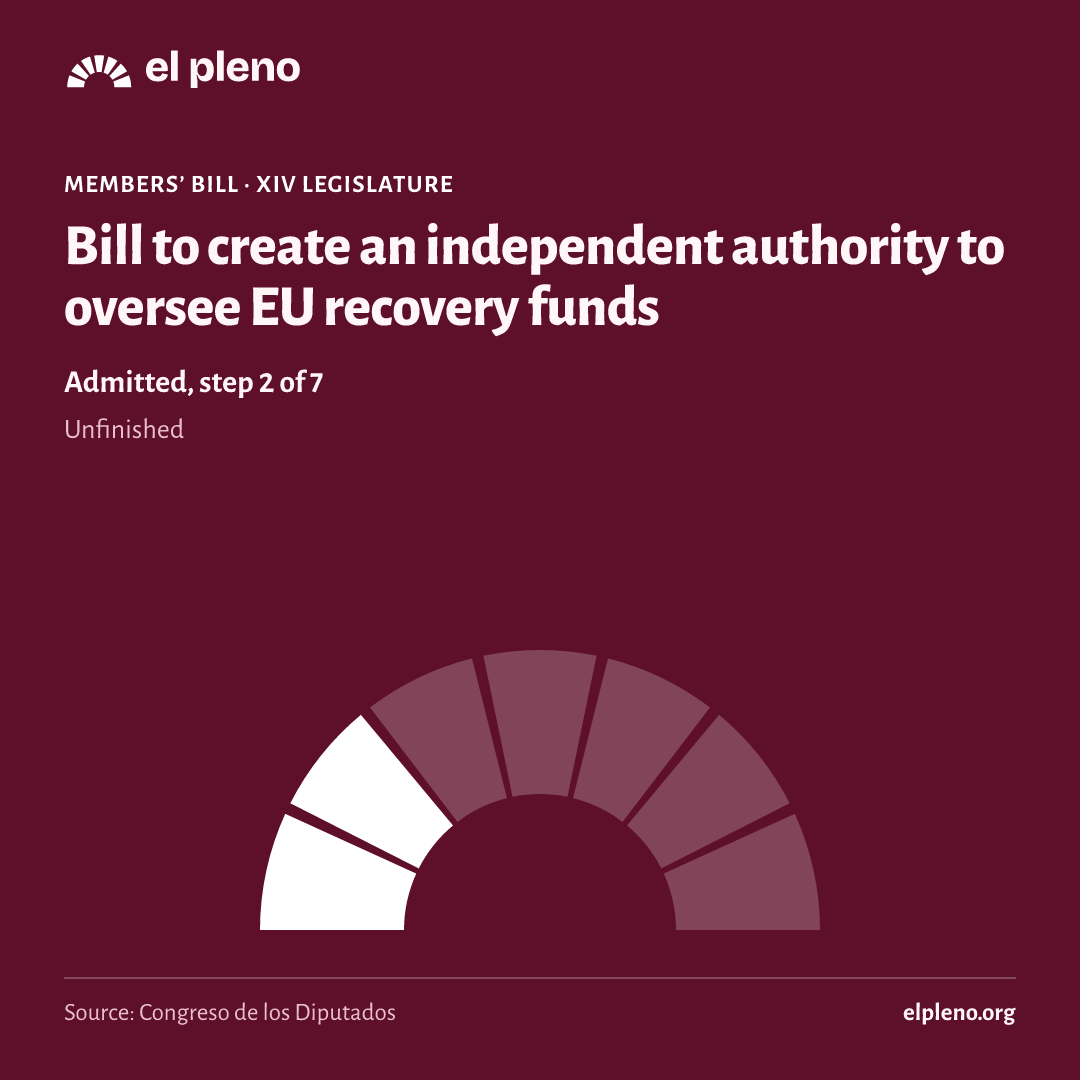
It took 2 of 7 steps. It reached Admitted, and today it is unfinished.
- Introduced23 February 2021Someone registers the text in the Congreso.
- Admitted2 March 2021The Bureau of the Congreso accepts it and, for a members’ bill, the plenary decides whether to consider it.
- Amendmentsnot reachedGroups propose changes.
- Committeenot reachedA committee goes through the text in detail.
- Plenarynot reachedAll 350 deputies vote.
- Senatenot reachedThe Senate can pass it, amend it or veto it.
- BOEnot reachedIt is published in the Official State Gazette (BOE) and comes into force.
See the 5 official steps on a timeline
Was there a plenary vote?
We have no plenary vote linked to this law in the Congreso’s data.
What happens next
What happens now?
The legislature ended before it finished. To go on, someone would have to introduce it again in the new Cortes.
It has not been presented again yet.
Sources
Where does all this come from?
- Congreso de los Diputados, file 122/000127
Official title, type, author, dates and stage.
Retrieved 11 November 2026
- The data comes from the open files of the Congreso, the Senate and the BOE, unaltered.
- Each deputy’s province is the one of their seat on the day of the vote.
- We only say “passed” or “rejected” when the majority needed is certain; otherwise we say which side had more votes.