What it is
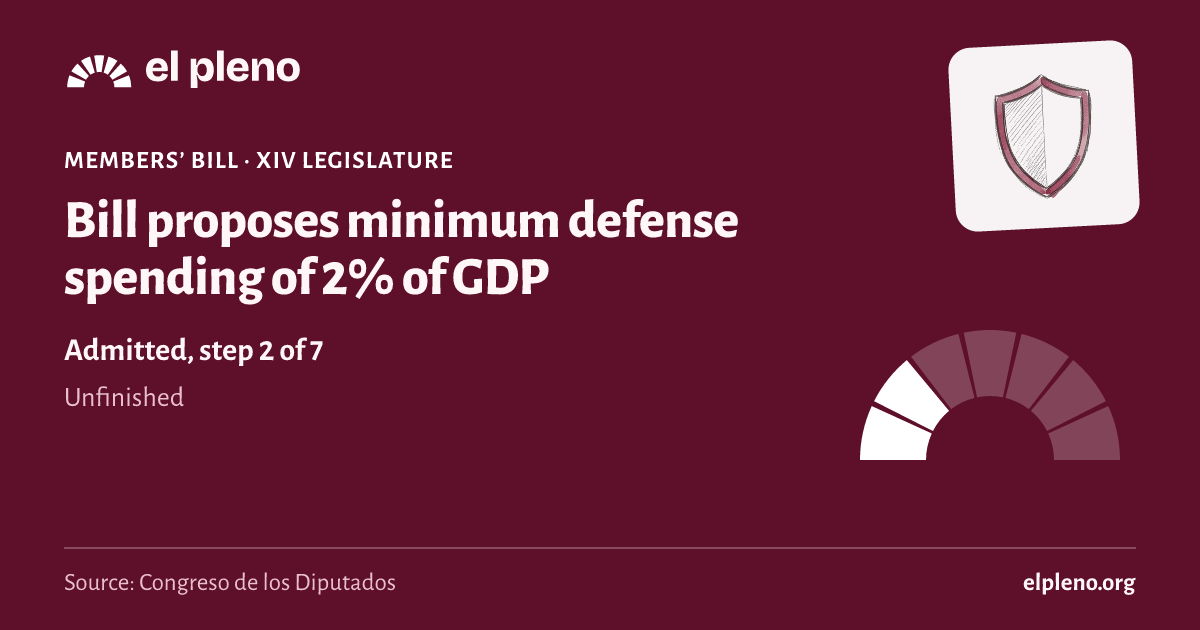
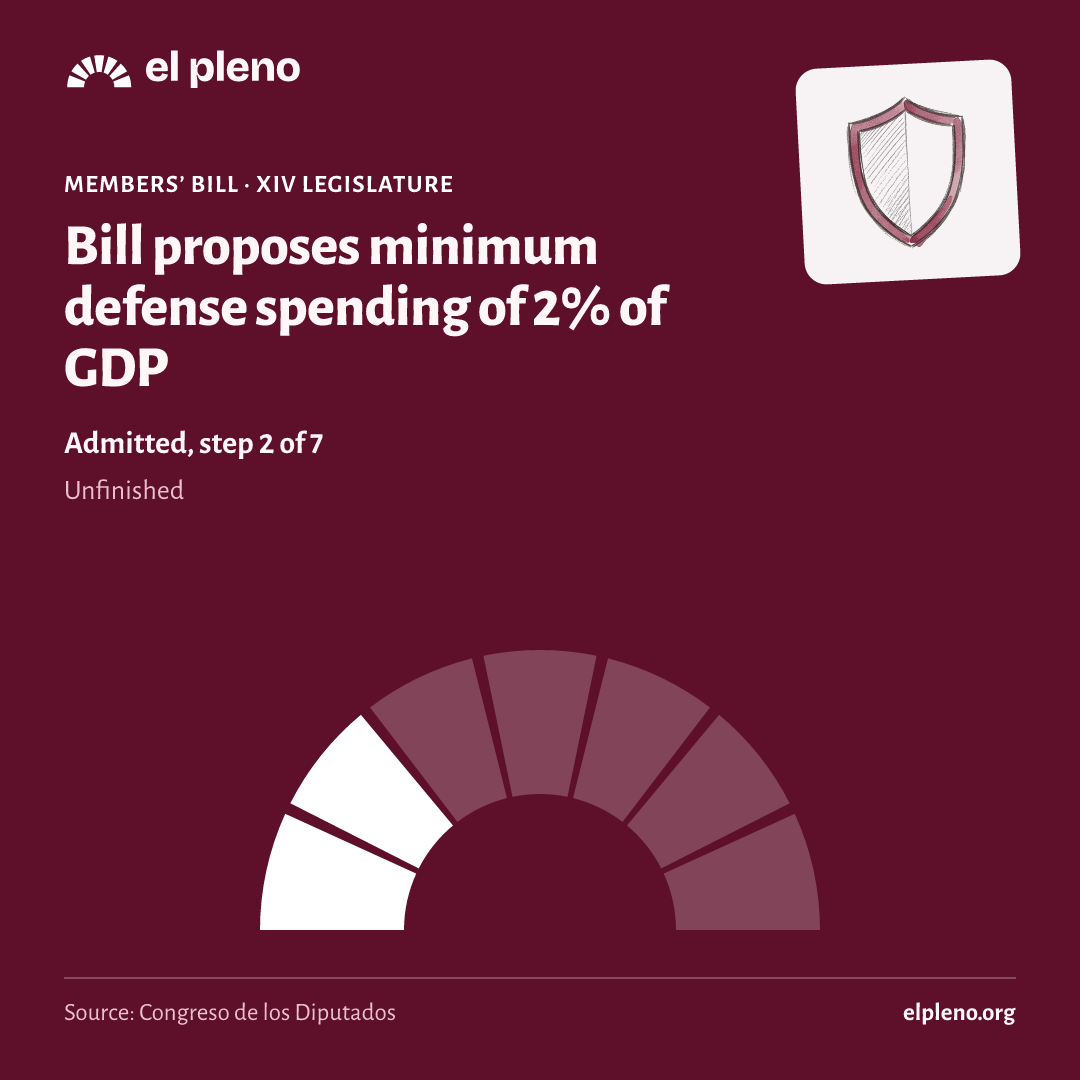
Bill proposes minimum defense spending of 2% of GDP
It is a members’ bill. Introduced by parliamentary groups, the Senate, regional governments or citizens. It was introduced on 24 November 2020. Introduced by: Grupo Parlamentario VOX.
Official title: Private member's bill for an Organic Law amending Organic Law 5/2005, of November 17, on National Defense.
Source: Congreso de los Diputados, file 122/000106· updated 11 Nov
Automatic summary, not yet reviewed
- The bill, introduced by the VOX parliamentary group, proposes amending the National Defense organic law A law on fundamental rights, the electoral system or other matters the Constitution reserves. It needs an absolute majority in the Congreso: 176 votes. to set a minimum level of defense spending. It is not an approved law, only a text submitted for debate.
- The main change is adding a provision requiring the Government to allocate to National Defense, in the State Budget, an annual amount of no less than 2% of the gross domestic product.
- That 2% would apply to the budget year immediately after the law takes effect and to the following years.
- The explanatory statement argues that Spain's defense spending is insufficient, far from the 2% commitment made at the 2014 NATO Summit, and that this creates risks for military personnel and loss of capabilities.
- Any rules of equal or lower rank that contradict the law would be repealed, and the law would take effect the day after its publication in the Official State Gazette.
Who it affects
- The Government: It would have to reserve at least 2% of GDP for National Defense in the State Budget.
- The Armed Forces: They would receive more funding for investments, maintenance and personnel, according to the explanatory statement.
- Military personnel and their families: The text says their needs are not well covered and that more funding would improve pay and conditions.
Words worth knowing
- Producto interior bruto (PIB)
- Gross domestic product: the total value of everything a country's economy produces in a year.
- Proposición de Ley Orgánica
- A bill introduced by members of Congress to amend an organic law, still subject to debate and approval.
- Disposición derogatoria
- Repealing provision: the part of a law that says which earlier rules stop applying.
- organic law
- A law on fundamental rights, the electoral system or other matters the Constitution reserves. It needs an absolute majority in the Congreso: 176 votes.
It summarizes the text as it was introduced. It is written by artificial intelligence and may contain mistakes: the official text is what counts. Read the official text · How we make summaries
Where it stands
How far did it get?
It took 2 of 7 steps. It reached Admitted, and today it is unfinished.
- Introduced24 November 2020Someone registers the text in the Congreso.
- Admitted30 November 2020The Bureau of the Congreso accepts it and, for a members’ bill, the plenary decides whether to consider it.
- Amendmentsnot reachedGroups propose changes.
- Committeenot reachedA committee goes through the text in detail.
- Plenarynot reachedAll 350 deputies vote.
- Senatenot reachedThe Senate can pass it, amend it or veto it.
- BOEnot reachedIt is published in the Official State Gazette (BOE) and comes into force.
See the 6 official steps on a timeline
Was there a plenary vote?
We have no plenary vote linked to this law in the Congreso’s data.
What happens next
What happens now?
The legislature ended before it finished. To go on, someone would have to introduce it again in the new Cortes.
It was presented again:
- XV Legislature, Congreso de los Diputados· Rejected Bill would let the Armed Forces act against illegal immigration
Sources
Where does all this come from?
- Congreso de los Diputados, file 122/000106
Official title, type, author, dates and stage.
Retrieved 11 November 2026
- The data comes from the open files of the Congreso, the Senate and the BOE, unaltered.
- Each deputy’s province is the one of their seat on the day of the vote.
- We only say “passed” or “rejected” when the majority needed is certain; otherwise we say which side had more votes.