What it is
Bill proposes a statute for prison service officers
It is a members’ bill. Introduced by parliamentary groups, the Senate, regional governments or citizens. It was introduced on 29 October 2020. Introduced by: Grupo Parlamentario Popular en el Congreso.
Official title: Private member's bill on the statutory regime of the personnel comprising the National Corps of Penitentiary Institutions.
Source: Congreso de los Diputados, file 122/000097· updated 11 Nov
Automatic summary, not yet reviewed
- The bill proposes a law that gathers into a single text the statute governing the staff of the National Corps of Penal Institutions, because current rules are scattered, outdated and create legal uncertainty.
- Prison officers would be civil servants with a civil nature and would act as agents of the authority when performing their duties. Their official reports, records and complaints would enjoy a presumption of truthfulness.
- The proposal organizes the staff into five corps (Technicians, Health, Nurses, Management and Officers) and sets the duties and the university or academic degree required to join each one.
- Entry would be through a competitive examination, with requirements such as Spanish nationality, being at least 18 years old and not being disqualified. The proposal also covers internal promotion, professional careers and training provided by the Prison Studies School.
- The proposal includes specific rights and duties: protection against assaults through a specific protocol, legal defense and civil liability insurance paid by the Administration, rewards such as the Prison Merit Medals, and the wearing of a uniform with an identifying badge.
- It creates a second activity status for officers working in direct contact with inmates: they could move to it due to insufficient physical or mental fitness or by age, receiving full basic pay plus an allowance of 80% of general complementary pay.
Who it affects
- Officers of the National Corps of Penal Institutions: They would be the main group affected: their rights, duties, pay, administrative situations and careers would be regulated in a single law.
- People who want to take the entrance exams for these corps: They would have to meet requirements such as Spanish nationality, a minimum age of 18 and the degree required for each corps, and pass the competitive examination.
- Secretaría General de Instituciones Penitenciarias (General Secretariat of Penal Institutions): It would concentrate staff management, entrance competitions and approval of protocols and work calendars.
- Labor staff at prisons: They would be governed by the Basic Statute of Public Employees and could receive the same rewards as officers, but functions involving public authority would be reserved to career civil servants.
Words worth knowing
- Régimen estatutario
- The set of rules governing the rights, duties and working conditions of a group of civil servants.
- Agente de la autoridad
- A legal status giving an officer reinforced protection and making what they record in writing especially strong as evidence.
- Oposición
- A selection system based on passing knowledge or aptitude tests against other candidates.
- Promoción interna
- A route for civil servants to move up to a higher corps by passing tests reserved for existing civil servants.
- Segunda actividad
- A special status for officers working in direct contact with inmates who no longer meet the physical or mental fitness requirements or exceed the set age; they remain available to the Administration with guaranteed pay.
It summarizes the text as it was introduced. It is written by artificial intelligence and may contain mistakes: the official text is what counts. Read the official text · How we make summaries
Where it stands
How far did it get?
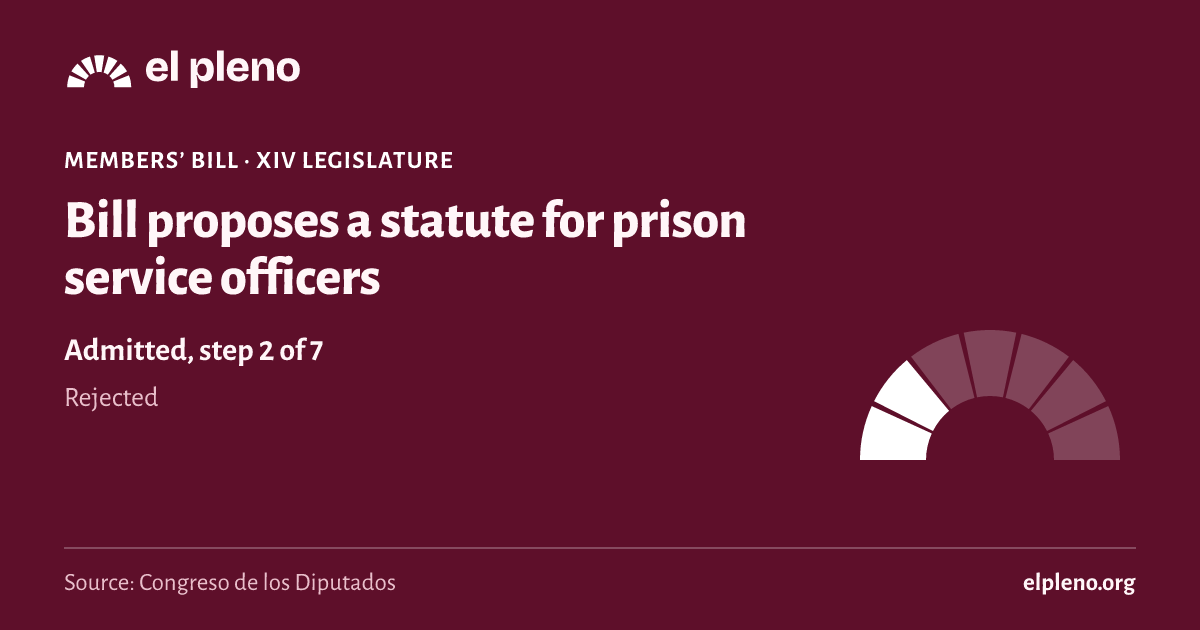
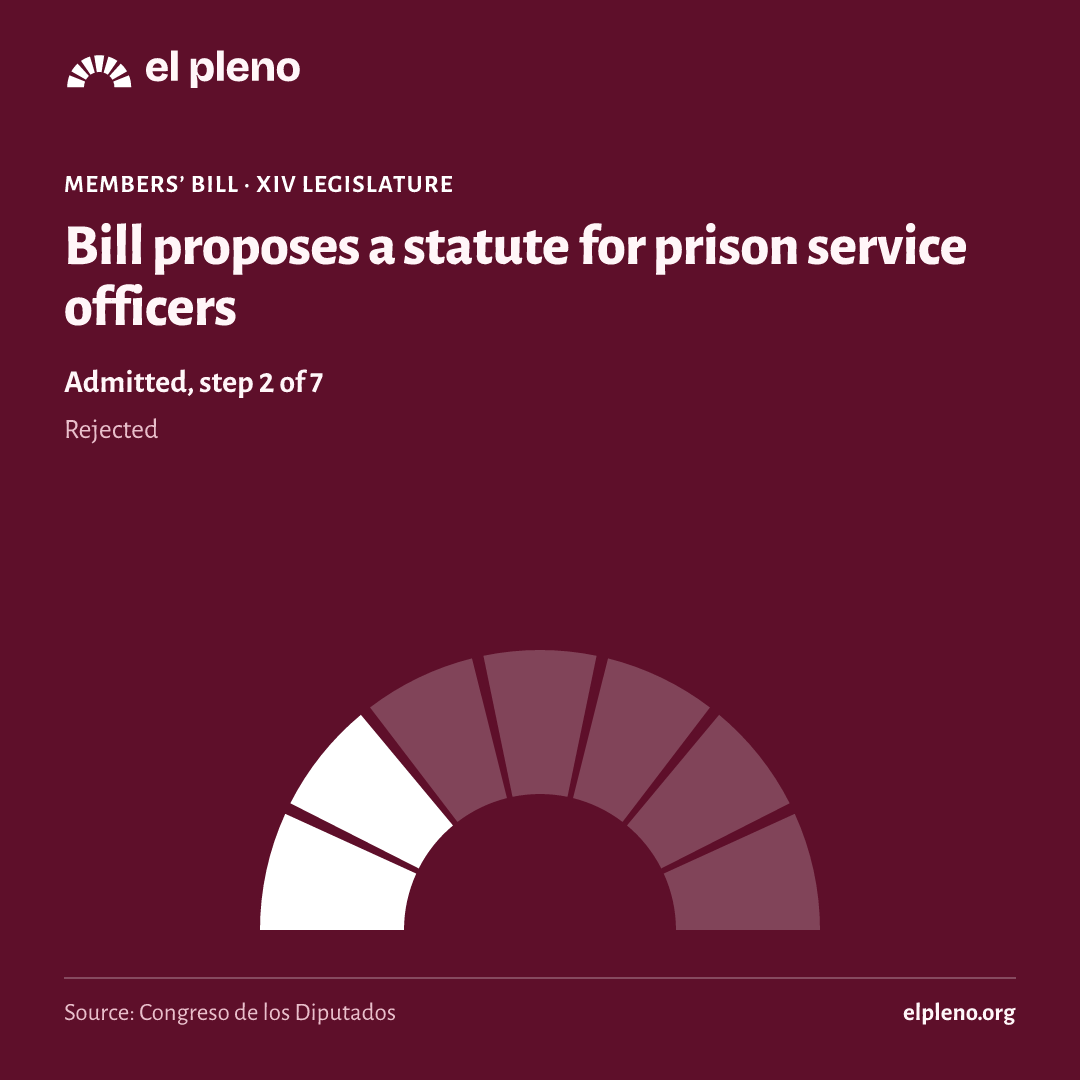
It took 2 of 7 steps. It reached Admitted, and today it is rejected.
- Introduced29 October 2020Someone registers the text in the Congreso.
- Admitted3 November 2020The Bureau of the Congreso accepts it and, for a members’ bill, the plenary decides whether to consider it.
- Amendmentsnot reachedGroups propose changes.
- Committeenot reachedA committee goes through the text in detail.
- Plenarynot reachedAll 350 deputies vote.
- Senatenot reachedThe Senate can pass it, amend it or veto it.
- BOEnot reachedIt is published in the Official State Gazette (BOE) and comes into force.
See the 6 official steps on a timeline
20 April 2021
How did the plenary vote?
Voted on: Private member's bill by the Popular Parliamentary Group in the Congress, on the statutory regime of the personnel comprising the National Corps of Penitentiary Institutions.
Source: Congreso de los Diputados, vote 1 of sitting 92· updated 11 Nov
Each dot is a seat. Tap one, or use the arrow keys, to see who it is.
Your province
How did the deputies from your province vote?
And your senators: the Senate does not link its votes to this law in its open data, so we cannot put them side by side here.
Or see how most of each province voted
- A Coruña More votes against 3 yes · 5 no
- Albacete Tie 2 yes · 2 no
- Alicante/Alacant More votes in favour 7 yes · 5 no
- Almería More votes in favour 4 yes · 2 no
- Araba/Álava More votes against 0 yes · 4 no
- Asturias More votes against 3 yes · 4 no
- Ávila More votes in favour 2 yes · 1 no
- Badajoz Tie 3 yes · 3 no
- Barcelona More votes against 6 yes · 26 no
- Bizkaia More votes against 1 yes · 7 no
- Burgos Tie 2 yes · 2 no
- Cáceres Tie 2 yes · 2 no
- Cádiz More votes in favour 5 yes · 4 no
- Cantabria More votes in favour 3 yes · 1 no · 1 abst.
- Castellón/Castelló More votes against 2 yes · 3 no
- Ceuta More votes in favour 1 yes · 0 no
- Ciudad Real More votes in favour 3 yes · 2 no
- Córdoba Tie 3 yes · 3 no
- Cuenca More votes against 1 yes · 2 no
- Gipuzkoa More votes against 0 yes · 6 no
- Girona More votes against 0 yes · 6 no
- Granada More votes against 3 yes · 4 no
- Guadalajara More votes in favour 2 yes · 1 no
- Huelva More votes against 2 yes · 3 no
- Huesca More votes against 1 yes · 2 no
- Illes Balears Tie 4 yes · 4 no
- Jaén More votes against 2 yes · 3 no
- La Rioja Tie 2 yes · 2 no
- Las Palmas More votes against 3 yes · 5 no
- León Tie 2 yes · 2 no
- Lleida More votes against 0 yes · 4 no
- Lugo Tie 2 yes · 2 no
- Madrid More votes in favour 22 yes · 15 no
- Málaga More votes in favour 6 yes · 5 no
- Melilla More votes in favour 1 yes · 0 no
- Murcia More votes in favour 6 yes · 4 no
- Navarra More votes against 2 yes · 3 no
- Ourense Tie 2 yes · 2 no
- Palencia More votes in favour 2 yes · 1 no
- Pontevedra More votes against 3 yes · 4 no
- Salamanca More votes in favour 3 yes · 1 no
- Santa Cruz de Tenerife More votes in favour 4 yes · 3 no
- Segovia More votes in favour 2 yes · 1 no
- Sevilla More votes against 5 yes · 7 no
- Soria Tie 1 yes · 1 no
- Tarragona More votes against 0 yes · 6 no
- Teruel Tie 1 yes · 1 no
- Toledo More votes in favour 4 yes · 2 no
- Valencia/València More votes in favour 9 yes · 6 no
- Valladolid More votes in favour 3 yes · 2 no
- Zamora More votes in favour 2 yes · 1 no
- Zaragoza More votes against 3 yes · 4 no
More details: how each group and each province voted
The groups
Who voted in favour and who against?
In favour, most of Mixto, Ciudadanos, Popular en el Congreso and VOX. Against, most of Euskal Herria Bildu, Republicano, Socialista, Vasco (EAJ-PNV), Gcup-ec-gc and GPlu. 7 deputies voted differently from their group.
By province: in 20 most voted in favour; in 20, against.
Coloured by how most of each province’s deputies voted.
- In favour: 20
- Against: 20
- Tie: 12
| Group | Seats | How it voted |
|---|---|---|
| Euskal Herria Bildu | 5 | 5 against |
| Republicano | 13 | 13 against |
| Socialista | 120 | 120 against |
| Vasco (EAJ-PNV) | 6 | 6 against |
| Mixto | 10 | 5 in favour · 3 against · 1 abst. · 1 did not vote |
| Ciudadanos | 9 | 9 in favour |
| Gcup-ec-gc | 35 | 35 against |
| GPlu | 12 | 3 in favour · 9 against |
| Popular en el Congreso | 88 | 88 in favour |
| VOX | 52 | 52 in favour |
What happens next
What happens now?
It goes no further. A similar one could be introduced later.
Sources
Where does all this come from?
- Congreso de los Diputados, file 122/000097
Official title, type, author, dates and stage.
Retrieved 11 November 2026
- Congreso de los Diputados, vote 1 of sitting 92
The count and every seat’s vote.
Retrieved 11 November 2026
- The data comes from the open files of the Congreso, the Senate and the BOE, unaltered.
- Each deputy’s province is the one of their seat on the day of the vote.
- We only say “passed” or “rejected” when the majority needed is certain; otherwise we say which side had more votes.