What it is
Bill would give long-serving temporary public workers a path to permanent jobs
It is a members’ bill. Introduced by parliamentary groups, the Senate, regional governments or citizens. It was introduced on 22 October 2020. Introduced by: Grupo Parlamentario Plural.
Official title: Private member's bill amending Royal Legislative Decree 5/2015, of October 30, approving the consolidated text of the Basic Statute of Public Employees Law.
Source: Congreso de los Diputados, file 122/000094· updated 11 Nov
Automatic summary, not yet reviewed
- The bill would amend the Basic Statute of Public Employees to create, exceptionally and only once, a special admission route for corps, scales or categories that have had no public employment offer since January 1, 2010, or only an insignificant one.
- Temporary staff (Personal interino Temporary public employee who fills a position provisionally until it is filled through a selection process.) could take part if, when the call is published, they can prove at least ten years of service in the corps, scales or categories covered by the call.
- The selection system would be a Concurso oposición Selection system combining a merits stage (courses, experience) and an eliminatory exam stage., with a single eliminatory theoretical and practical test related to the usual tasks of the positions. Up to 70% of the places in public employment offers could be reserved for this special route.
- The bill justifies the measure by high temporary employment in public administrations, by the replacement caps that limited public employment offers, and by Court of Justice of the European Union case law on the abuse of temporary hiring. It cites Constitutional Court rulings that allow preferential treatment in exceptional, justified cases.
Who it affects
- Temporary public employees (personal interino) with at least ten years of service in corps, scales or categories without a public employment offer since January 1, 2010: Could use the special route to make their position permanent, if the bill is passed.
- Public Administrations: Could hold this special selection round once and reserve up to 70% of the places in their employment offers.
- Other applicants for public jobs: In the affected corps, up to 70% of the places would be reserved for the special route.
Words worth knowing
- Personal interino
- Temporary public employee who fills a position provisionally until it is filled through a selection process.
- Oferta de empleo público
- Annual list of positions each administration offers to fill through competitive exams.
- Tasas de reposición
- Caps set in the budget on how many positions can be offered, usually only a share of those vacated.
- Concurso oposición
- Selection system combining a merits stage (courses, experience) and an eliminatory exam stage.
- Turno de acceso
- Entry route into a public service corps or scale, reserved for a specific group.
It summarizes the text as it was introduced. It is written by artificial intelligence and may contain mistakes: the official text is what counts. Read the official text · How we make summaries
Where it stands
How far did it get?
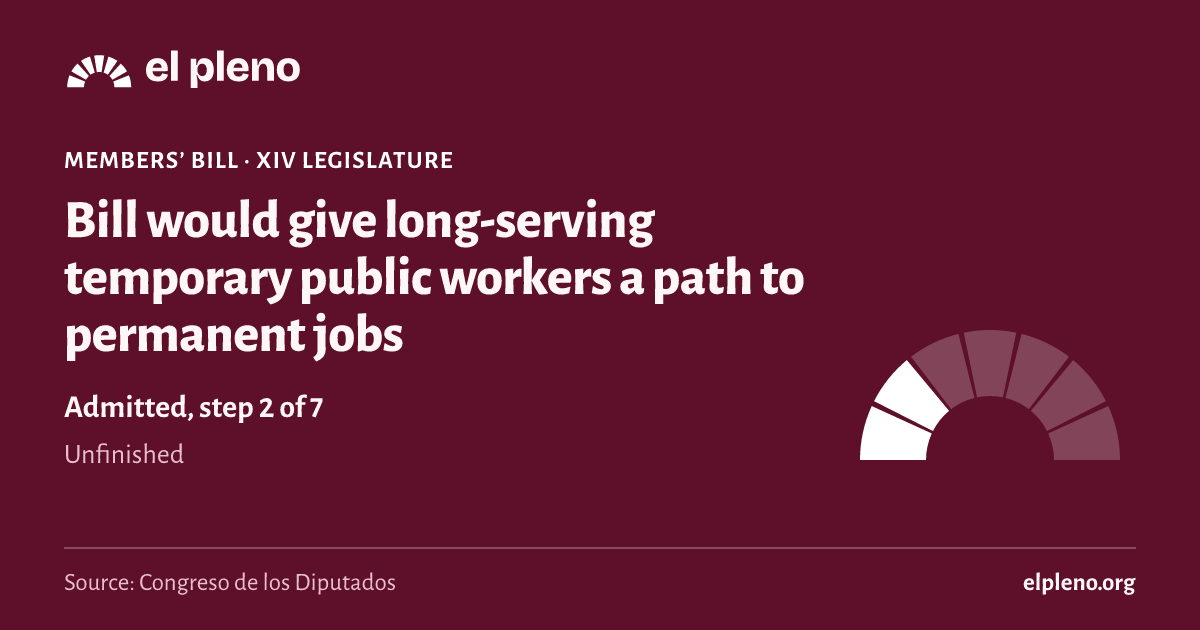
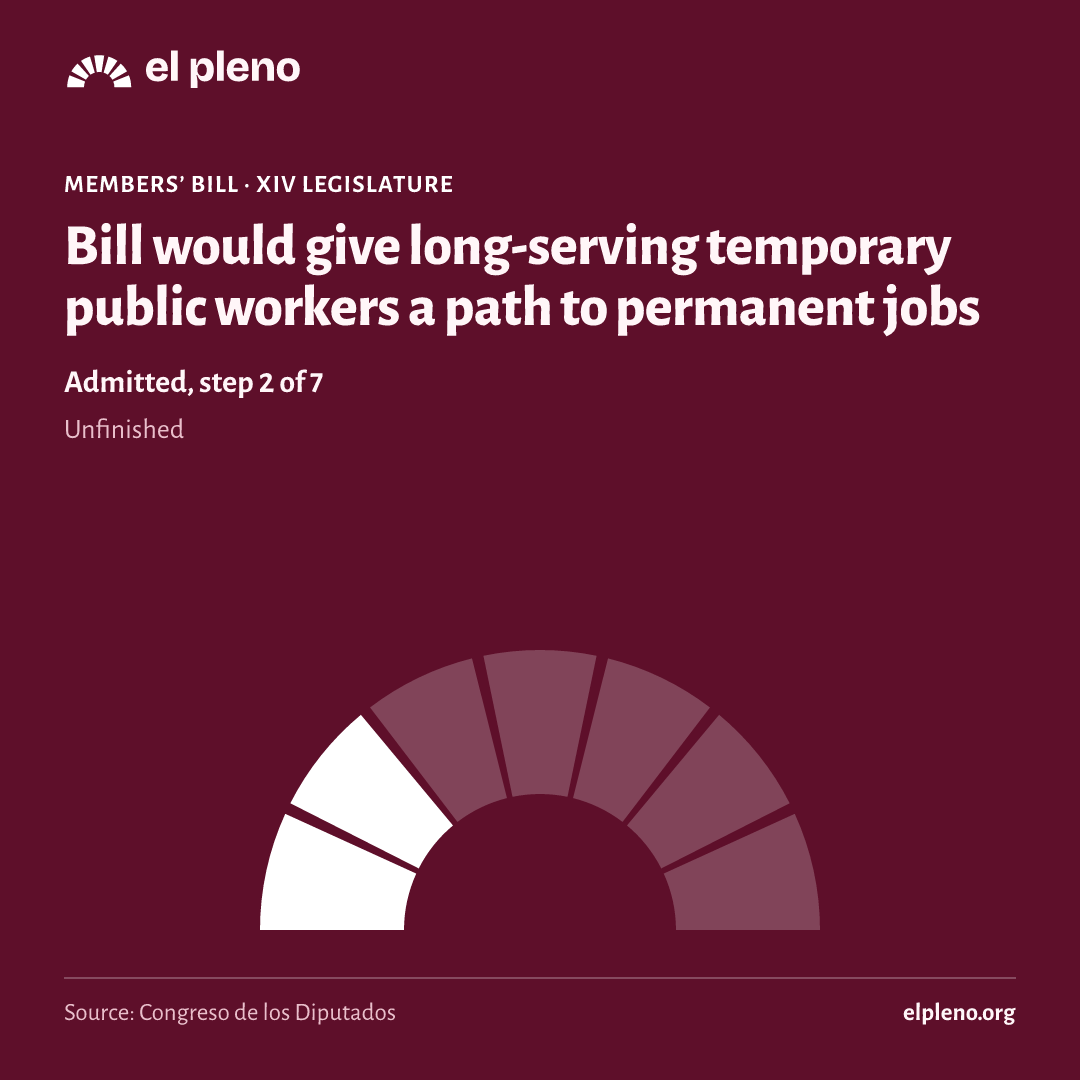
It took 2 of 7 steps. It reached Admitted, and today it is unfinished.
- Introduced22 October 2020Someone registers the text in the Congreso.
- Admitted27 October 2020The Bureau of the Congreso accepts it and, for a members’ bill, the plenary decides whether to consider it.
- Amendmentsnot reachedGroups propose changes.
- Committeenot reachedA committee goes through the text in detail.
- Plenarynot reachedAll 350 deputies vote.
- Senatenot reachedThe Senate can pass it, amend it or veto it.
- BOEnot reachedIt is published in the Official State Gazette (BOE) and comes into force.
See the 6 official steps on a timeline
Was there a plenary vote?
We have no plenary vote linked to this law in the Congreso’s data.
What happens next
What happens now?
The legislature ended before it finished. To go on, someone would have to introduce it again in the new Cortes.
It was presented again:
- XV Legislature, Congreso de los Diputados· Unfinished Bill to move nursing and physiotherapy into group A1
Sources
Where does all this come from?
- Congreso de los Diputados, file 122/000094
Official title, type, author, dates and stage.
Retrieved 11 November 2026
- The data comes from the open files of the Congreso, the Senate and the BOE, unaltered.
- Each deputy’s province is the one of their seat on the day of the vote.
- We only say “passed” or “rejected” when the majority needed is certain; otherwise we say which side had more votes.