What it is
Bill to curb abusive temporary contracts and boost job stability
It is a members’ bill. Introduced by parliamentary groups, the Senate, regional governments or citizens. It was introduced on 4 September 2020. Introduced by: Grupo Parlamentario Confederal de Unidas Podemos-En Comú Podem-Galicia en Común.
Official title: Private member's bill against precariousness and for stability in employment.
Source: Congreso de los Diputados, file 122/000081· updated 11 Nov
Automatic summary, not yet reviewed
- The bill would limit temporary hiring: temporary contracts would only be allowed for productive reasons (activity peaks) or organizational reasons (replacing someone with a job-return guarantee), and the task or service contract would disappear. Productive-reason contracts would last at most six months, extendable to one year by collective agreement.
- Workers hired temporarily in breach of the new rules would become permanent employees, and their dismissal would be declared null. The bill also sets an end-of-contract payment of twenty days of salary per year of service and a minimum fifteen-day notice.
- Part-time work would be reformed: complementary hours would be eliminated, paid overtime would be allowed, contracts must state start and end times, and workers could request reduced hours for training, career advancement or disability.
- The permanent seasonal (fijo discontinuo) contract would be strengthened: employers must keep an annual census of these workers, follow an objective call-back order (by seniority if no agreement says otherwise) and may not replace them with temporary staff. Failure to call them back counts as a company breach.
- Daily working-time records would be required for all workers, with a monthly copy for the worker and access for the Labor Inspectorate. Fraudulent use of temporary or part-time contracts would become a very serious offense.
- The Government would have to set annual limits on the number of temporary contracts and raise their Social Security contributions, and within twelve months submit a bill on temporary public employment. The law would take effect the day after publication in the official gazette (BOE).
Who it affects
- Temporary and part-time workers: They could become permanent if their contract breaks the rules, and would get better hour records and more rights.
- Employers: They would have to justify every temporary contract, record everyone's daily hours, and face sanctions and forced conversions to permanent status if they fail.
- Permanent seasonal workers (fijos discontinuos): They would be entitled to a census, an objective call-back order and certificates of days worked.
- Public employment: The bill does not directly regulate their temporary work, but it requires the Government to prepare a specific law within twelve months.
- Labor Inspectorate: Inspection campaigns in hospitality and retail and working-time controls would be stepped up.
Words worth knowing
- Contrato fijo discontinuo
- A permanent contract for seasonal or campaign work: the person works only when the company calls them back.
- Horas complementarias
- Extra hours an employer could impose on a part-time worker; the bill eliminates them.
- Estatuto de los Trabajadores
- Spain's main labor law, the Workers' Statute.
- Proposición de ley
- A bill proposed in Congress that still must be debated and passed; it is not in force.
It summarizes the text as it was introduced. It is written by artificial intelligence and may contain mistakes: the official text is what counts. Read the official text · How we make summaries
Where it stands
How far did it get?
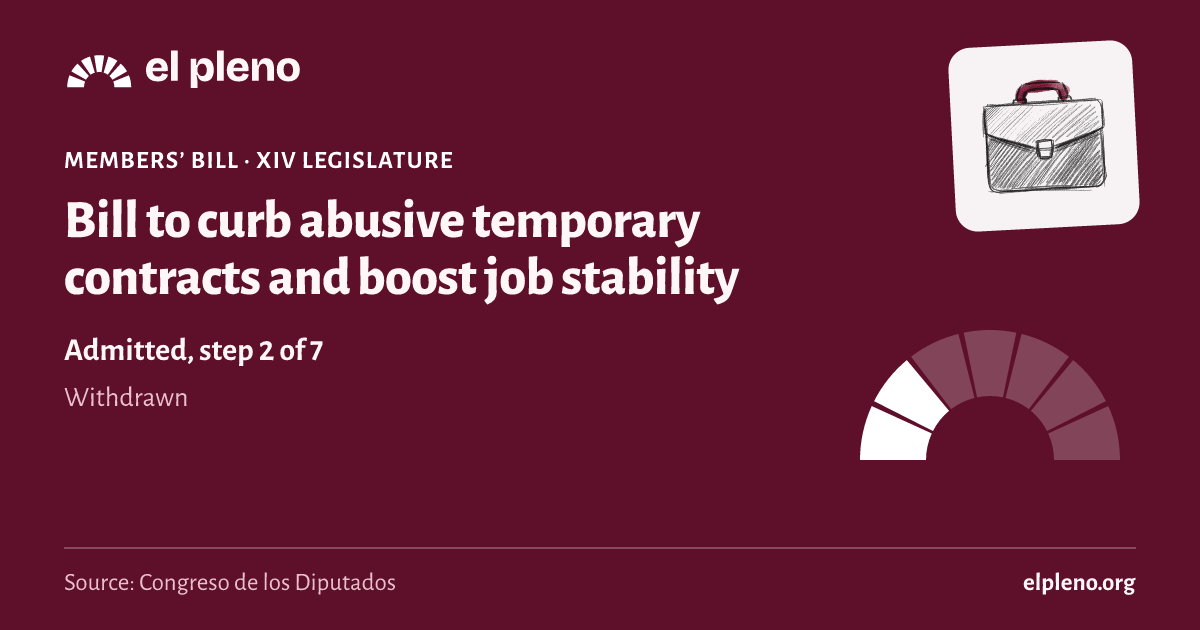
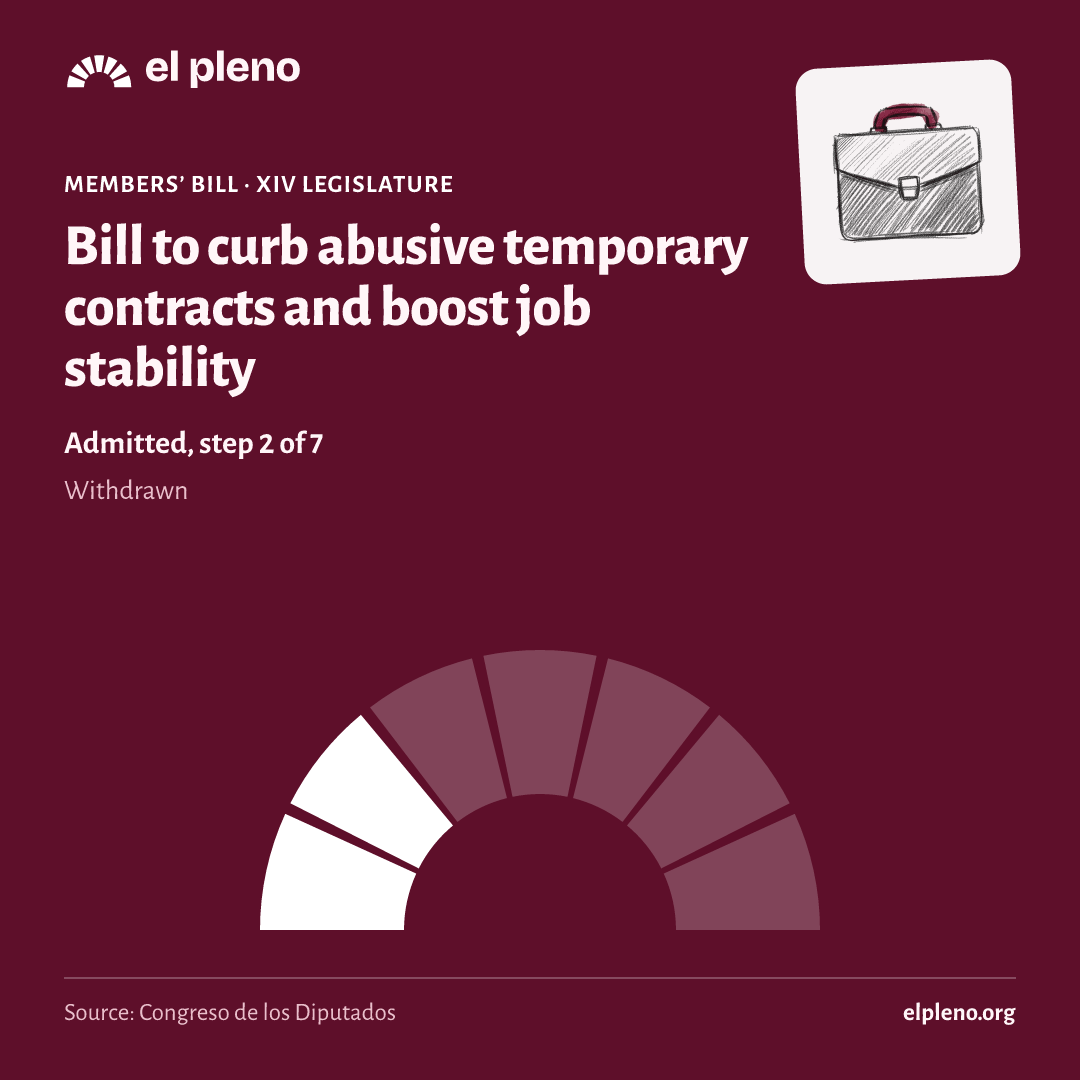
It took 2 of 7 steps. It reached Admitted, and today it is withdrawn.
- Introduced4 September 2020Someone registers the text in the Congreso.
- Admitted8 September 2020The Bureau of the Congreso accepts it and, for a members’ bill, the plenary decides whether to consider it.
- Amendmentsnot reachedGroups propose changes.
- Committeenot reachedA committee goes through the text in detail.
- Plenarynot reachedAll 350 deputies vote.
- Senatenot reachedThe Senate can pass it, amend it or veto it.
- BOEnot reachedIt is published in the Official State Gazette (BOE) and comes into force.
See the 6 official steps on a timeline
Was there a plenary vote?
We have no plenary vote linked to this law in the Congreso’s data.
What happens next
What happens now?
Whoever introduced it withdrew it, or it was merged into another one. It goes no further.
Presented before in:
- XII Legislature, Congreso de los Diputados· Unfinished Bill to curb temporary hiring and precarious part-time work
Sources
Where does all this come from?
- Congreso de los Diputados, file 122/000081
Official title, type, author, dates and stage.
Retrieved 11 November 2026
- The data comes from the open files of the Congreso, the Senate and the BOE, unaltered.
- Each deputy’s province is the one of their seat on the day of the vote.
- We only say “passed” or “rejected” when the majority needed is certain; otherwise we say which side had more votes.