What it is
The bill would reform civil service employment in the State Administration
It is a government bill. Introduced by the Government. It was introduced on 17 March 2023. Introduced by: Gobierno.
Official title: Government bill on the Public Service of the State Administration.
Source: Congreso de los Diputados, file 121/000149· updated 11 Nov
Automatic summary, not yet reviewed
- The bill would set out the rules for the civil service of the State Administration, developing the Basic Statute of Public Employees, and is part of component 11 of the Recovery, Transformation and Resilience Plan.
- It would create a horizontal career: civil servants could advance through career stages without changing jobs, with a new career allowance paying for that progression. Moving up a stage would require five or six years of service, a track record, performance evaluation and training.
- It would regulate performance evaluation, mandatory for all staff in active service, with effects on variable pay, career progression, job assignments and training.
- It would create the figure of the professional public manager, covering deputy director generals and equivalent positions. Appointment would be by free designation, for a maximum renewable term of five years, with performance evaluation.
- It would introduce the new professional group B, requiring an advanced vocational training qualification, and create bodies such as the Technical Computer Corps and the Environmental Technical Corps.
- Public employment offers would reserve at least 30% of positions for internal promotion and at least 10% for people with disabilities, aiming to reach 2% of the total workforce.
- It would replace the current temporary assignment figure with temporary job provision, capped at twelve months, and would eliminate figures such as forced leave, incentivized voluntary leave and job expectation status.
- It would strengthen gender equality with equality plans, a zero-tolerance protocol against sexual harassment and harassment based on sex, and a disability inclusion unit in each ministry.
Who it affects
- Civil service exam candidates: People seeking to join the State Administration would see changes to competitive exams: more practical, regionally held tests, and reserved positions for internal promotion and people with disabilities.
- Career civil servants: Career civil servants would get a new horizontal career, a career allowance, mandatory performance evaluation, and changes to leave, vacations and administrative statuses.
- Senior and middle managers: Deputy director generals and equivalent posts would become professional public managers, with term appointments and evaluation.
- Interim and special-trust staff: Interim staff would face clearer limits: vacant positions filled by interim staff for a maximum of three years, with the interim relationship ending after that period.
- People with disabilities: A disability inclusion unit would be created in each ministry, and positions would be reserved in public employment offers.
Words worth knowing
- Carrera horizontal (horizontal career)
- Career progression through stages that recognizes experience and training without needing to change jobs.
- Oferta de empleo público (public employment offer)
- The annual list of positions the Administration approves to fill with new staff.
- Provisión de puestos (job assignment)
- The system for assigning each civil servant a job, either through a merit-based competition or free designation.
- Situación administrativa (administrative status)
- Each civil servant's status regarding service: active duty, leave of absence, suspension, and so on.
- Libre designación (free designation)
- A way to fill a position where the Administration discretionarily chooses among candidates who meet the requirements.
It summarizes the text as it was introduced. It is written by artificial intelligence and may contain mistakes: the official text is what counts. Read the official text · How we make summaries
Where it stands
How far did it get?
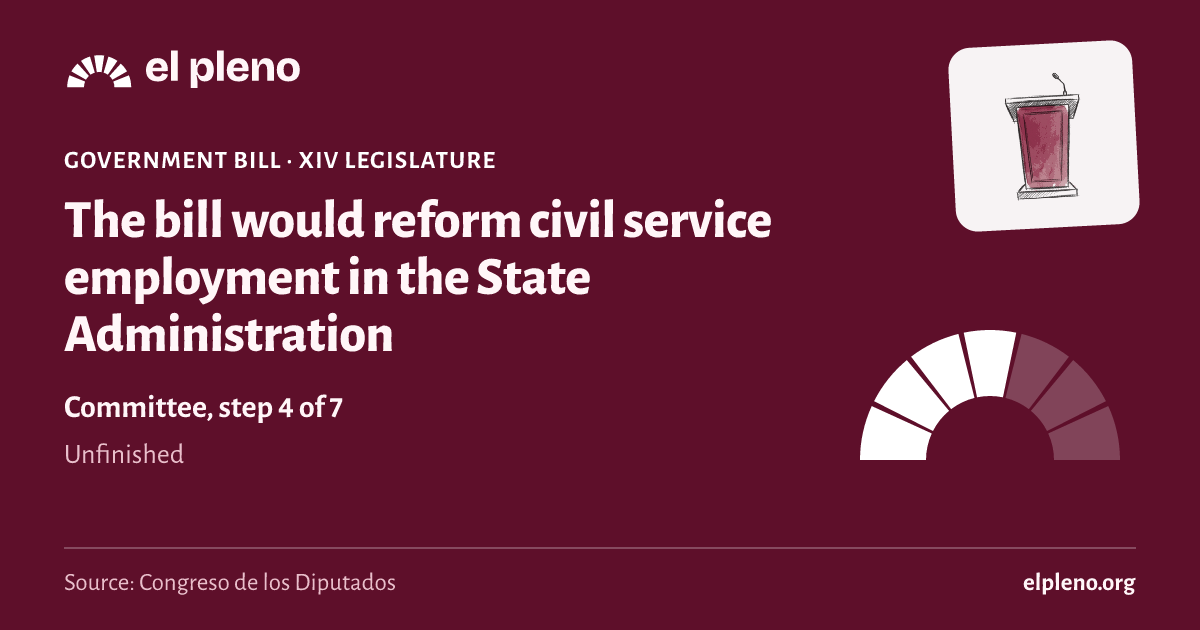
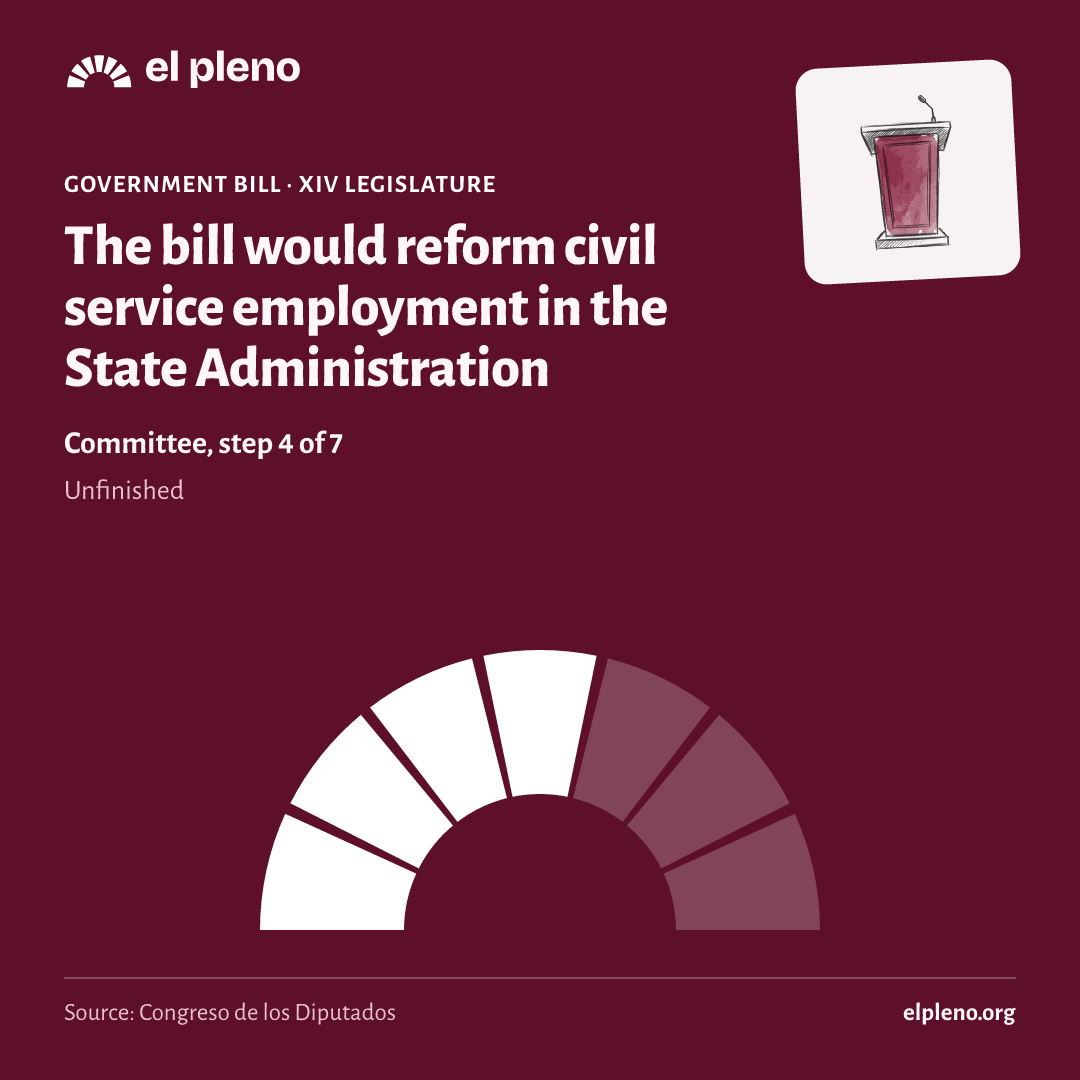
It took 4 of 7 steps. It reached Committee, and today it is unfinished.
- Introduced17 March 2023Someone registers the text in the Congreso.
- Admitted22 March 2023The Bureau of the Congreso accepts it and, for a members’ bill, the plenary decides whether to consider it.
- Amendments24 March 2023Groups propose changes.
- Committee5 May 2023A committee goes through the text in detail.
- Plenarynot reachedAll 350 deputies vote.
- Senatenot reachedThe Senate can pass it, amend it or veto it.
- BOEnot reachedIt is published in the Official State Gazette (BOE) and comes into force.
See the 6 official steps on a timeline
Was there a plenary vote?
We have no plenary vote linked to this law in the Congreso’s data.
What happens next
What happens now?
The legislature ended before it finished. To go on, someone would have to introduce it again in the new Cortes.
It was presented again:
- XV Legislature, Congreso de los Diputados· Unfinished The bill would set new rules for Spanish State civil servants
Sources
Where does all this come from?
- Congreso de los Diputados, file 121/000149
Official title, type, author, dates and stage.
Retrieved 11 November 2026
- The data comes from the open files of the Congreso, the Senate and the BOE, unaltered.
- Each deputy’s province is the one of their seat on the day of the vote.
- We only say “passed” or “rejected” when the majority needed is certain; otherwise we say which side had more votes.