What it is
Bill to strengthen public healthcare and expand universal access
It is a government bill. Introduced by the Government. It was introduced on 16 June 2022. Introduced by: Gobierno.
Official title: Government bill amending various regulations to consolidate the equity, universality, and cohesion of the National Health System.
Source: Congreso de los Diputados, file 121/000110· updated 11 Nov
Automatic summary, not yet reviewed
- The bill would require that public health centers and services be managed directly, meaning with one hundred percent public ownership. Private management would only be allowed exceptionally, with a justified and motivated decision, and never as a replacement for public management.
- It would restore the common portfolio of SNS services as a single portfolio, merging the three categories created in 2012. It would prevent new healthcare copayments, keeping user contributions only for pharmaceutical, orthopedic products and accessory services.
- It would extend the right to public healthcare to new groups: Spanish citizens living abroad during temporary visits to Spain and their accompanying family members, reunited dependent ascendants, applicants for international protection, people under temporary protection, and victims of human trafficking or sexual exploitation.
- Government rules would have to include a health impact assessment in their regulatory analysis reports, to evaluate how rules on housing, education, environment, transport and other areas affect health.
- It would strengthen the participation of patients, professionals and citizens in the SNS through the Open Health Forum, which would become a permanent advisory and proposal-making body.
- It would set the conditions for accessing and processing health data for health policy planning, healthcare, public health surveillance and research, with data protection safeguards and recorded access for audits.
- It would authorize the creation of the consortium of the Spanish Network of Health Technology Assessment Agencies (RedETS), with its own legal personality, to strengthen the assessment of health technologies and services.
- It would repeal the 1997 law that allowed private management formulas in the SNS, and the law would enter into force twenty days after its publication in the Official State Gazette.
Who it affects
- People with insufficient resources or in an irregular administrative situation: They would be guaranteed access to public healthcare under the same conditions as those holding the right.
- Spanish citizens living abroad and their families: They would have the right to public healthcare during temporary stays in Spain.
- Patients and the general public: They could take part in SNS advisory bodies, and new healthcare copayments would be prevented.
- Health professionals and researchers: They would have clear rules for accessing health data for management, surveillance and research purposes.
- Public health administrations: They would have to manage centers and services directly, with private management limited to exceptional cases.
Words worth knowing
- Sistema Nacional de Salud (SNS)
- Spain's national health system, made up of the health services of the central government and the autonomous communities.
- Cartera común de servicios
- The list of health services (appointments, medicines, rehabilitation, etc.) covered by the public system for the whole population.
- Copago
- The share of the cost of a medicine or service paid by the user, with the rest covered by the public system.
- Consejo Interterritorial del SNS
- The body where the central government and the autonomous communities jointly agree on health matters.
- Concierto sanitario
- An agreement under which a private center provides public health services, usually in exchange for payment.
It summarizes the text as it was introduced. It is written by artificial intelligence and may contain mistakes: the official text is what counts. Read the official text · How we make summaries
Where it stands
How far did it get?
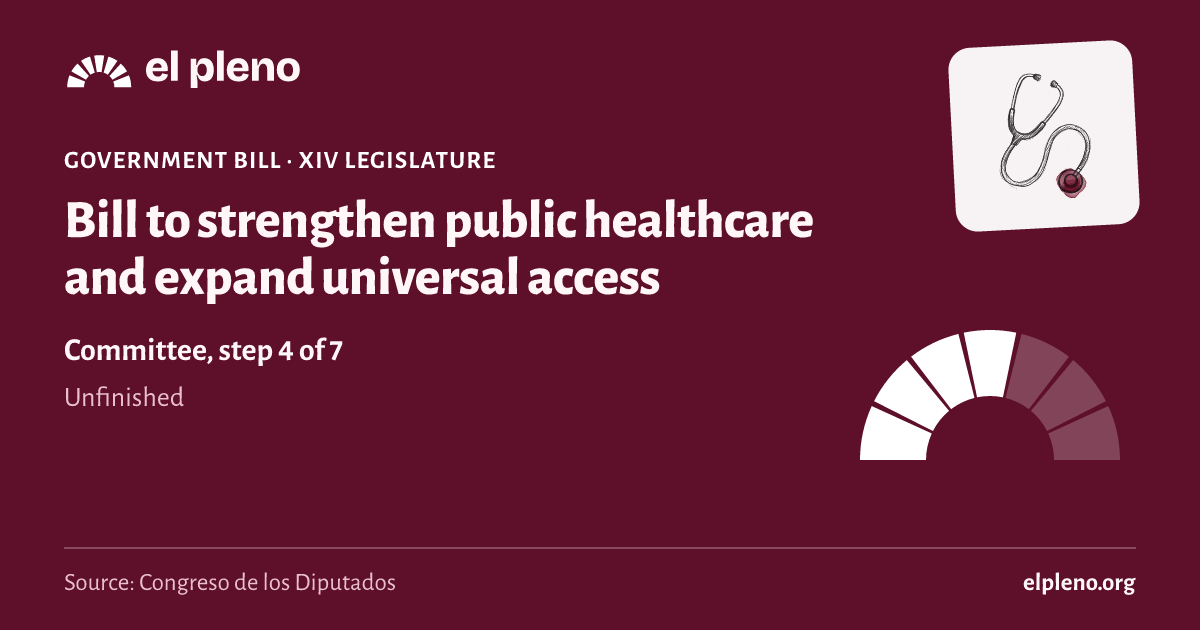
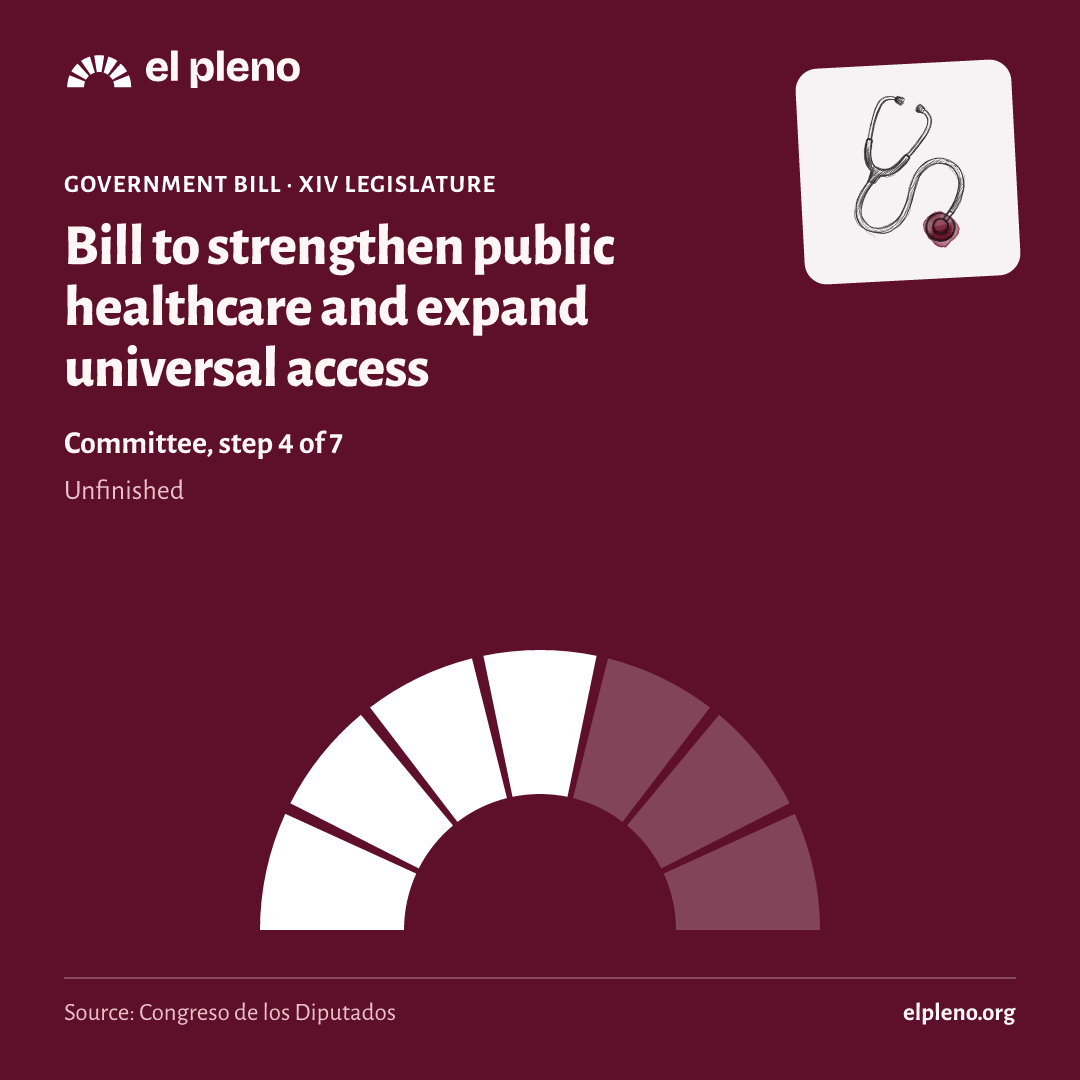
It took 4 of 7 steps. It reached Committee, and today it is unfinished.
- Introduced16 June 2022Someone registers the text in the Congreso.
- Admitted21 June 2022The Bureau of the Congreso accepts it and, for a members’ bill, the plenary decides whether to consider it.
- Amendments24 June 2022Groups propose changes.
- Committee13 September 2022A committee goes through the text in detail.
- Plenarynot reachedAll 350 deputies vote.
- Senatenot reachedThe Senate can pass it, amend it or veto it.
- BOEnot reachedIt is published in the Official State Gazette (BOE) and comes into force.
See the 7 official steps on a timeline
22 September 2022
How did the plenary vote?
Voted on: Joint vote on the amendments to the whole for return of the Government bill amending various regulations to consolidate equity, universality and cohesion of the National Health System, submitted by the Ciudadanos and VOX Parliamentary Groups.
Source: Congreso de los Diputados, vote 19 of sitting 202· updated 10 Nov
Each dot is a seat. Tap one, or use the arrow keys, to see who it is.
Your province
How did the deputies from your province vote?
And your senators: the Senate does not link its votes to this law in its open data, so we cannot put them side by side here.
Or see how most of each province voted
- A Coruña More votes against 0 yes · 4 no · 3 abst.
- Albacete More votes against 1 yes · 2 no · 1 abst.
- Alicante/Alacant More votes against 4 yes · 5 no · 3 abst.
- Almería Tie 2 yes · 2 no · 2 abst.
- Araba/Álava More votes against 0 yes · 4 no
- Asturias More votes against 1 yes · 4 no · 2 abst.
- Ávila Tie 1 yes · 1 no · 1 abst.
- Badajoz More votes against 1 yes · 3 no · 2 abst.
- Barcelona More votes against 4 yes · 24 no · 2 abst.
- Bizkaia More votes against 0 yes · 6 no · 1 abst.
- Burgos More votes against 0 yes · 2 no · 2 abst.
- Cáceres More votes against 1 yes · 2 no · 1 abst.
- Cádiz More votes against 3 yes · 4 no · 2 abst.
- Cantabria More votes against 1 yes · 2 no · 2 abst.
- Castellón/Castelló More votes against 1 yes · 3 no · 1 abst.
- Ceuta More votes in favour 1 yes · 0 no
- Ciudad Real More votes against 1 yes · 2 no · 2 abst.
- Córdoba More votes against 1 yes · 3 no · 2 abst.
- Cuenca More votes against 0 yes · 2 no · 1 abst.
- Gipuzkoa More votes against 0 yes · 6 no
- Girona More votes against 0 yes · 6 no
- Granada More votes against 1 yes · 4 no · 2 abst.
- Guadalajara Tie 1 yes · 1 no · 1 abst.
- Huelva More votes against 1 yes · 3 no · 1 abst.
- Huesca More votes against 0 yes · 2 no · 1 abst.
- Illes Balears More votes against 2 yes · 4 no · 1 abst.
- Jaén More votes against 1 yes · 3 no · 1 abst.
- La Rioja More votes against 0 yes · 2 no · 2 abst.
- Las Palmas More votes against 1 yes · 4 no · 2 abst.
- León More votes against 1 yes · 2 no · 1 abst.
- Lleida More votes against 0 yes · 4 no
- Lugo More votes against 0 yes · 2 no · 2 abst.
- Madrid More votes against 10 yes · 17 no · 10 abst.
- Málaga More votes against 3 yes · 5 no · 3 abst.
- Melilla Tie 0 yes · 0 no · 1 abst.
- Murcia More votes against 3 yes · 4 no · 3 abst.
- Navarra More votes against 2 yes · 3 no
- Ourense More votes against 0 yes · 2 no · 2 abst.
- Palencia More votes against 0 yes · 1 no · 2 abst.
- Pontevedra More votes against 0 yes · 4 no · 3 abst.
- Salamanca Tie 1 yes · 1 no · 2 abst.
- Santa Cruz de Tenerife More votes against 1 yes · 3 no · 2 abst.
- Segovia Tie 1 yes · 1 no · 1 abst.
- Sevilla More votes against 3 yes · 7 no · 2 abst.
- Soria More votes against 0 yes · 1 no · 1 abst.
- Tarragona More votes against 0 yes · 6 no
- Teruel More votes against 0 yes · 2 no · 1 abst.
- Toledo Tie 2 yes · 2 no · 2 abst.
- Valencia/València More votes against 4 yes · 7 no · 4 abst.
- Valladolid More votes against 1 yes · 2 no · 2 abst.
- Zamora Tie 1 yes · 1 no · 1 abst.
- Zaragoza More votes against 1 yes · 4 no · 2 abst.
More details: how each group and each province voted
The groups
Who voted in favour and who against?
In favour, most of Ciudadanos and VOX. Against, most of Euskal Herria Bildu, Republicano, Socialista, Vasco (EAJ-PNV), Mixto, Gcup-ec-gc and GPlu. 4 deputies voted differently from their group.
By province: in 1 most voted in favour; in 34, against.
Coloured by how most of each province’s deputies voted.
- In favour: 1
- Against: 34
- Abstained: 3
- Tie: 14
| Group | Seats | How it voted |
|---|---|---|
| Euskal Herria Bildu | 5 | 5 against |
| Republicano | 13 | 12 against · 1 did not vote |
| Socialista | 120 | 120 against |
| Vasco (EAJ-PNV) | 6 | 5 against · 1 did not vote |
| Mixto | 11 | 3 in favour · 5 against · 1 abst. · 2 did not vote |
| Ciudadanos | 9 | 9 in favour |
| Gcup-ec-gc | 33 | 33 against |
| GPlu | 12 | 11 against · 1 did not vote |
| Popular en el Congreso | 88 | 87 abst. · 1 did not vote |
| VOX | 52 | 52 in favour |
What happens next
What happens now?
The legislature ended before it finished. To go on, someone would have to introduce it again in the new Cortes.
It has not been presented again yet.
Sources
Where does all this come from?
- Congreso de los Diputados, file 121/000110
Official title, type, author, dates and stage.
Retrieved 11 November 2026
- Congreso de los Diputados, vote 19 of sitting 202
The count and every seat’s vote.
Retrieved 10 November 2026
- The data comes from the open files of the Congreso, the Senate and the BOE, unaltered.
- Each deputy’s province is the one of their seat on the day of the vote.
- We only say “passed” or “rejected” when the majority needed is certain; otherwise we say which side had more votes.