What it is
The bill would change excise duties, VAT and consular fees
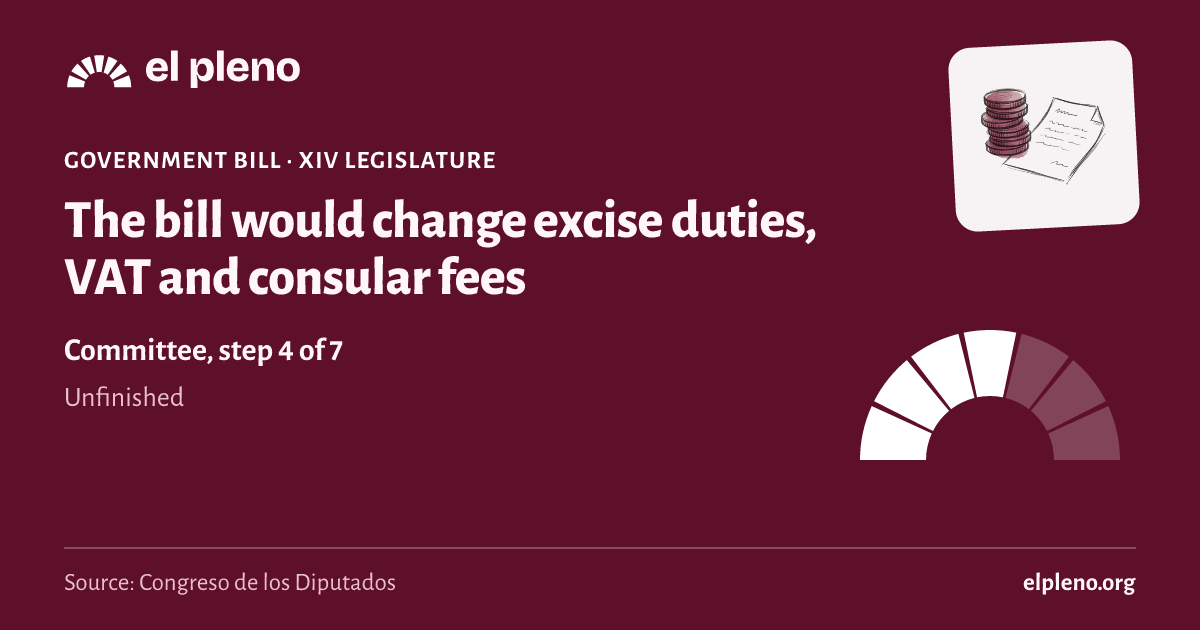
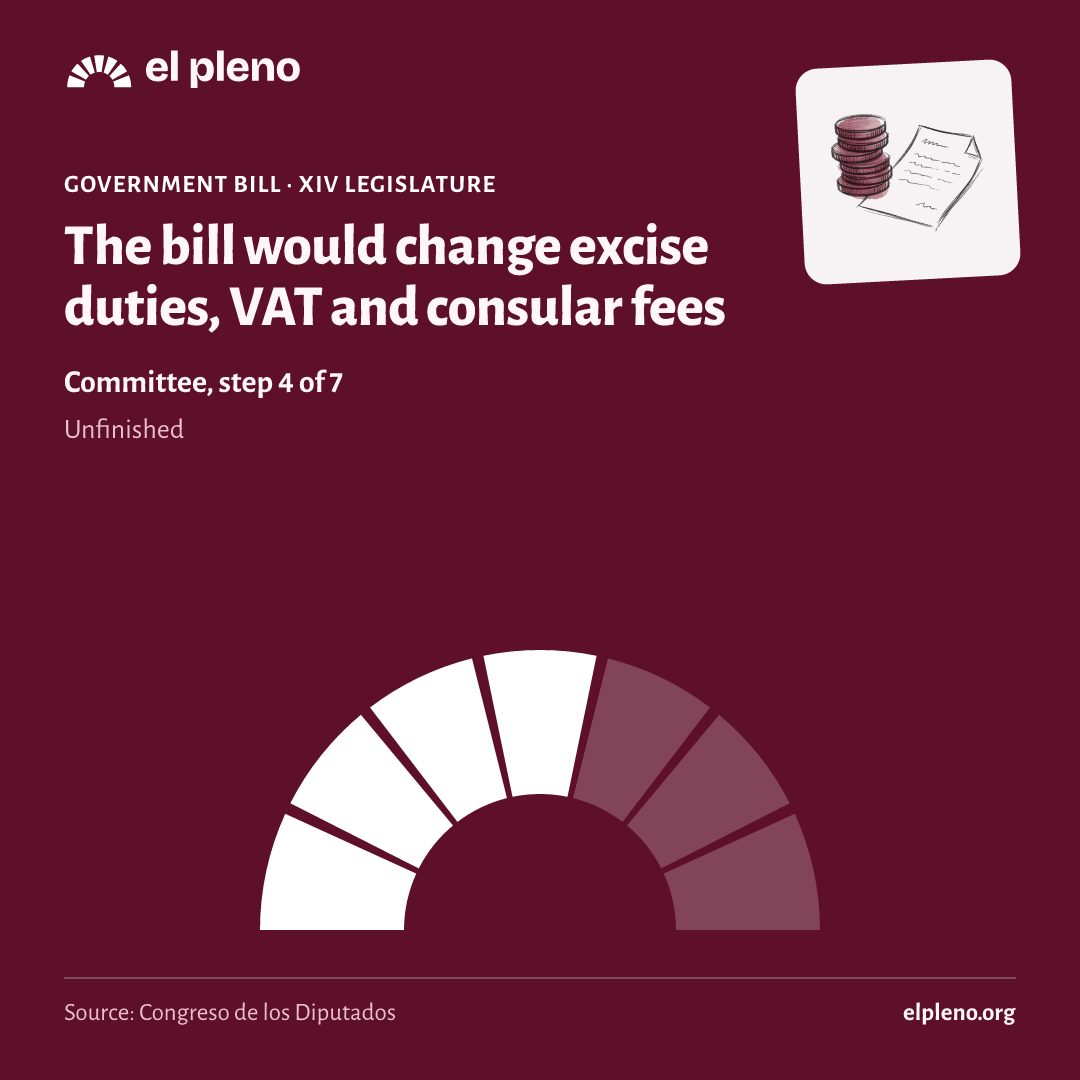
Committee step 4 of 7 · UnfinishedIt is a government bill. Introduced by the Government. It was introduced on 20 October 2021. Introduced by: Gobierno.
Official title: Government bill to amend Law 38/1992, of December 28, on Excise Duties, Law 37/1992, of December 28, on Value Added Tax, and Law 9/2011, of May 10, on consular fees.
Source: Congreso de los Diputados, file 121/000072· updated 11 Nov
Automatic summary, not yet reviewed
- The bill would amend the Excise Duties Law and the VAT Law to bring Spanish law into line with three European directives on excise duties and VAT.
- The bill would grant tax benefits for European Union defense efforts: supplies to the armed forces of other member states taking part in a Union activity under the common security and defense policy would be exempt from excise duties and VAT.
- For the Hydrocarbons Tax, people or companies holding or distributing products similar to diesel would be jointly liable for the tax if it has not been paid. The Tax Agency could also require a guarantee to cover the circulation, holding and use of these products.
- The bill would create new offenses and penalties for failures, delays or false data in the SIANE and SILICIE systems and in communications for the professional diesel refund, with fixed fines that are more moderate than those under the general regime.
- Two new categories of economic operators would be created, the certified consignor and the certified consignee, to identify in the computer system those who move products with excise duties already paid between member states.
- The bill would amend the consular fees law to set fees for the new titles of Sworn Translator and Sworn Interpreter, which replace the single Sworn Translator-Interpreter title. Those who obtain the title through the Ministry of Foreign Affairs exams would be exempt from the fee for issuing the title.
- The bill would enter into force the day after its publication in the Official State Gazette, although several measures would apply later: some on January 1, 2022, others on July 1, 2022, and others on February 13, 2023.
Who it affects
- Companies and operators that manufacture, import or move products subject to excise duties (alcohol, tobacco, hydrocarbons, electricity): New definitions, procedures, reporting obligations and specific penalties.
- Those who hold or distribute diesel-like products without paying the tax: They could be jointly liable for payment and required to provide guarantees.
- Armed forces of other member states and those supplying them with goods or electricity: Operations linked to European Union defense efforts would be exempt from excise duties and VAT.
- Sworn translators and interpreters: New fees for two separate titles and their professional ID cards.
- People who buy alcohol or tobacco in duty-free shops, and travelers bringing in these products: The import limits for alcoholic beverages and tobacco products for travelers and private shipments would be updated.
Words worth knowing
- Impuestos especiales (excise duties)
- Taxes on the consumption of specific products, such as alcohol, tobacco, hydrocarbons or electricity.
- Régimen suspensivo (suspensive regime)
- A situation where payment of the excise duty is postponed while the product is manufactured, stored or transported under control.
- Responsabilidad solidaria (joint and several liability)
- It makes a person liable to pay someone else's tax debt if that person does not pay it.
- Devengo (accrual)
- The moment when the obligation to pay the tax arises.
- Traductor Jurado (Sworn Translator)
- An official title allowing translation of documents with legal validity; the bill would separate this title from that of Sworn Interpreter.
It summarizes the text as it was introduced. It is written by artificial intelligence and may contain mistakes: the official text is what counts. Read the official text · How we make summaries
Where it stands
How far did it get?
It took 4 of 7 steps. It reached Committee, and today it is unfinished.
- Introduced20 October 2021Someone registers the text in the Congreso.
- Admitted26 October 2021The Bureau of the Congreso accepts it and, for a members’ bill, the plenary decides whether to consider it.
- Amendments29 October 2021Groups propose changes.
- Committee24 November 2021A committee goes through the text in detail.
- Plenarynot reachedAll 350 deputies vote.
- Senatenot reachedThe Senate can pass it, amend it or veto it.
- BOEnot reachedIt is published in the Official State Gazette (BOE) and comes into force.
See the 6 official steps on a timeline
Was there a plenary vote?
We have no plenary vote linked to this law in the Congreso’s data.
What happens next
What happens now?
The legislature ended before it finished. To go on, someone would have to introduce it again in the new Cortes.
It has not been presented again yet.
Sources
Where does all this come from?
- Congreso de los Diputados, file 121/000072
Official title, type, author, dates and stage.
Retrieved 11 November 2026
- The data comes from the open files of the Congreso, the Senate and the BOE, unaltered.
- Each deputy’s province is the one of their seat on the day of the vote.
- We only say “passed” or “rejected” when the majority needed is certain; otherwise we say which side had more votes.