What it is
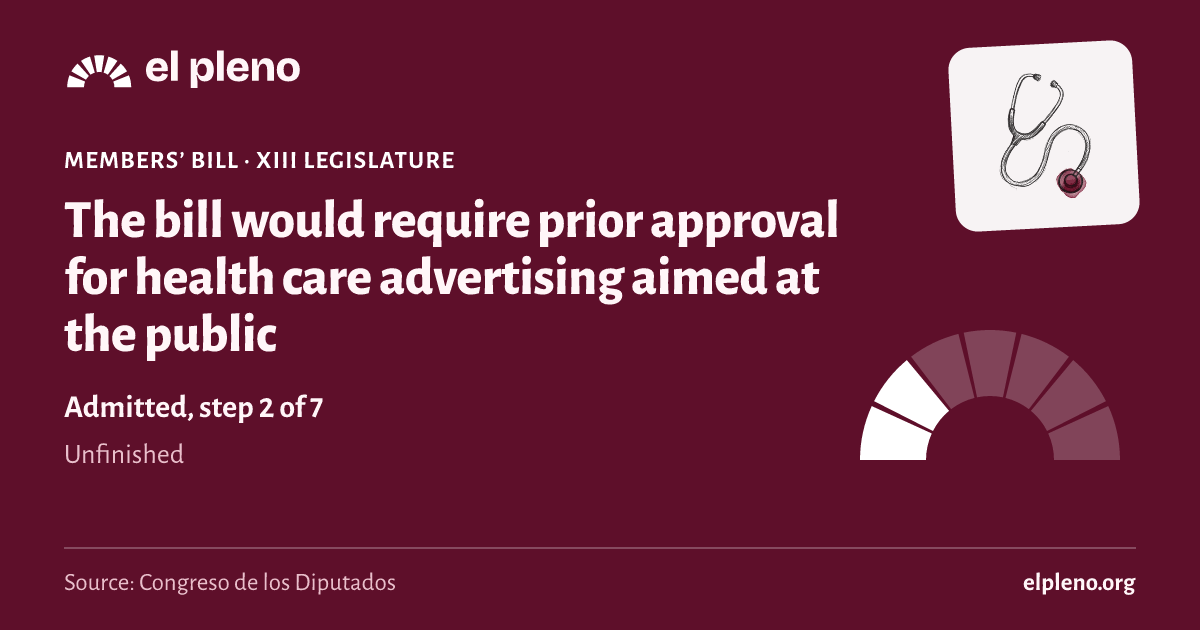
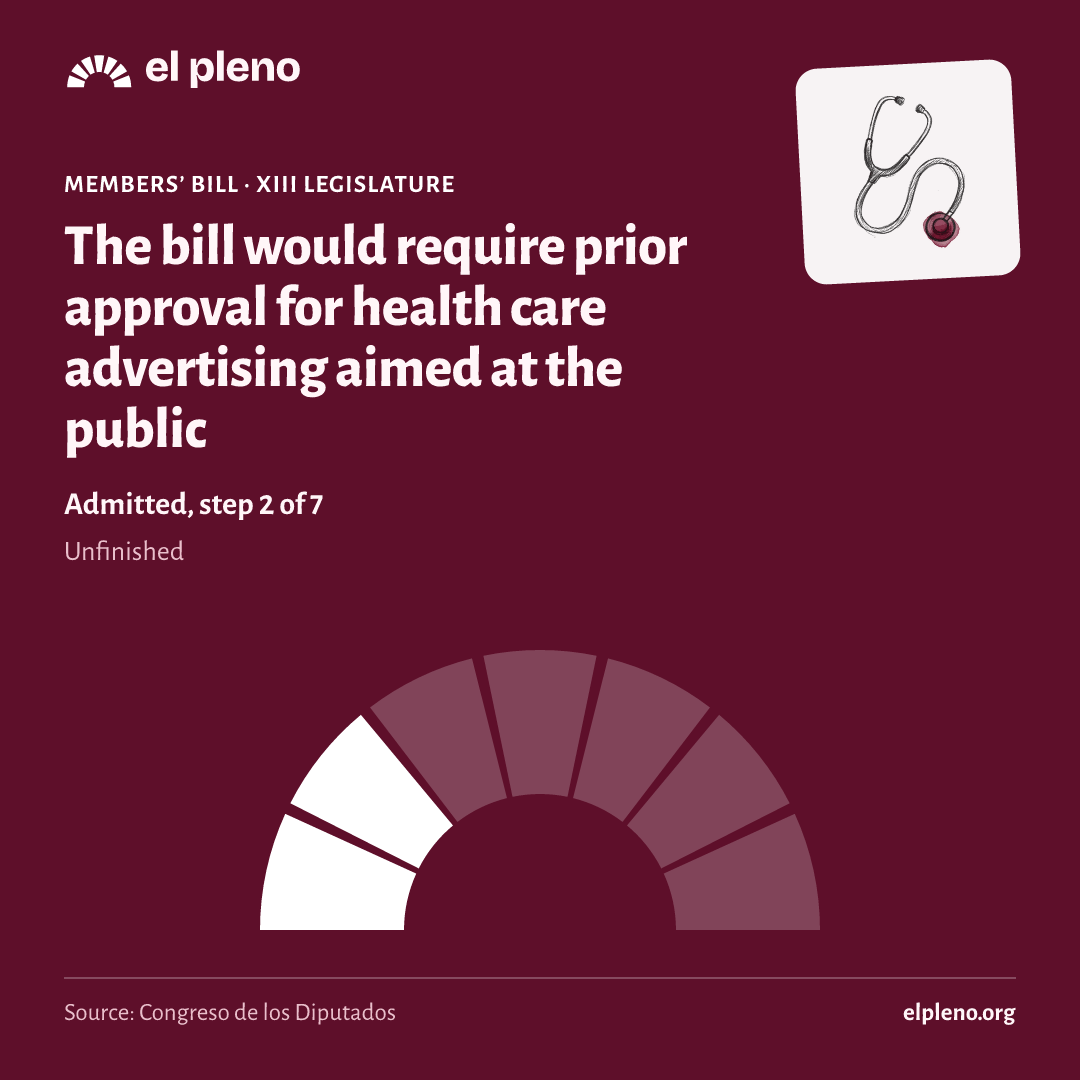
The bill would require prior approval for health care advertising aimed at the public
Admitted step 2 of 7 · UnfinishedIt is a members’ bill. Introduced by parliamentary groups, the Senate, regional governments or citizens. It was introduced on 13 September 2019. Introduced by: Grupo Parlamentario Popular.
Official title: Private member's bill on the advertising of health services and activities.
Source: Congreso de los Diputados, file 122/000049· updated 11 Nov
Automatic summary, not yet reviewed
- The bill would regulate health care advertising, splitting it into two types: advertising aimed at the public and advertising aimed at health care professionals.
- Health care advertising would have to be based on scientific evidence and be objective, prudent and truthful. Only authorized health centers and facilities could advertise to the public, and the ads would have to match their operating authorization.
- Ads could not promise guaranteed results, target children, use recovery testimonials, offer discounts or gifts to encourage hiring, or compare with or disparage other providers. Health professionals would also be banned from endorsing commercial advertising aimed at the public.
- Advertising aimed at the public would need prior approval from the health authority, which would have to decide within two months. The approval would be valid for up to five years and could be renewed.
- Advertising aimed at health professionals would not need approval, but it would have to be reported before starting and provide enough scientific and technical information for professionals to judge the services.
- The bill would create a system to request that illegal advertising stop, plus penalties under health regulations. Companies would have six months to adapt their campaigns after the law takes effect.
Who it affects
- Health centers, services and facilities: They would be the only ones allowed to advertise health services to the public, and each campaign would need prior approval.
- Health care professionals: They could not endorse commercial advertising aimed at the public or advertise as specialists without the official degree.
- Drug and medical device companies: They would be banned from advertising health services to the public.
- Consumers and patients: They would get more tightly controlled health advertising, with truthful messages and warnings about risks.
- Health authorities and professional associations: They would inspect, approve and monitor health care advertising.
Words worth knowing
- Proposición de ley
- A bill introduced by a parliamentary group. It is not an approved law yet.
- Prestación sanitaria
- Health-related services that are not strictly health care activities, provided by qualified people or companies.
- Actividad sanitaria
- Activities to promote, prevent, diagnose, treat or rehabilitate people's health.
- Acción de cesación
- A court action to make someone stop doing something, here to stop running illegal advertising.
- Normativa básica
- Rules set by the central State so they apply the same across Spain, even though regional governments may develop them further.
It summarizes the text as it was introduced. It is written by artificial intelligence and may contain mistakes: the official text is what counts. Read the official text · How we make summaries
Where it stands
How far did it get?
It took 2 of 7 steps. It reached Admitted, and today it is unfinished.
- Introduced13 September 2019Someone registers the text in the Congreso.
- Admitted17 September 2019The Bureau of the Congreso accepts it and, for a members’ bill, the plenary decides whether to consider it.
- Amendmentsnot reachedGroups propose changes.
- Committeenot reachedA committee goes through the text in detail.
- Plenarynot reachedAll 350 deputies vote.
- Senatenot reachedThe Senate can pass it, amend it or veto it.
- BOEnot reachedIt is published in the Official State Gazette (BOE) and comes into force.
See the 5 official steps on a timeline
Was there a plenary vote?
We have no plenary vote linked to this law in the Congreso’s data.
What happens next
What happens now?
The legislature ended before it finished. To go on, someone would have to introduce it again in the new Cortes.
It was presented again:
- XIV Legislature, Congreso de los Diputados· Rejected Stricter rules for health care advertising
Presented before in:
- XII Legislature, Congreso de los Diputados· Unfinished Stricter rules for advertising health services
Sources
Where does all this come from?
- Congreso de los Diputados, file 122/000049
Official title, type, author, dates and stage.
Retrieved 11 November 2026
- The data comes from the open files of the Congreso, the Senate and the BOE, unaltered.
- Each deputy’s province is the one of their seat on the day of the vote.
- We only say “passed” or “rejected” when the majority needed is certain; otherwise we say which side had more votes.