What it is
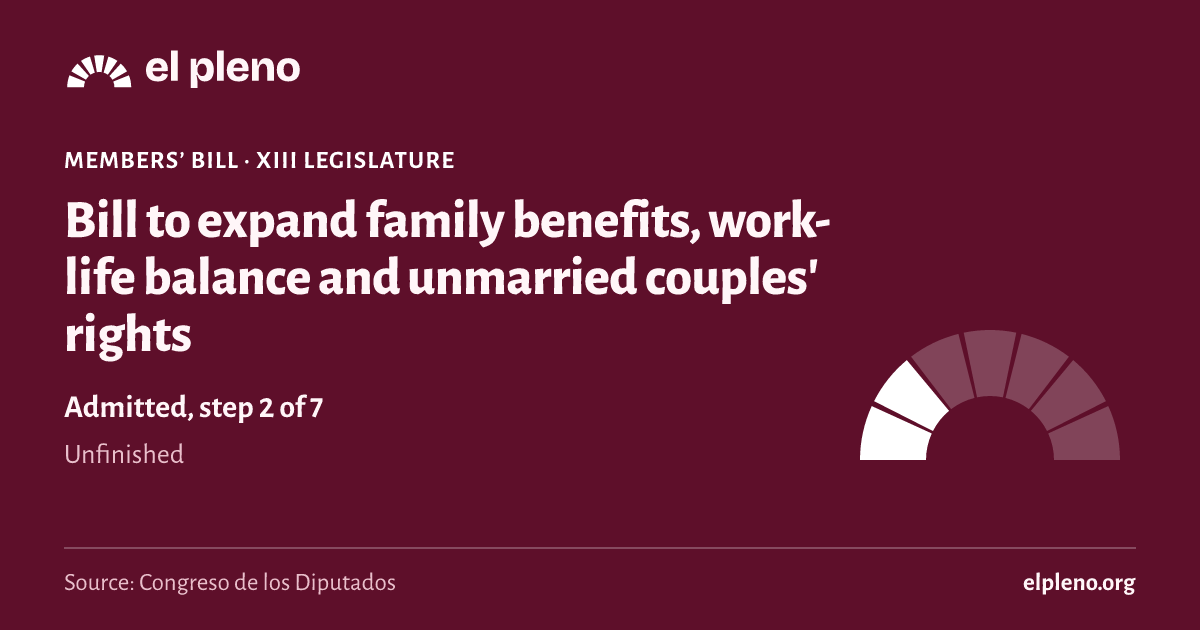
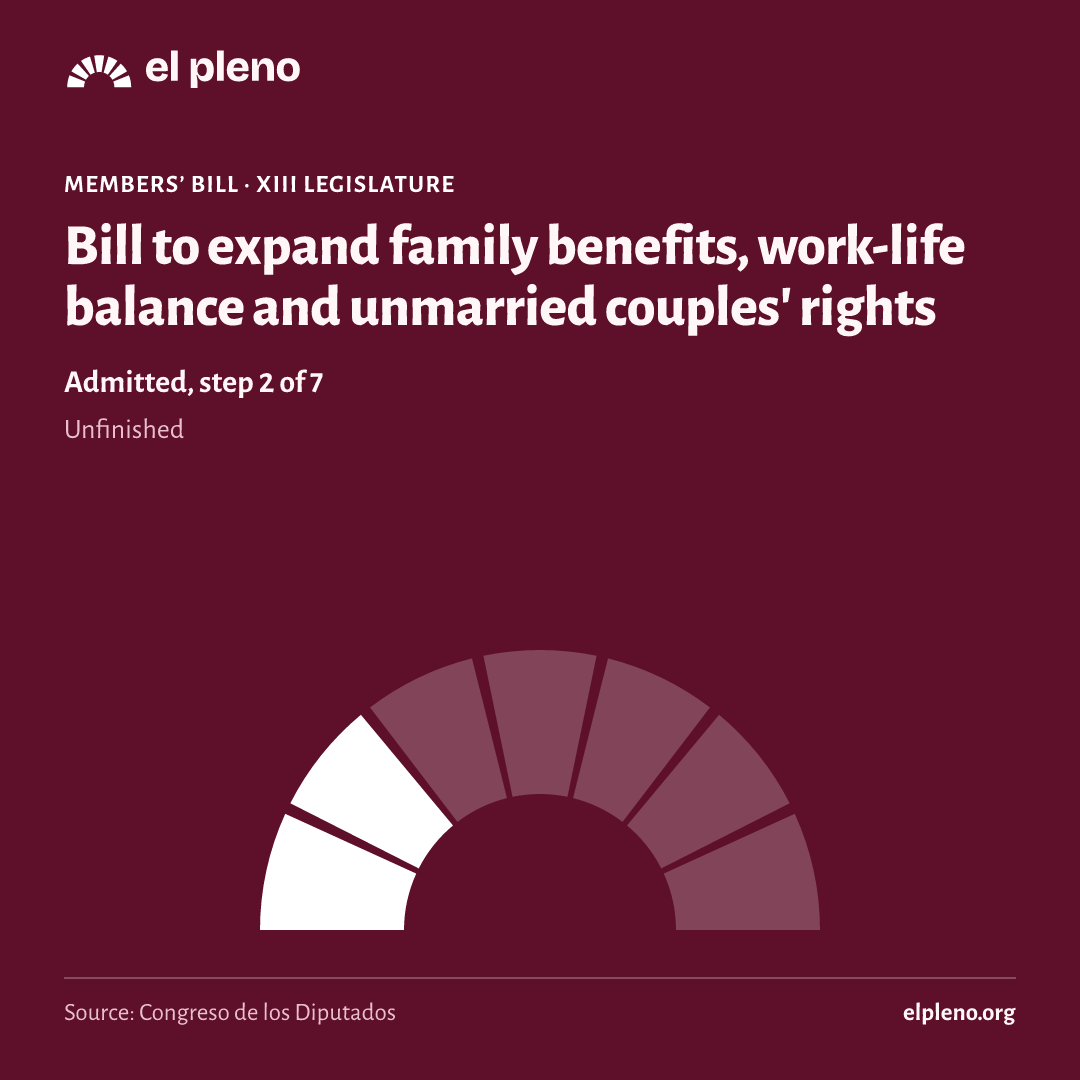
Bill to expand family benefits, work-life balance and unmarried couples' rights
Admitted step 2 of 7 · UnfinishedIt is a members’ bill. Introduced by parliamentary groups, the Senate, regional governments or citizens. It was introduced on 12 June 2019. Introduced by: Grupo Parlamentario Ciudadanos.
Official title: Private member's bill on the Comprehensive Protection and Support for Families.
Source: Congreso de los Diputados, file 122/000012· updated 11 Nov
Automatic summary, not yet reviewed
- The bill would make every family with two or more children a large family, and families with three or more children would move into the special category (currently five are required).
- For the first time, it would create a protection scheme for single-parent families: they would receive the same benefits as large families, and those with two or more children, the special-category benefits. In these households, birth or adoption leave would be extended to 32 weeks.
- It would recognize, for all workers, both men and women, the right to work-life balance, with fast court protections if the employer refuses.
- It would extend reduced schedules to the care of elderly people or relatives living in the same home, allow these reductions to be accumulated into full days, and create time banks so workers can make up those hours without losing pay.
- Workers could convert up to seven vacation days into hours for personal matters, and moving voluntarily between on-site and remote work would be made easier.
- It would reward shared responsibility with two extra weeks of leave for each parent who takes all of their leave, and it would grant leave for foster care arrangements shorter than one year, currently excluded.
- It would extend the birth and child care subsidy to men and to adoption or foster care cases, and it would grant a 100% rebate on employer Social Security contributions during leave, pregnancy-related sick leave and replacement contracts.
- It would put unmarried couples on equal footing with married couples: they could qualify as a large family, get 15 days of leave when the partnership is registered, file joint income tax The personal income tax (IRPF in Spain): what people pay on what they earn from work, business or savings. returns, and receive survivor's pensions and death grants on the same terms.
Who it affects
- Families with two or more children and single-parent families: They would qualify as large families and receive those benefits, with extended leave for single-parent households.
- Employees and civil servants: They would gain new work-life balance rights: reduced schedules, time banks, vacation days convertible into hours and remote work.
- Unmarried couples (parejas de hecho): They would be equal to married couples in leave, income tax, large-family status and survivor's pensions.
- Employers: They would receive a 100% rebate on Social Security contributions during their workers' leave and on replacement contracts.
Words worth knowing
- Familia numerosa de categoría especial (special-category large family)
- The tier of large families with the most benefits. The bill would reserve it for families with three or more children.
- Banco de horas (time bank)
- A company record of the hours a worker takes off for family reasons and later makes up by working, without losing pay.
- Subsidio por nacimiento y cuidado de menor (birth and child care subsidy)
- A Social Security payment for people who do not meet the minimum contribution period required for the contributory benefit.
- Pareja de hecho (registered unmarried couple)
- A stable, public union of two people in an affectionate relationship who live together, without being married.
- IRPF (Spanish personal income tax)
- The tax paid on personal income in Spain.
- income tax
- The personal income tax (IRPF in Spain): what people pay on what they earn from work, business or savings.
It summarizes the text as it was introduced. It is written by artificial intelligence and may contain mistakes: the official text is what counts. Read the official text · How we make summaries
Where it stands
How far did it get?
It took 2 of 7 steps. It reached Admitted, and today it is unfinished.
- Introduced12 June 2019Someone registers the text in the Congreso.
- Admitted20 June 2019The Bureau of the Congreso accepts it and, for a members’ bill, the plenary decides whether to consider it.
- Amendmentsnot reachedGroups propose changes.
- Committeenot reachedA committee goes through the text in detail.
- Plenarynot reachedAll 350 deputies vote.
- Senatenot reachedThe Senate can pass it, amend it or veto it.
- BOEnot reachedIt is published in the Official State Gazette (BOE) and comes into force.
See the 5 official steps on a timeline
Was there a plenary vote?
We have no plenary vote linked to this law in the Congreso’s data.
What happens next
What happens now?
The legislature ended before it finished. To go on, someone would have to introduce it again in the new Cortes.
It was presented again:
- XIV Legislature, Congreso de los Diputados· Rejected Bill to expand family benefits and make work-life balance easier
Sources
Where does all this come from?
- Congreso de los Diputados, file 122/000012
Official title, type, author, dates and stage.
Retrieved 11 November 2026
- The data comes from the open files of the Congreso, the Senate and the BOE, unaltered.
- Each deputy’s province is the one of their seat on the day of the vote.
- We only say “passed” or “rejected” when the majority needed is certain; otherwise we say which side had more votes.