What it is
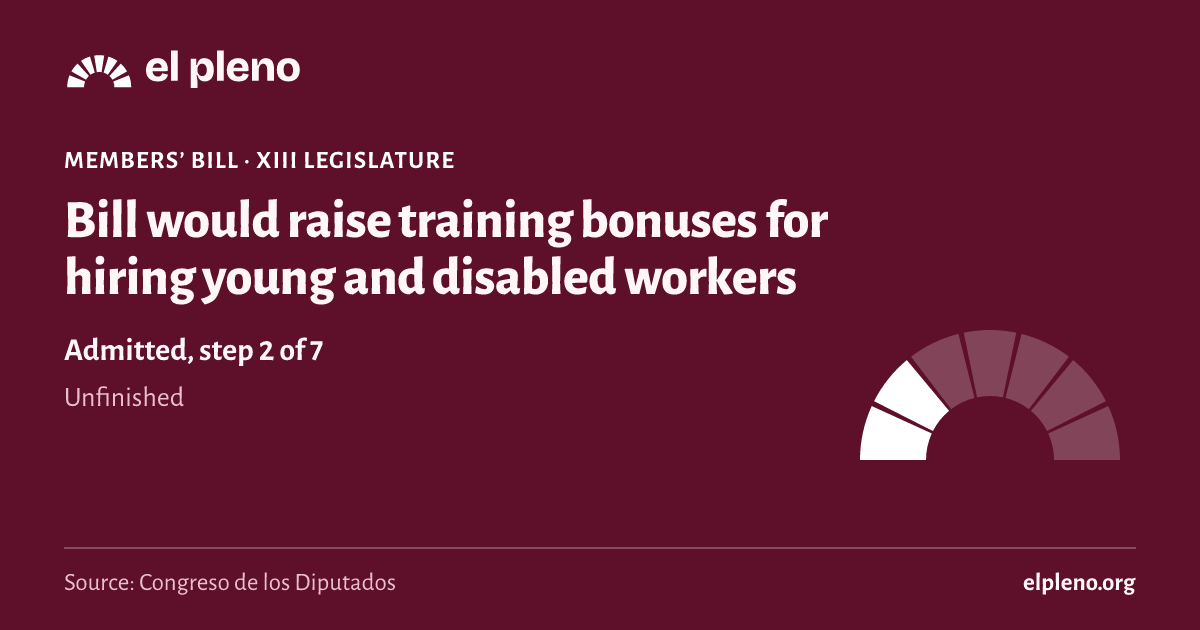
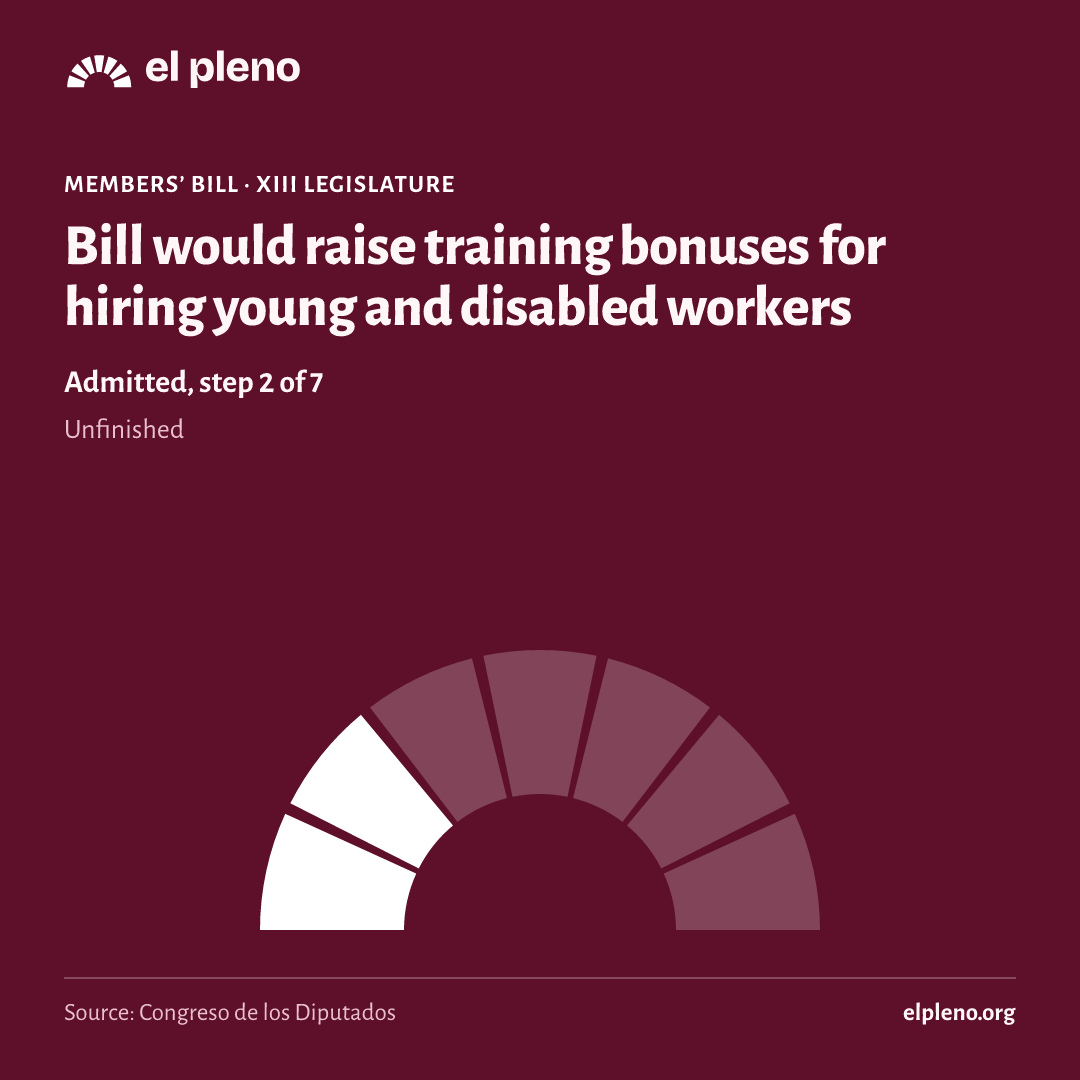
Bill would raise training bonuses for hiring young and disabled workers
Admitted step 2 of 7 · UnfinishedIt is a members’ bill. Introduced by parliamentary groups, the Senate, regional governments or citizens. It was introduced on 6 June 2019. Introduced by: Grupo Parlamentario Popular.
Official title: Private member's bill on the inclusion of a new paragraph to Article 109 of Royal Decree-Law 8/2014, of July 4, with the aim of promoting Dual Vocational Training, the Vocational Training System for Employment, for young people and for persons with disabilities benefiting from the National Youth Guarantee System.
Source: Congreso de los Diputados, file 122/000004· updated 11 Nov
Automatic summary, not yet reviewed
- The bill would add a new section to Article 109 of royal decree-law A rule with the force of law that the Government passes because it is urgent. It applies from its publication, but the Congreso must validate it within 30 days or it lapses. 8/2014 to raise the maximum bonus for companies that hire National Youth Guarantee beneficiaries under a training and apprenticeship contract: 50 % of the workday in the first year and 25 % in the second and third years.
- If the contract is signed with a person with a disability, the maximum bonus would be 50 % of the workday for every year of the contract.
- The explanatory statement says current rules only allow a bonus of 25 % of the workday in the first year and 15 % in the second and third years, and that a higher percentage would allow training programs tailored to each person.
- The law would take effect the day after its publication in the Official State Gazette (Boletín Oficial del Estado), except for measures affecting the budget, which would wait until the next fiscal year.
Who it affects
- Companies that hire young National Youth Guarantee beneficiaries under a training and apprenticeship contract.: They could apply larger bonuses to cover training costs.
- Companies that hire people with disabilities under this type of contract.: They could apply a bonus of 50 % of the workday for every year of the contract.
- Young people and people with disabilities who are Youth Guarantee beneficiaries.: They would have more training hours within their apprenticeship contract.
Words worth knowing
- Contrato para la formación y el aprendizaje
- A contract that combines working for a company with studying at a training center.
- Sistema Nacional de Garantía Juvenil (National Youth Guarantee)
- A set of measures so young people who neither work nor study receive an offer of employment, training or an internship.
- Bonificación
- A discount on the Social Security contributions a company pays for its workers.
- Formación profesional dual (dual vocational training)
- Training that alternates classes at a training center with hands-on work at a company.
- Proposición de ley
- A bill introduced by a parliamentary group; it is not yet an approved law.
- royal decree-law
- A rule with the force of law that the Government passes because it is urgent. It applies from its publication, but the Congreso must validate it within 30 days or it lapses.
- decree-law
- A rule with the force of law that the Government passes because it is urgent. It applies from its publication, but the Congreso must validate it within 30 days or it lapses.
It summarizes the text as it was introduced. It is written by artificial intelligence and may contain mistakes: the official text is what counts. Read the official text · How we make summaries
Where it stands
How far did it get?
It took 2 of 7 steps. It reached Admitted, and today it is unfinished.
- Introduced6 June 2019Someone registers the text in the Congreso.
- Admitted11 June 2019The Bureau of the Congreso accepts it and, for a members’ bill, the plenary decides whether to consider it.
- Amendmentsnot reachedGroups propose changes.
- Committeenot reachedA committee goes through the text in detail.
- Plenarynot reachedAll 350 deputies vote.
- Senatenot reachedThe Senate can pass it, amend it or veto it.
- BOEnot reachedIt is published in the Official State Gazette (BOE) and comes into force.
See the 6 official steps on a timeline
Was there a plenary vote?
We have no plenary vote linked to this law in the Congreso’s data.
What happens next
What happens now?
The legislature ended before it finished. To go on, someone would have to introduce it again in the new Cortes.
It has not been presented again yet.
Presented before in:
- XII Legislature, Congreso de los Diputados· Unfinished Bill would raise company bonuses for training young and disabled workers
Sources
Where does all this come from?
- Congreso de los Diputados, file 122/000004
Official title, type, author, dates and stage.
Retrieved 11 November 2026
- The data comes from the open files of the Congreso, the Senate and the BOE, unaltered.
- Each deputy’s province is the one of their seat on the day of the vote.
- We only say “passed” or “rejected” when the majority needed is certain; otherwise we say which side had more votes.