What it is
State fund to compensate asbestos victims
It is a members’ bill. Introduced by parliamentary groups, the Senate, regional governments or citizens. It was introduced on 15 March 2017. Introduced by: Comunidad Autónoma del País Vasco - Parlamento.
Official title: Private member's bill for the creation of a compensation fund for victims of asbestos.
Source: Congreso de los Diputados, file 125/000009· updated 11 Nov
Automatic summary, not yet reviewed
- The bill would create the Fund for the Compensation of Asbestos Victims, a public agency attached to the social security ministry. It would pay compensation to anyone with a recognized occupational disease caused by asbestos, or anyone harmed by asbestos exposure in Spain.
- The fund would be financed by contributions from employers, payments from work accident mutual funds, and money from the state budget. The contribution base would be the same as for workplace accidents and unemployment, paid together with social security contributions.
- The fund would be run by a governing council with representatives of the administration, unions, employers and mutual funds, plus a general secretariat that decides compensation claims at first instance. Local administrative units would work within provincial social security offices, with a monitoring committee in each province.
- Claimants would file a request with a medical certificate and proof of asbestos exposure. If the disease is already recognized as occupational, the social security decision alone would suffice. The fund would have six months to make a compensation offer; accepting it means giving up any lawsuit over the same harm.
- Decisions could be appealed to the social security minister within one month, and then challenged before the administrative courts. Once compensation is paid, the fund steps into the victim's rights and pursues the parties responsible for the harm on its own.
- The explanatory statement justifies the fund because many companies where exposure occurred have disappeared by the time the disease shows up, decades later, and victims face costly lawsuits against social security and mutual funds without ever getting paid.
Who it affects
- People with a recognized occupational disease caused by asbestos: They could ask the fund for full compensation for their losses.
- People harmed by asbestos exposure in Spain, even outside work: They could also apply for compensation.
- Public and private employers with employees: They would be required to contribute to the fund.
- Work accident and occupational disease mutual funds: They would have to pay into the fund and could face claims from it after paying compensation.
- Victims' family members: They could avoid costly lawsuits by accepting the fund's offer.
Words worth knowing
- Organismo autónomo
- A public agency with its own legal personality, created by the state to run a specific service.
- Mutua de accidentes de trabajo
- An entity that works with social security and manages benefits for workplace accidents and occupational diseases.
- Subrogación (subrogation)
- The fund takes the victim's place and itself claims the money from those responsible for the harm.
- Recurso de alzada
- A request for a higher authority to review a decision made by a lower one.
- Jurisdicción contencioso-administrativa
- The courts that review decisions made by public administrations.
It summarizes the text as it was introduced. It is written by artificial intelligence and may contain mistakes: the official text is what counts. Read the official text · How we make summaries
Where it stands
How far did it get?
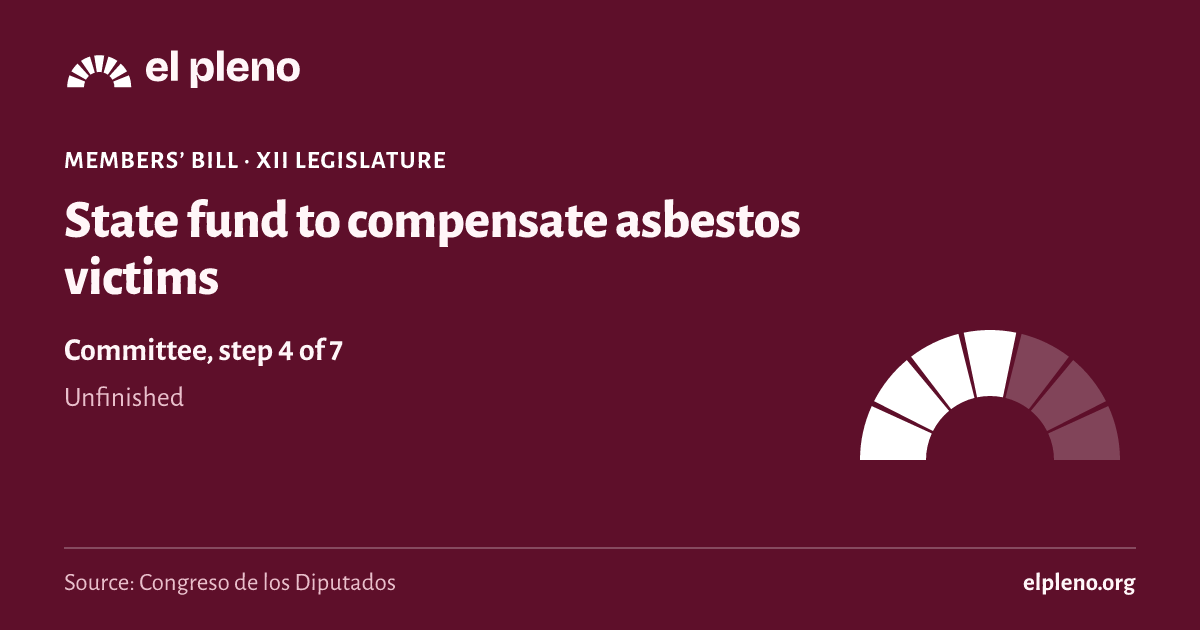
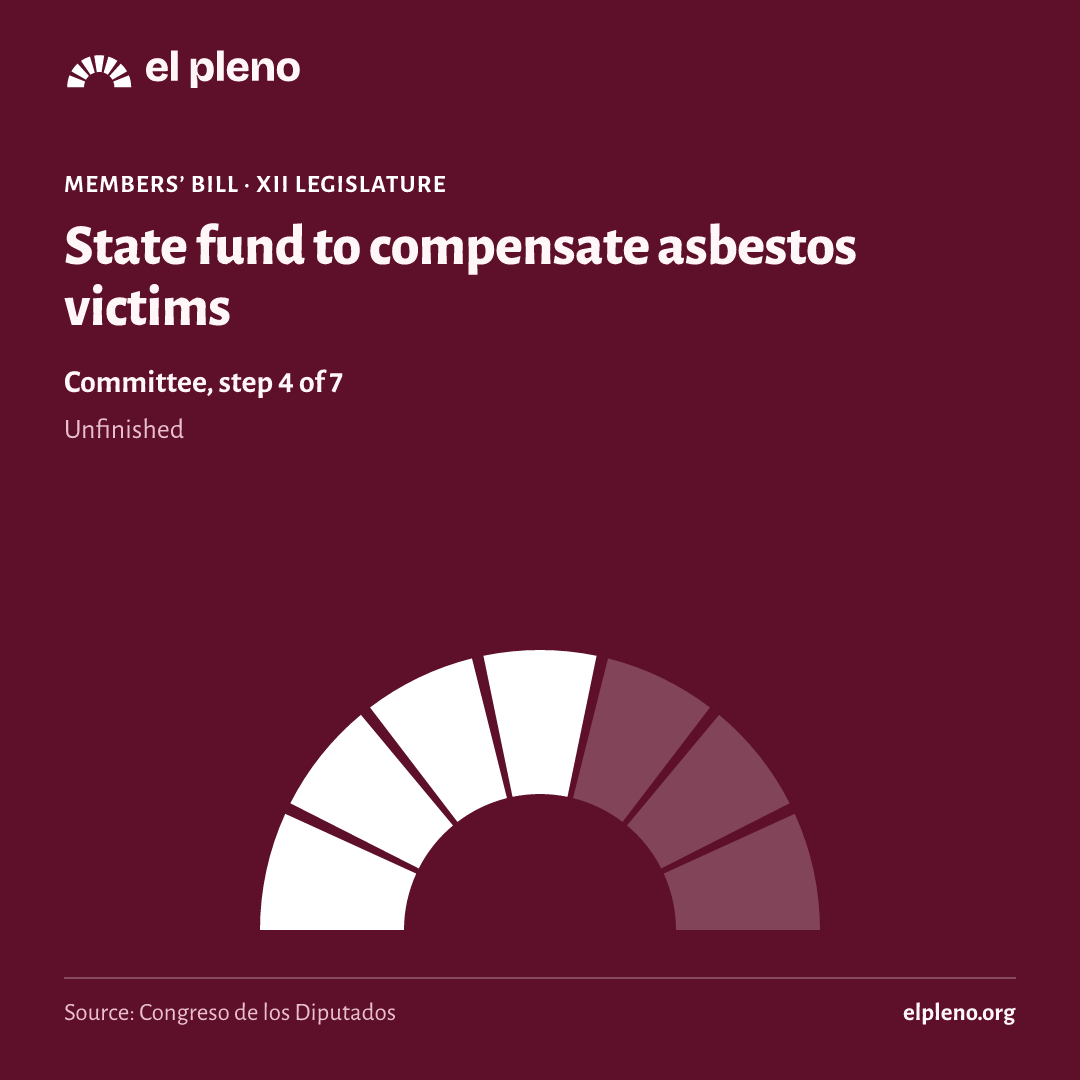
It took 4 of 7 steps. It reached Committee, and today it is unfinished.
- Introduced15 March 2017Someone registers the text in the Congreso.
- Admitted21 March 2017The Bureau of the Congreso accepts it and, for a members’ bill, the plenary decides whether to consider it.
- Amendments20 October 2017Groups propose changes.
- Committee3 October 2018A committee goes through the text in detail.
- Plenarynot reachedAll 350 deputies vote.
- Senatenot reachedThe Senate can pass it, amend it or veto it.
- BOEnot reachedIt is published in the Official State Gazette (BOE) and comes into force.
See the 11 official steps on a timeline
10 October 2017
How did the plenary vote?
Voted on: Private member's bill by the Basque Parliament, for the creation of a compensation fund for the victims of asbestos.
Source: Congreso de los Diputados, vote 1 of sitting 76· updated 10 Nov
Each dot is a seat. Tap one, or use the arrow keys, to see who it is.
Your province
How did the deputies from your province vote?
And your senators: the Senate does not link its votes to this law in its open data, so we cannot put them side by side here.
Or see how most of each province voted
- A Coruña More votes in favour 4 yes · 0 no · 4 abst.
- Albacete More votes in favour 2 yes · 0 no · 2 abst.
- Alicante/Alacant More votes in favour 7 yes · 0 no · 5 abst.
- Almería More votes in favour 3 yes · 0 no · 3 abst.
- Araba/Álava More votes in favour 3 yes · 0 no · 1 abst.
- Asturias More votes in favour 6 yes · 0 no · 2 abst.
- Ávila More votes in favour 1 yes · 0 no · 2 abst.
- Badajoz More votes in favour 3 yes · 0 no · 3 abst.
- Barcelona More votes in favour 18 yes · 0 no · 3 abst.
- Bizkaia More votes in favour 7 yes · 0 no · 1 abst.
- Burgos More votes in favour 2 yes · 0 no · 2 abst.
- Cáceres More votes in favour 2 yes · 0 no · 2 abst.
- Cádiz More votes in favour 6 yes · 0 no · 3 abst.
- Cantabria More votes in favour 3 yes · 0 no · 2 abst.
- Castellón/Castelló More votes in favour 3 yes · 0 no · 2 abst.
- Ceuta Tie 0 yes · 0 no · 1 abst.
- Ciudad Real More votes in favour 2 yes · 0 no · 3 abst.
- Córdoba More votes in favour 4 yes · 0 no · 2 abst.
- Cuenca More votes in favour 1 yes · 0 no · 2 abst.
- Gipuzkoa More votes in favour 6 yes · 0 no
- Girona More votes in favour 2 yes · 0 no
- Granada More votes in favour 3 yes · 0 no · 3 abst.
- Guadalajara More votes in favour 1 yes · 0 no · 2 abst.
- Huelva More votes in favour 3 yes · 0 no · 1 abst.
- Huesca More votes in favour 2 yes · 0 no · 1 abst.
- Illes Balears More votes in favour 5 yes · 0 no · 3 abst.
- Jaén More votes in favour 3 yes · 0 no · 2 abst.
- La Rioja More votes in favour 2 yes · 0 no · 2 abst.
- Las Palmas More votes in favour 5 yes · 0 no · 3 abst.
- León More votes in favour 2 yes · 0 no · 2 abst.
- Lleida More votes in favour 1 yes · 0 no · 1 abst.
- Lugo More votes in favour 2 yes · 0 no · 2 abst.
- Madrid More votes in favour 20 yes · 0 no · 11 abst.
- Málaga More votes in favour 7 yes · 0 no · 4 abst.
- Melilla Tie 0 yes · 0 no · 1 abst.
- Murcia More votes in favour 5 yes · 0 no · 5 abst.
- Navarra More votes in favour 5 yes · 0 no
- Ourense More votes in favour 1 yes · 0 no · 3 abst.
- Palencia More votes in favour 1 yes · 0 no · 1 abst.
- Pontevedra More votes in favour 4 yes · 0 no · 3 abst.
- Salamanca More votes in favour 1 yes · 0 no · 3 abst.
- Santa Cruz de Tenerife More votes in favour 3 yes · 0 no · 3 abst.
- Segovia More votes in favour 1 yes · 0 no · 2 abst.
- Sevilla More votes in favour 7 yes · 0 no · 4 abst.
- Soria More votes in favour 1 yes · 0 no · 1 abst.
- Tarragona More votes in favour 3 yes · 0 no · 1 abst.
- Teruel More votes in favour 1 yes · 0 no · 2 abst.
- Toledo More votes in favour 3 yes · 0 no · 3 abst.
- Valencia/València More votes in favour 10 yes · 0 no · 6 abst.
- Valladolid More votes in favour 3 yes · 0 no · 2 abst.
- Zamora More votes in favour 1 yes · 0 no · 2 abst.
- Zaragoza More votes in favour 4 yes · 0 no · 3 abst.
More details: how each group and each province voted
The groups
Who voted in favour and who against?
In favour, most of Socialista, Vasco (EAJ-PNV), Mixto, Ciudadanos and Gcup-ec-em.
By province: in 25 most voted in favour; in 0, against.
Coloured by how most of each province’s deputies voted.
- In favour: 25
- Against: 0
- Abstained: 11
- Tie: 16
| Group | Seats | How it voted |
|---|---|---|
| Socialista | 84 | 82 in favour · 2 did not vote |
| Vasco (EAJ-PNV) | 5 | 5 in favour |
| Mixto | 19 | 11 in favour · 8 did not vote |
| Ciudadanos | 32 | 31 in favour · 1 did not vote |
| Gcup-ec-em | 67 | 66 in favour · 1 did not vote |
| GER | 9 | 9 did not vote |
| Popular en el Congreso | 134 | 127 abst. · 7 did not vote |
What happens next
What happens now?
The legislature ended before it finished. To go on, someone would have to introduce it again in the new Cortes.
It was presented again:
- XIII Legislature, Congreso de los Diputados· Unfinished Proposición de Ley de creación de un fondo de compensación para las víctimas del amianto
- XIV Legislature, Senate Private member's bill for the creation of a compensation fund for victims of asbestos.
Sources
Where does all this come from?
- Congreso de los Diputados, file 125/000009
Official title, type, author, dates and stage.
Retrieved 11 November 2026
- Congreso de los Diputados, vote 1 of sitting 76
The count and every seat’s vote.
Retrieved 10 November 2026
- The data comes from the open files of the Congreso, the Senate and the BOE, unaltered.
- Each deputy’s province is the one of their seat on the day of the vote.
- We only say “passed” or “rejected” when the majority needed is certain; otherwise we say which side had more votes.