What it is
Bill to restore local status to sub-municipal entities in Spain
It is a members’ bill. Introduced by parliamentary groups, the Senate, regional governments or citizens. It was introduced on 8 November 2018. Introduced by: Grupo Parlamentario Mixto.
Official title: Private member's bill to amend Law 7/1985, of 2 April, on the Basic Regime of Local Government, and Law 27/2013, of 27 December, on the rationalization and sustainability of local administration, regarding territorial entities with a scope smaller than the municipality.
Source: Congreso de los Diputados, file 122/000305· updated 11 Nov
Automatic summary, not yet reviewed
- The bill would reverse the change made by Law 27/2013 (LRSAL Law 27/2013 on the rationalization and sustainability of local government, which changed the regime of these entities.), which turned entities below the municipal level (EATIM) into simple deconcentrated bodies of the town council, with no legal personality. They used to be local entities with legal personality.
- To do this, it would amend Article 3 of Law 7/1985 so that sub-municipal entities are listed again as local entities, and would delete Article 24 bis, which currently sets them up as deconcentrated bodies.
- It would also restore the original wording of Article 45 of Law 7/1985, which requires these entities to have a single-member executive body elected directly by residents and a control body appointed according to election results.
- In Law 27/2013, it would add a new provision keeping the duty to submit accounts to the State and the autonomous community, with dissolution if they fail to do so, and would delete the fifth transitional provision.
- The explanatory statement argues that there are now two different legal regimes for identical realities: entities created before 2013 are local entities, while those created after are deconcentrated bodies, creating inequality among residents of separated population centers.
Who it affects
- Residents of separated population centers (hamlets, villages, neighborhoods, etc.): They could again directly elect their representative and have entities with their own legal personality.
- Existing minor local entities: They would recover the legal regime in force before the LRSAL.
- Town councils (ayuntamientos): They would stop appointing the heads of these bodies and would keep the duty to ratify certain entity decisions.
- Autonomous communities: They would regain the leading role in regulating these entities through their local government laws.
Words worth knowing
- EATIM (entidad territorial de ámbito territorial inferior al municipio)
- An entity that manages the affairs of a separated population center within a municipality, such as a pedanía or a village.
- Entidad local (local entity)
- A public organization with its own legal personality within local government, such as a municipality or province.
- Órgano desconcentrado (deconcentrated body)
- A unit with no legal personality of its own that depends on the town council and only does what the council assigns to it.
- LRSAL
- Law 27/2013 on the rationalization and sustainability of local government, which changed the regime of these entities.
- Concejo abierto (open council)
- A system where residents take part directly in the entity's assembly, used in small municipalities.
It summarizes the text as it was introduced. It is written by artificial intelligence and may contain mistakes: the official text is what counts. Read the official text · How we make summaries
Where it stands
How far did it get?
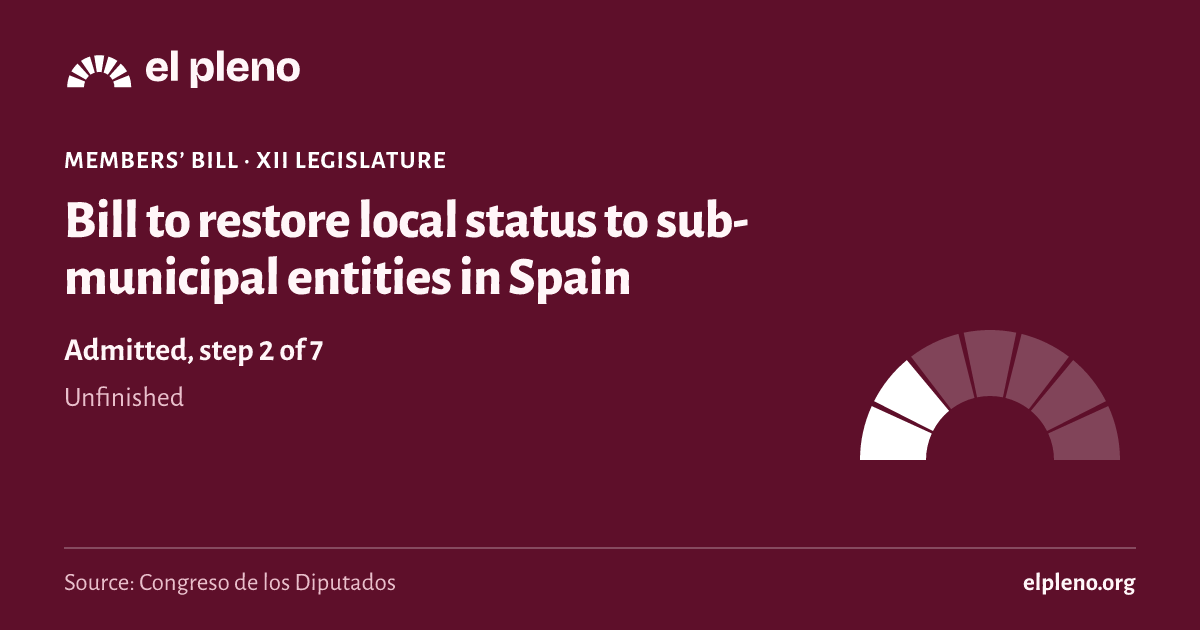
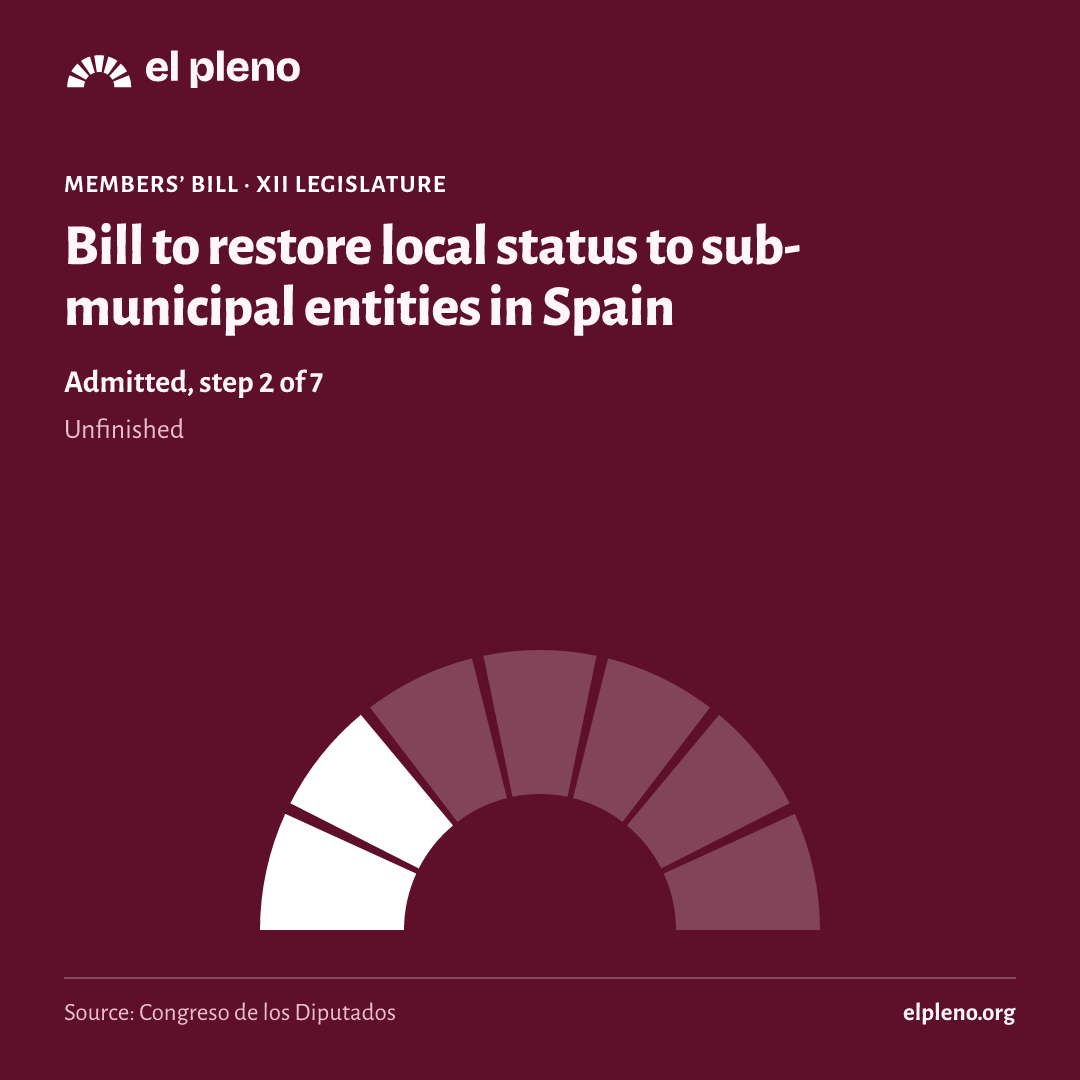
It took 2 of 7 steps. It reached Admitted, and today it is unfinished.
- Introduced8 November 2018Someone registers the text in the Congreso.
- Admitted13 November 2018The Bureau of the Congreso accepts it and, for a members’ bill, the plenary decides whether to consider it.
- Amendmentsnot reachedGroups propose changes.
- Committeenot reachedA committee goes through the text in detail.
- Plenarynot reachedAll 350 deputies vote.
- Senatenot reachedThe Senate can pass it, amend it or veto it.
- BOEnot reachedIt is published in the Official State Gazette (BOE) and comes into force.
See the 6 official steps on a timeline
Was there a plenary vote?
We have no plenary vote linked to this law in the Congreso’s data.
What happens next
What happens now?
The legislature ended before it finished. To go on, someone would have to introduce it again in the new Cortes.
It has not been presented again yet.
Sources
Where does all this come from?
- Congreso de los Diputados, file 122/000305
Official title, type, author, dates and stage.
Retrieved 11 November 2026
- The data comes from the open files of the Congreso, the Senate and the BOE, unaltered.
- Each deputy’s province is the one of their seat on the day of the vote.
- We only say “passed” or “rejected” when the majority needed is certain; otherwise we say which side had more votes.