What it is
Bill to make top Spanish public administration jobs professional, filled by open competition
It is a members’ bill. Introduced by parliamentary groups, the Senate, regional governments or citizens. It was introduced on 11 October 2018. Introduced by: Grupo Parlamentario Ciudadanos.
Official title: Private member's bill on the professionalization of senior management in Public Administrations.
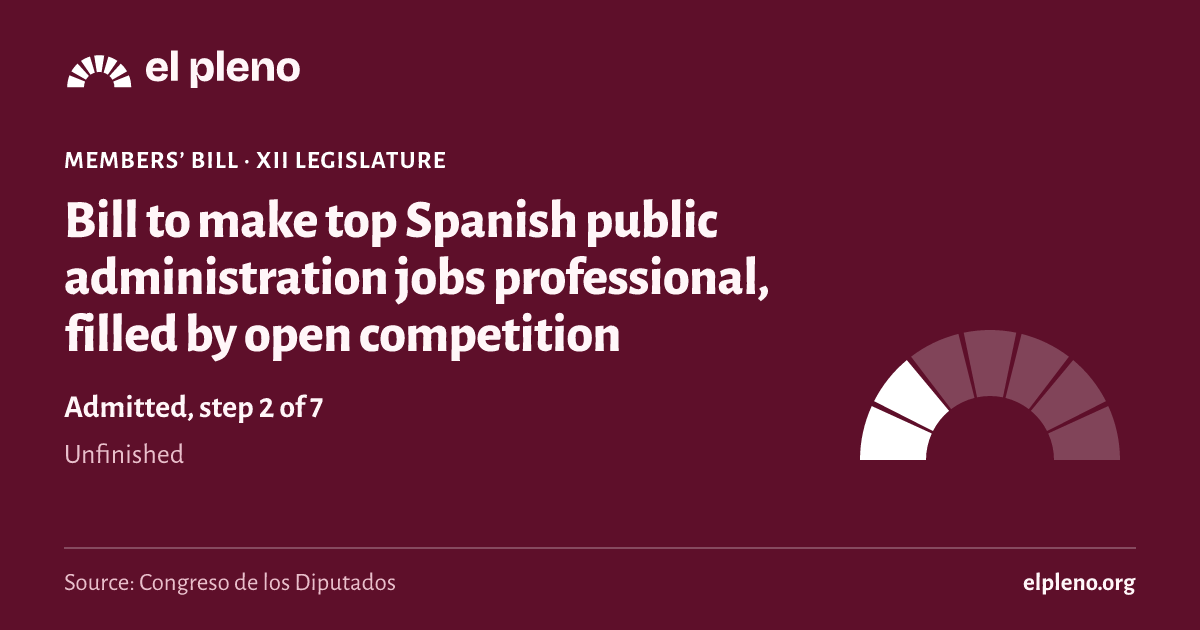
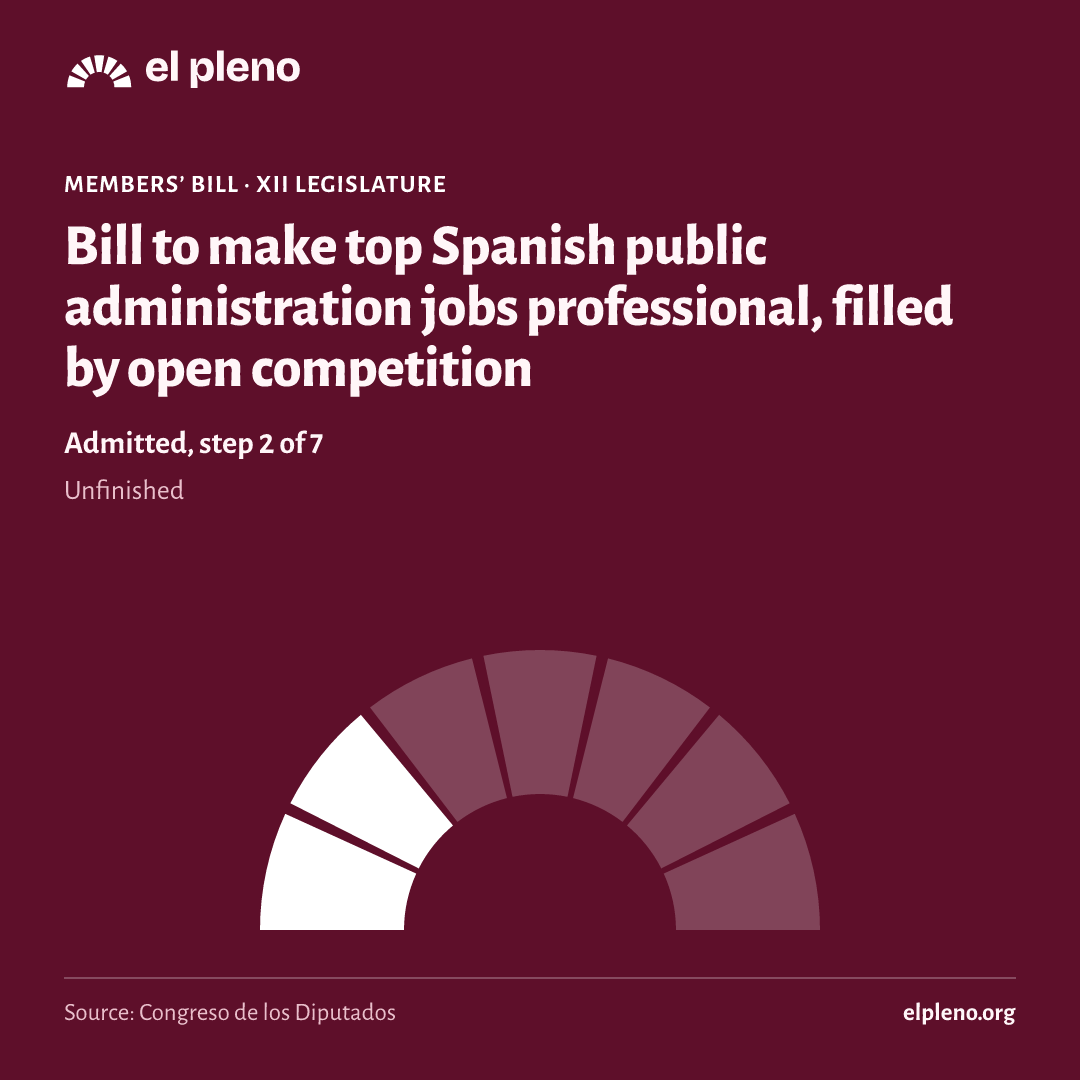
Source: Congreso de los Diputados, file 122/000289· updated 11 Nov
Automatic summary, not yet reviewed
- The bill would split senior management into two groups: 'altos cargos', political positions filled by free appointment, and 'altos directivos', professional managers chosen through an open, competitive process, preferably among career civil servants.
- Appointees would need to be suitable: honest, professionally competent and experienced. They must sign a declaration of compliance and submit their résumé, and the future Independent Public Integrity Authority would check suitability; a negative ruling would block them from taking office.
- The bill sets rules against conflicts of interest: exclusive dedication to the post, recusal from matters affecting personal or family interests, limits on holding shares in companies contracting with the public sector (a 10 percent capital cap), and a duty to declare activities and assets within three months of taking office.
- After leaving office, for two years they could not work in or for companies affected by their decisions, or sign contracts with the administration they served if related to their duties. In return, they could receive financial compensation during that period.
- It would create the Independent Public Integrity Authority, led by a president elected by the Congress of Deputies (Congreso de los Diputados) by a two-thirds majority for a single six-year term. It would enforce the rules, keep the activity and asset registries, and review officials' wealth at the end of their term.
- The bill provides sanctions: very serious violations could mean removal from office and a ban from holding a senior management post for five to ten years. It would also require congressional hearings for candidates to certain posts and ban 'Personal eventual Trusted staff freely appointed to advise or support an official, without a permanent position.' (political patronage) staff as advisers to professional managers.
Who it affects
- Senior officials of the state administration: They would have to prove suitability, declare activities and assets, and follow conflict-of-interest and post-employment rules.
- Career civil servants: They could reach senior management posts (deputy secretaries, directors general and similar) through open competition, previously reserved for political appointment.
- Companies contracting with the public sector or receiving subsidies: They could not have senior officials among significant shareholders, and firms hiring violating former officials risk fines and contract nullity.
- Local governments and the state public sector: Their management posts would go to professionals chosen by competition, with changes to the local government and public sector laws.
Words worth knowing
- Alto cargo
- A senior public administration post of a political nature, filled by free government appointment.
- Alto directivo
- A senior public administration post of a professional nature, filled through a merit-based competition.
- Concurso
- A selection process where candidates are chosen based on published merits, not free choice.
- Conflicto de intereses
- A situation where an official's personal interest could improperly influence their public decisions.
- Personal eventual
- Trusted staff freely appointed to advise or support an official, without a permanent position.
It summarizes the text as it was introduced. It is written by artificial intelligence and may contain mistakes: the official text is what counts. Read the official text · How we make summaries
Where it stands
How far did it get?
It took 2 of 7 steps. It reached Admitted, and today it is unfinished.
- Introduced11 October 2018Someone registers the text in the Congreso.
- Admitted16 October 2018The Bureau of the Congreso accepts it and, for a members’ bill, the plenary decides whether to consider it.
- Amendmentsnot reachedGroups propose changes.
- Committeenot reachedA committee goes through the text in detail.
- Plenarynot reachedAll 350 deputies vote.
- Senatenot reachedThe Senate can pass it, amend it or veto it.
- BOEnot reachedIt is published in the Official State Gazette (BOE) and comes into force.
See the 6 official steps on a timeline
Was there a plenary vote?
We have no plenary vote linked to this law in the Congreso’s data.
What happens next
What happens now?
The legislature ended before it finished. To go on, someone would have to introduce it again in the new Cortes.
It has not been presented again yet.
Sources
Where does all this come from?
- Congreso de los Diputados, file 122/000289
Official title, type, author, dates and stage.
Retrieved 11 November 2026
- The data comes from the open files of the Congreso, the Senate and the BOE, unaltered.
- Each deputy’s province is the one of their seat on the day of the vote.
- We only say “passed” or “rejected” when the majority needed is certain; otherwise we say which side had more votes.