What it is
Bill to improve pensions and restore retirement at age 65
It is a members’ bill. Introduced by parliamentary groups, the Senate, regional governments or citizens. It was introduced on 27 April 2018. Introduced by: Grupo Parlamentario Confederal de Unidos Podemos-En Comú Podem-En Marea.
Official title: Private member's bill on pension reform and other social order measures.
Source: Congreso de los Diputados, file 122/000228· updated 11 Nov
Automatic summary, not yet reviewed
- The bill would set the ordinary retirement age back at 65, undoing the gradual increase to 67 introduced by the 2011 law. It would also allow retirement from age 61 if the worker reaches 100 percent of the base for calculating the pension without needing minimum-income top-ups.
- Early retirement would be eased: involuntary job-loss retirement would require 30 years of contributions and voluntary early retirement 33, and in both cases the pension would only be cut by 0.5 percent per month short of the legal age, instead of today's harsher coefficients.
- The pension base would be calculated over 20 years of contributions (240 months), and for the first time each worker could choose their best contribution months over their whole working life, not necessarily the last ones. Months without contributions would be filled in at the minimum base.
- The child supplement in contributory pensions would be reformed: 5 percent of the pension per child, up to a maximum of 15 percent, and 10 percent per child for single-parent families or children with a disability of 65 percent or more. Up to 6 years of credited contributions per child would also count toward the minimum contribution period.
- The bill would abolish the sustainability factor, which cuts pensions based on life expectancy, and restore annual pension increases tied to the forecast consumer price index, with a one-time payment of the difference if actual inflation is higher.
- The unemployment benefit for people over 52 would return to that age (currently 55 is required), and its amount would rise to 75 percent of the minimum wage, up to 133 percent with three or more dependents, instead of being based on the IPREM Indicador Público de Renta de Efectos Múltiples: an annual income reference used in Spain to set benefits and subsidies. index.
- Social Security funding would be reformed: State contributions would be permanently set in the national budgets and would cover any deficit when contributions fall short, to avoid cutting benefits.
- To fight fraud in part-time work, the bill would require daily working-time records, eliminate voluntary additional hours, and toughen company penalties, while strengthening labor inspection in hospitality and retail.
Who it affects
- Workers over 50: They could retire earlier (at 65, or 61 with a full pension) and with higher pensions, by choosing their best contribution years.
- Working women: A better child supplement and credited contribution periods, aimed at correcting shorter and more broken working careers.
- Unemployed people over 52: They could access the benefit again from age 52 and at a higher amount tied to the minimum wage.
- Companies, especially those using part-time contracts: New working-time record duties, limits on additional hours, and tougher penalties for violations.
- Recipients of non-contributory or very low pensions: Their non-contributory pensions would be at least equal to the IPREM index, and income would be counted individually.
Words worth knowing
- Base reguladora
- The amount used to calculate the pension, drawn from the contribution bases (what was paid in on your wages) over a set period.
- Factor de sostenibilidad (sustainability factor)
- A mechanism that reduces the initial pension amount when life expectancy rises, to contain spending.
- Coeficiente reductor (reduction coefficient)
- The percentage deducted from the pension when someone retires before the legal age.
- IPREM
- Indicador Público de Renta de Efectos Múltiples: an annual income reference used in Spain to set benefits and subsidies.
- Complemento para mínimos (minimum top-up)
- Money Social Security adds to a contributory pension when it falls below the minimum amount set.
It summarizes the text as it was introduced. It is written by artificial intelligence and may contain mistakes: the official text is what counts. Read the official text · How we make summaries
Where it stands
How far did it get?
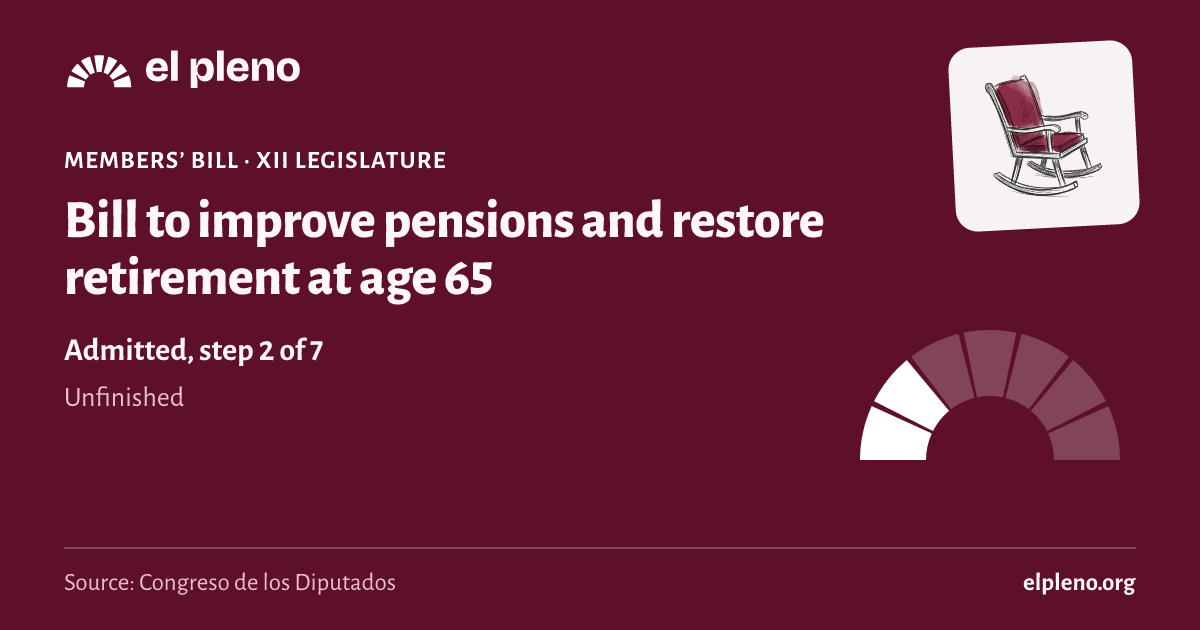
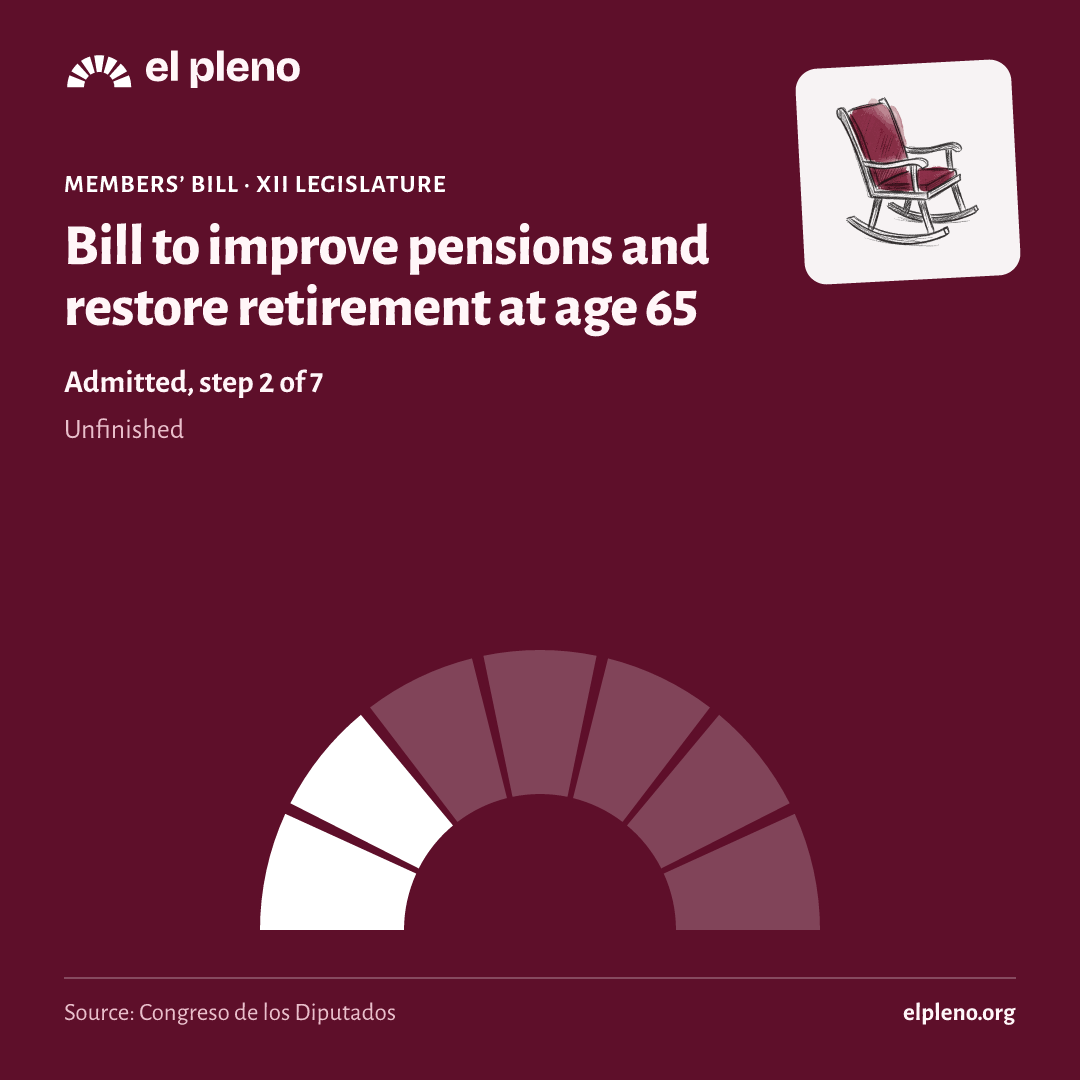
It took 2 of 7 steps. It reached Admitted, and today it is unfinished.
- Introduced27 April 2018Someone registers the text in the Congreso.
- Admitted3 May 2018The Bureau of the Congreso accepts it and, for a members’ bill, the plenary decides whether to consider it.
- Amendmentsnot reachedGroups propose changes.
- Committeenot reachedA committee goes through the text in detail.
- Plenarynot reachedAll 350 deputies vote.
- Senatenot reachedThe Senate can pass it, amend it or veto it.
- BOEnot reachedIt is published in the Official State Gazette (BOE) and comes into force.
See the 6 official steps on a timeline
Was there a plenary vote?
We have no plenary vote linked to this law in the Congreso’s data.
What happens next
What happens now?
The legislature ended before it finished. To go on, someone would have to introduce it again in the new Cortes.
It has not been presented again yet.
Sources
Where does all this come from?
- Congreso de los Diputados, file 122/000228
Official title, type, author, dates and stage.
Retrieved 11 November 2026
- The data comes from the open files of the Congreso, the Senate and the BOE, unaltered.
- Each deputy’s province is the one of their seat on the day of the vote.
- We only say “passed” or “rejected” when the majority needed is certain; otherwise we say which side had more votes.