What it is
Proposal to strengthen collective bargaining and limit pay cuts
It is a members’ bill. Introduced by parliamentary groups, the Senate, regional governments or citizens. It was introduced on 27 April 2018. Introduced by: Grupo Parlamentario Confederal de Unidos Podemos-En Comú Podem-En Marea.
Official title: Private member's bill to amend Royal Legislative Decree 2/2015, of October 23, approving the consolidated text of the Workers' Statute, to strengthen collective bargaining in the regulation of labor relations.
Source: Congreso de los Diputados, file 122/000225· updated 11 Nov
Automatic summary, not yet reviewed
- The bill, introduced by Unidos Podemos in 2018, aims to strengthen collective bargaining, which the text says was weakened by the 2011 and 2012 labor reforms.
- It limits opting out of collective agreements: companies could only stop applying agreed pay terms for serious economic reasons, after a consultation period and a worker vote, and for at most three years.
- It restores the priority of sector-wide agreements over company-level ones on key matters such as pay, maximum working hours and work-life balance, and brings back 'ultraactivity': the agreement stays in force while a new one is negotiated.
- It tightens the rules for substantial changes to working conditions: companies must prove the reasons, hold a consultation period of at least 20 days, and pay compensation if a court finds the change unjustified.
- Companies would have to record each worker's daily working hours, with access for the worker, their representatives and the Labor Inspectorate. If the company skips the legal procedure, the deadline to sue becomes one year.
- The law would take effect the day after its publication in the Official State Gazette, except for measures with budget costs, which would take effect the following fiscal year.
Who it affects
- Workers, especially in small and medium-sized companies: Would be better protected against pay cuts and imposed changes to their working conditions.
- Companies: Would face more limits on opting out of agreements or changing conditions unilaterally, plus new time-recording and compensation duties.
- Unions and workers' representatives: Would regain weight against company-level agreements, and their agreements would stay in force during negotiations.
Words worth knowing
- Descuelgue
- When a company stops applying what was agreed in a collective agreement.
- Convenio colectivo
- Collective agreement between unions and employers setting working conditions for a sector or company.
- Ultraactividad
- The agreement stays in force after its end date, until a new one is signed.
- Modificación sustancial de condiciones de trabajo
- A major change imposed by the company on matters such as schedules, shifts or pay.
It summarizes the text as it was introduced. It is written by artificial intelligence and may contain mistakes: the official text is what counts. Read the official text · How we make summaries
Where it stands
How far did it get?
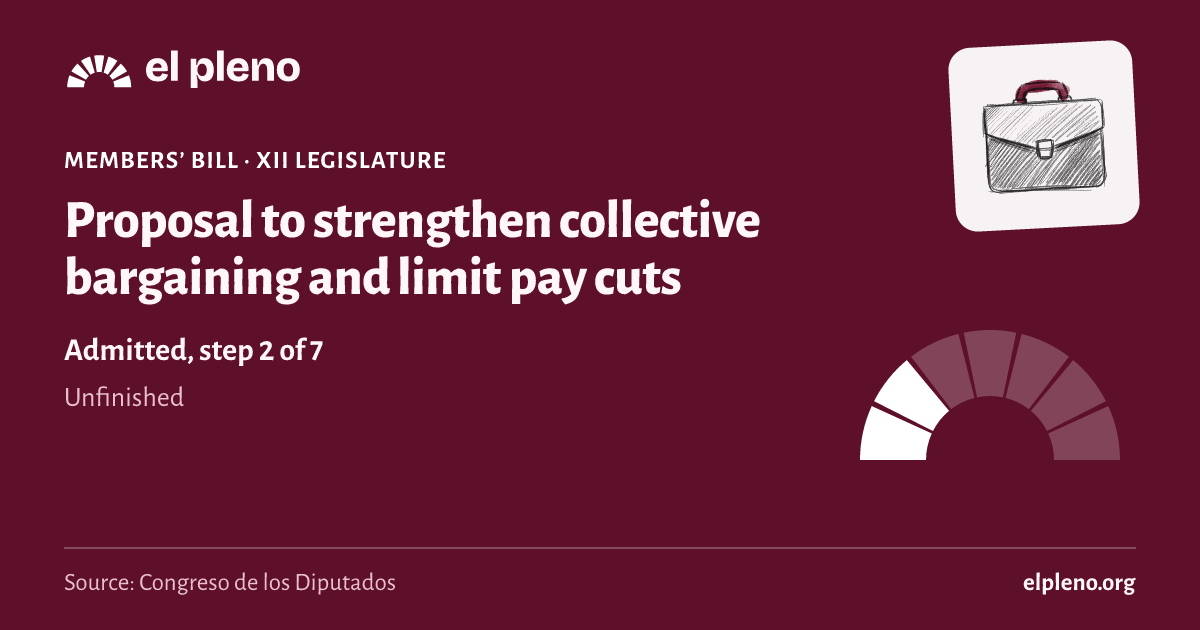
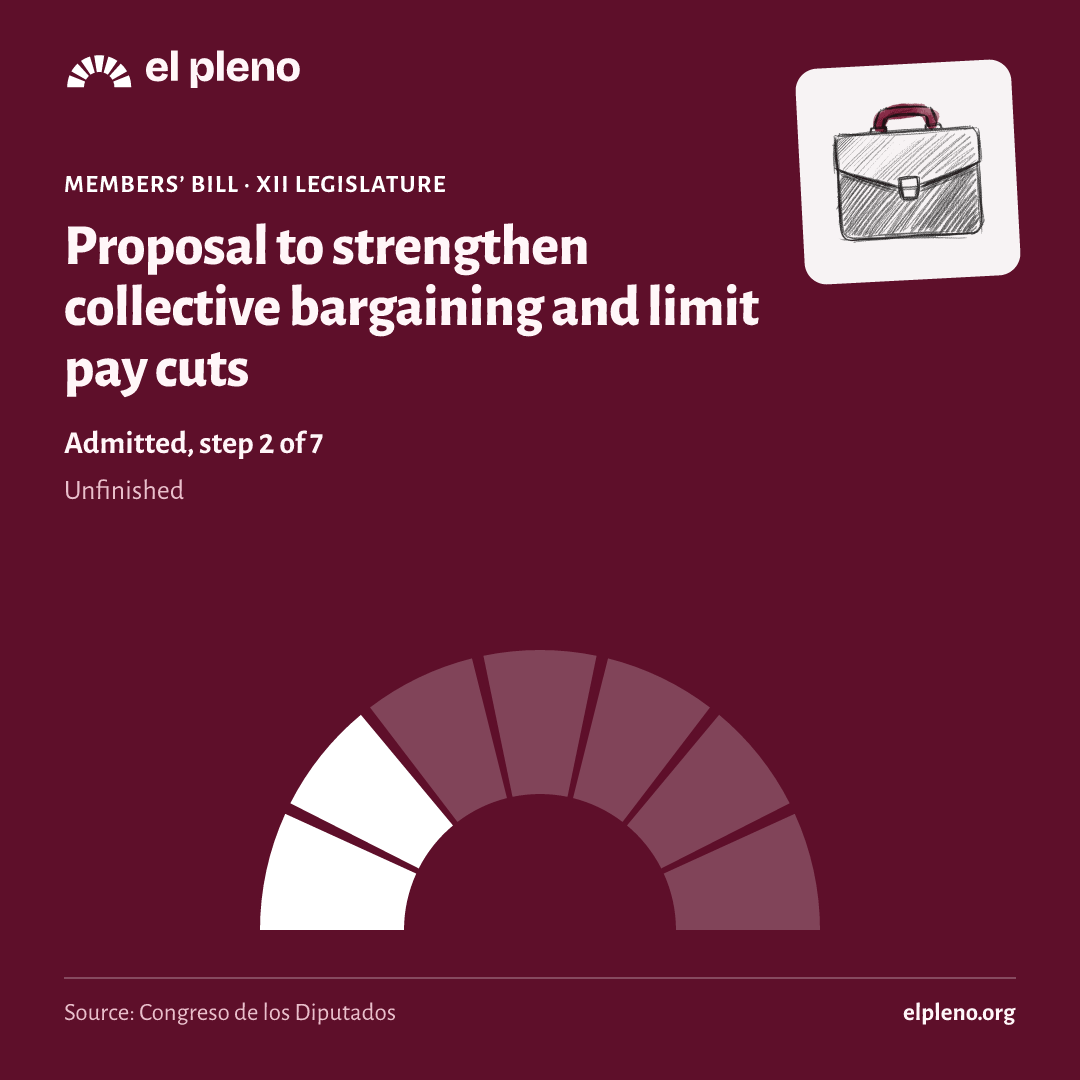
It took 2 of 7 steps. It reached Admitted, and today it is unfinished.
- Introduced27 April 2018Someone registers the text in the Congreso.
- Admitted3 May 2018The Bureau of the Congreso accepts it and, for a members’ bill, the plenary decides whether to consider it.
- Amendmentsnot reachedGroups propose changes.
- Committeenot reachedA committee goes through the text in detail.
- Plenarynot reachedAll 350 deputies vote.
- Senatenot reachedThe Senate can pass it, amend it or veto it.
- BOEnot reachedIt is published in the Official State Gazette (BOE) and comes into force.
See the 6 official steps on a timeline
Was there a plenary vote?
We have no plenary vote linked to this law in the Congreso’s data.
What happens next
What happens now?
The legislature ended before it finished. To go on, someone would have to introduce it again in the new Cortes.
It has not been presented again yet.
Sources
Where does all this come from?
- Congreso de los Diputados, file 122/000225
Official title, type, author, dates and stage.
Retrieved 11 November 2026
- The data comes from the open files of the Congreso, the Senate and the BOE, unaltered.
- Each deputy’s province is the one of their seat on the day of the vote.
- We only say “passed” or “rejected” when the majority needed is certain; otherwise we say which side had more votes.