What it is
Bill to make pay equal for women and men doing equal work
It is a members’ bill. Introduced by parliamentary groups, the Senate, regional governments or citizens. It was introduced on 20 February 2018. Introduced by: Grupo Parlamentario Socialista.
Official title: Private member's bill to guarantee equal treatment and equal opportunities between women and men in remuneration matters.
Source: Congreso de los Diputados, file 122/000184· updated 11 Nov
Automatic summary, not yet reviewed
- The bill starts from the fact that a pay gap between women and men exists, and that part of it may come from direct or indirect discrimination based on sex. For that reason, it argues specific legal measures on pay are needed.
- The bill would require companies to pay the same for equal work or work of equal value, with no discrimination based on sex. It would also require a pay register broken down by sex, which workers could access.
- If in a company with at least 25 workers the pay of one sex exceeds the other's by 25 percent or more, pay discrimination would be presumed unless the company proves otherwise. Failing to keep the pay register or to inform about it would be a serious offense, with fines based on the company's total payroll.
- Pay audits would become part of the equality plans that companies with more than 250 workers must prepare. Not preparing or not applying the plan, including the audit, would be a very serious offense.
- In public employment, the right to the same pay for work of equal value would be recognized. It would also strengthen leave and special unpaid status for female civil servants who are victims of gender violence Violence a woman suffers from a current or former partner because she is a woman., and public administrations would have to prepare equality plans.
- Capital companies would have to avoid sex discrimination in directors' pay and break down pay by sex in their annual report. Cooperatives would have to pay equally for equal work or work of equal value, and worker-owned companies would have to promote pay equality.
Words worth knowing
- Brecha salarial (pay gap)
- The difference between the average earnings of women and men, expressed as a percentage of men's average pay.
- Discriminación indirecta (indirect discrimination)
- A seemingly neutral rule or practice that in practice disadvantages one sex more than the other.
- Trabajo de igual valor (work of equal value)
- Different jobs that require equivalent effort, training, responsibility or conditions, and should therefore be paid the same.
- Plan de igualdad (equality plan)
- A set of measures a company adopts to remove obstacles to equality between women and men at work.
- Auditoría salarial (pay audit)
- An analysis of a company's pay to check whether there are unjustified differences between women and men.
- gender violence
- Violence a woman suffers from a current or former partner because she is a woman.
It summarizes the text as it was introduced. It is written by artificial intelligence and may contain mistakes: the official text is what counts. Read the official text · How we make summaries
Where it stands
How far did it get?
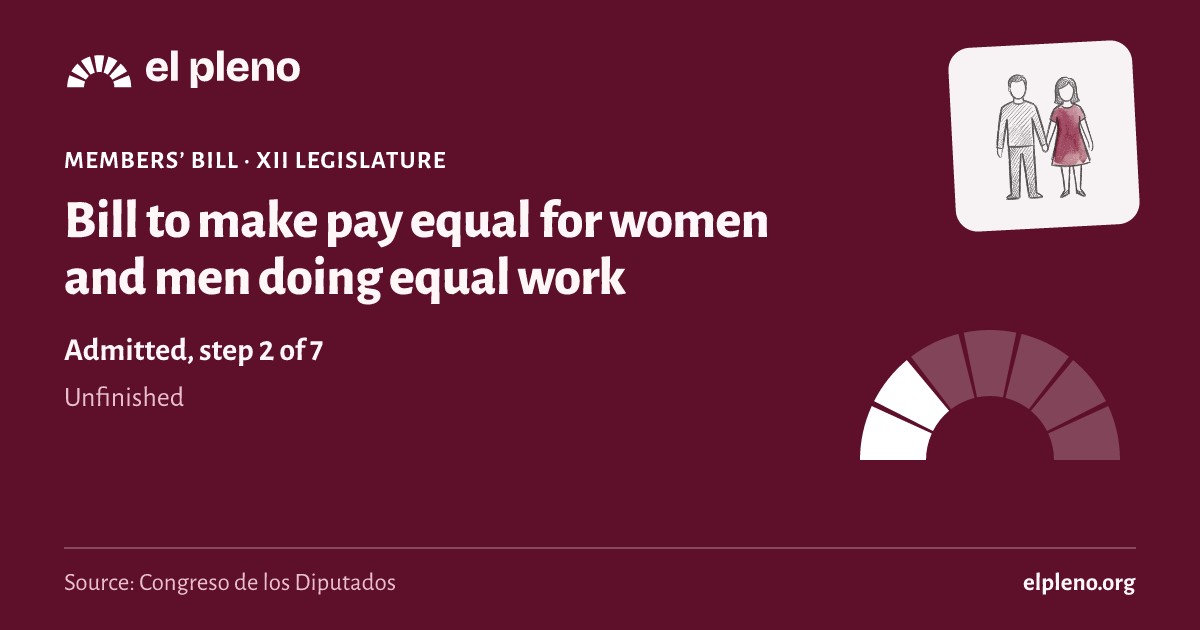
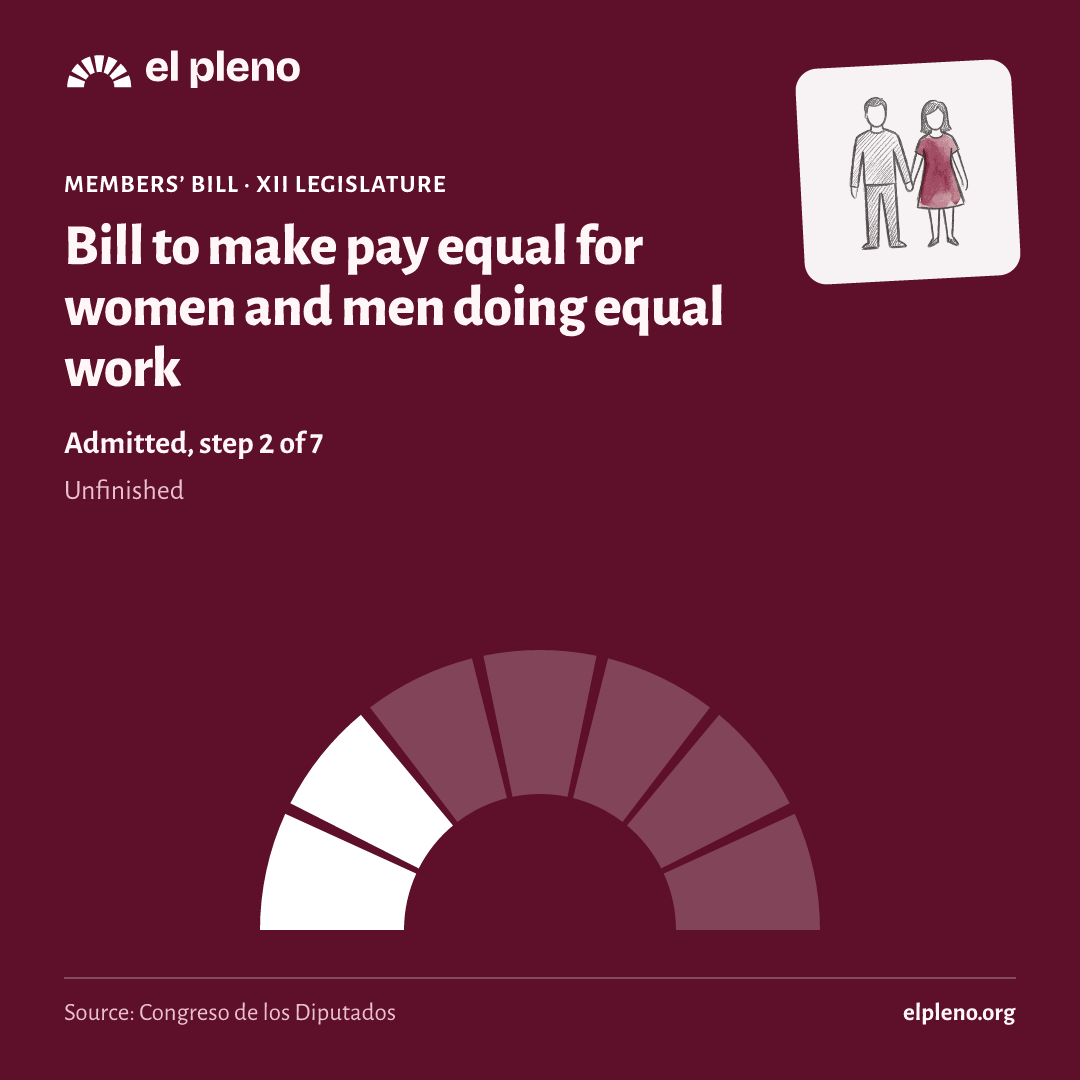
It took 2 of 7 steps. It reached Admitted, and today it is unfinished.
- Introduced20 February 2018Someone registers the text in the Congreso.
- Admitted27 February 2018The Bureau of the Congreso accepts it and, for a members’ bill, the plenary decides whether to consider it.
- Amendmentsnot reachedGroups propose changes.
- Committeenot reachedA committee goes through the text in detail.
- Plenarynot reachedAll 350 deputies vote.
- Senatenot reachedThe Senate can pass it, amend it or veto it.
- BOEnot reachedIt is published in the Official State Gazette (BOE) and comes into force.
See the 6 official steps on a timeline
Was there a plenary vote?
We have no plenary vote linked to this law in the Congreso’s data.
What happens next
What happens now?
The legislature ended before it finished. To go on, someone would have to introduce it again in the new Cortes.
It has not been presented again yet.
Sources
Where does all this come from?
- Congreso de los Diputados, file 122/000184
Official title, type, author, dates and stage.
Retrieved 11 November 2026
- The data comes from the open files of the Congreso, the Senate and the BOE, unaltered.
- Each deputy’s province is the one of their seat on the day of the vote.
- We only say “passed” or “rejected” when the majority needed is certain; otherwise we say which side had more votes.