What it is
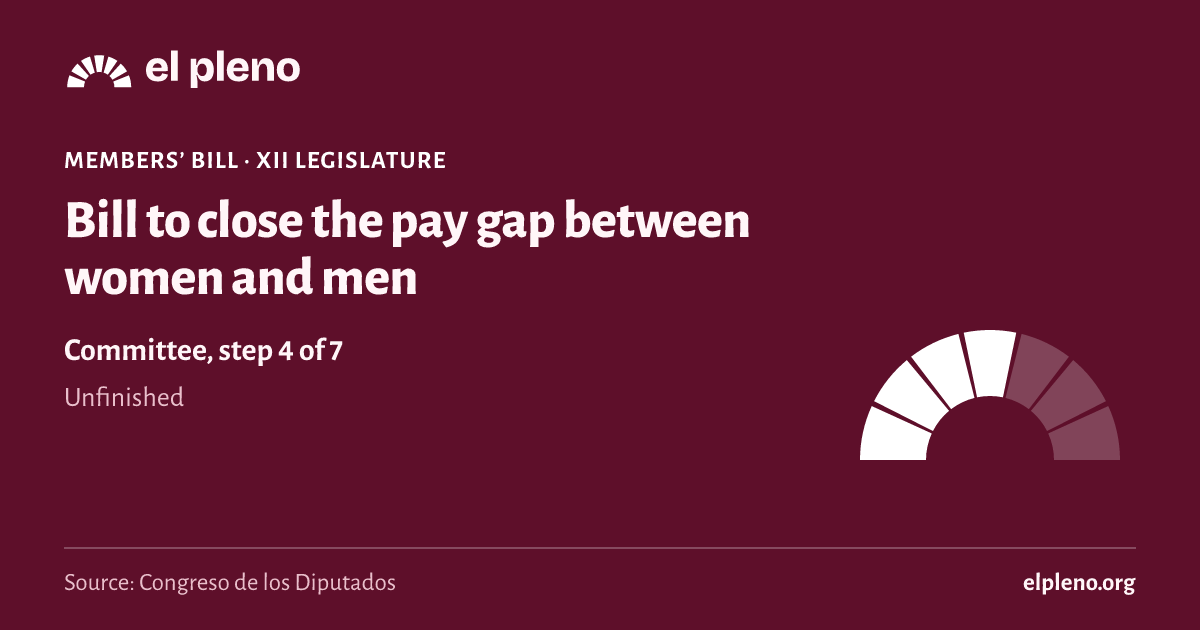
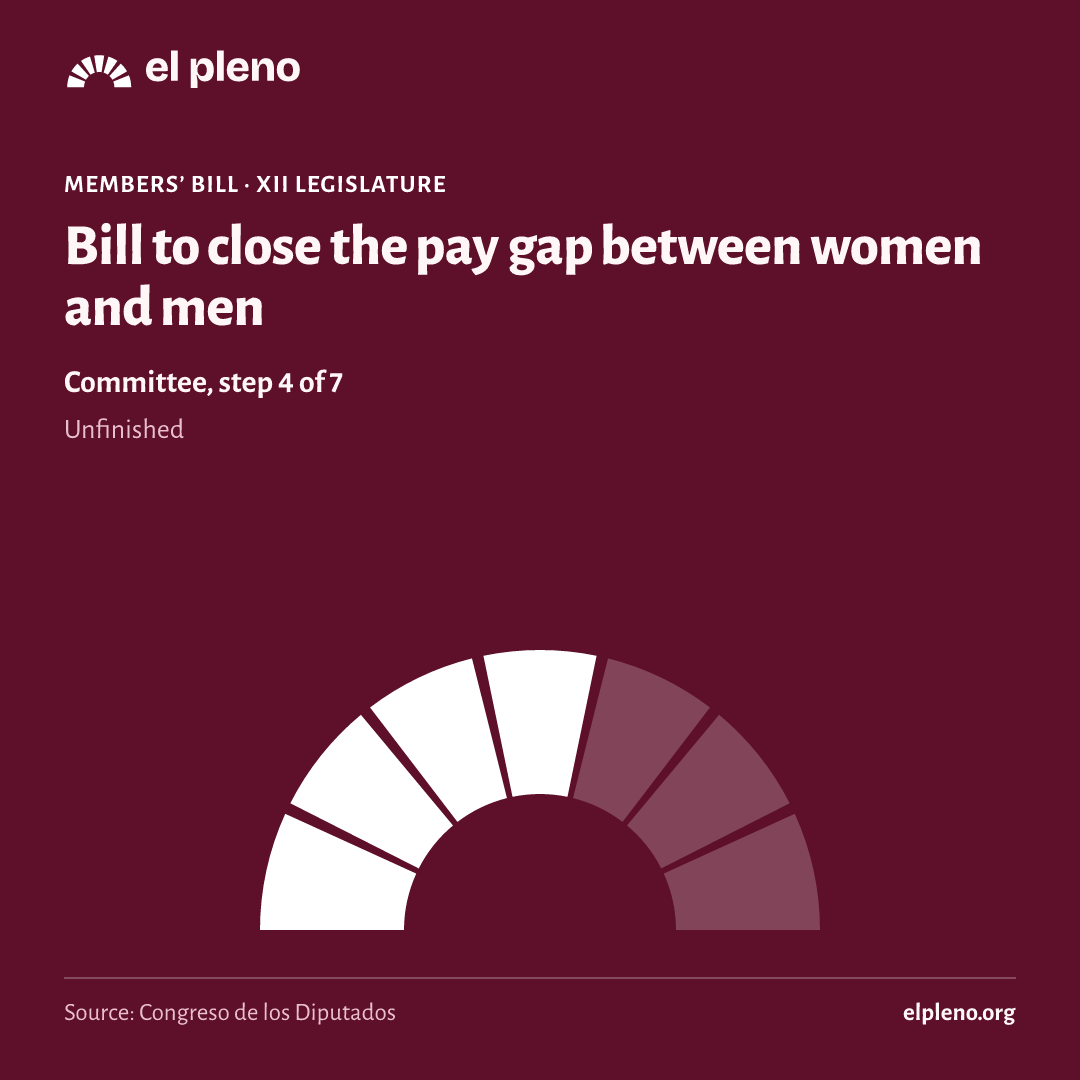
Bill to close the pay gap between women and men
It is a members’ bill. Introduced by parliamentary groups, the Senate, regional governments or citizens. It was introduced on 24 October 2017. Introduced by: Grupo Parlamentario Confederal de Unidos Podemos-En Comú Podem-En Marea.
Official title: Private member's bill on equal pay between women and men.
Source: Congreso de los Diputados, file 122/000138· updated 11 Nov
Automatic summary, not yet reviewed
- The bill aims to tackle the gender pay gap, which according to the figures it cites stands at around 17.3% in Spain. It is presented as a pioneering law within the European Union.
- It rewrites the Workers' Statute to strengthen pay equality. If in a company with 25 or more workers the average pay of one sex is more than 20 percentage points higher than the other's, discrimination is presumed unless the company proves otherwise.
- Companies with worker representatives must include in every payslip the average pay information broken down by sex, and representatives will be entitled to receive it at least once a year. Large companies must also include pay audits in their equality plans.
- It improves the tools for going to court: proving discrimination becomes easier, the Women's Institute and statewide equality associations can challenge collective agreements and take part in proceedings, and judges will receive a mandatory prior report in indirect discrimination cases.
- The same rules apply to public employment: equal pay for work of equal value, a presumption of discrimination when gaps exceed 20 percentage points, and the right of public employees to receive pay information broken down by sex.
- It strengthens oversight and penalties: specialized equality units will be created in every Provincial Labor Inspectorate, and failing to deliver the payslip as required will become a serious offense.
- The bill provides for fully equalizing paternity and maternity leave, making it equal, non-transferable and fully paid, within a maximum of five years. It also creates an Interministerial Commission and a Directorate General for Pay Equality.
- The General Treasury of Social Security must develop software to detect pay inequalities from contribution data, notify companies with gaps above 20%, and send workers annual data. The Government will have one year to issue the implementing regulations.
Who it affects
- Workers, who will be able to know their company's average pay and file claims if they suspect discrimination.: Right to information and to file claims
- Companies, especially those with 25 or more workers, which must be transparent about pay and justify differences.: New obligations
- Worker representatives and unions, who will receive pay data broken down by sex and can help push claims forward.: More information and standing
- Public employees and public administrations, subject to the same pay equality and transparency rules.: Pay equality in the public sector
- The Women's Institute, Labor Inspectorate and equality bodies, with new duties of oversight, reporting and support for claims.: Stronger institutions
Words worth knowing
- Brecha salarial (gender pay gap)
- The average difference between what men and women earn per hour.
- Discriminación indirecta (indirect discrimination)
- A rule or practice that looks neutral but disadvantages one sex more than the other.
- Auditoría salarial (pay audit)
- An analysis of a company's wages to detect and correct differences between men and women.
- Trabajo de igual valor (work of equal value)
- Different jobs that require the same effort, qualifications or responsibility, and must be paid the same.
- Convenio colectivo (collective agreement)
- An agreement setting working conditions for a sector or company.
It summarizes the text as it was introduced. It is written by artificial intelligence and may contain mistakes: the official text is what counts. Read the official text · How we make summaries
Where it stands
How far did it get?
It took 4 of 7 steps. It reached Committee, and today it is unfinished.
- Introduced24 October 2017Someone registers the text in the Congreso.
- Admitted6 November 2017The Bureau of the Congreso accepts it and, for a members’ bill, the plenary decides whether to consider it.
- Amendments2 March 2018Groups propose changes.
- Committee28 November 2018A committee goes through the text in detail.
- Plenarynot reachedAll 350 deputies vote.
- Senatenot reachedThe Senate can pass it, amend it or veto it.
- BOEnot reachedIt is published in the Official State Gazette (BOE) and comes into force.
See the 11 official steps on a timeline
22 February 2018
How did the plenary vote?
Voted on: Private Member's Bill by the Confederal Parliamentary Group of Unidos Podemos-En Comú Podem-En Marea, on equal pay between women and men.
Source: Congreso de los Diputados, vote 1 of sitting 102· updated 10 Nov
Each dot is a seat. Tap one, or use the arrow keys, to see who it is.
Your province
How did the deputies from your province vote?
And your senators: the Senate does not link its votes to this law in its open data, so we cannot put them side by side here.
Or see how most of each province voted
- A Coruña More votes in favour 4 yes · 0 no · 4 abst.
- Albacete More votes in favour 2 yes · 0 no · 2 abst.
- Alicante/Alacant More votes in favour 6 yes · 0 no · 5 abst.
- Almería More votes in favour 3 yes · 0 no · 2 abst.
- Araba/Álava More votes in favour 3 yes · 0 no
- Asturias More votes in favour 6 yes · 0 no · 2 abst.
- Ávila More votes in favour 1 yes · 0 no · 2 abst.
- Badajoz More votes in favour 2 yes · 0 no · 3 abst.
- Barcelona More votes in favour 27 yes · 0 no · 4 abst.
- Bizkaia More votes in favour 7 yes · 0 no · 1 abst.
- Burgos More votes in favour 2 yes · 0 no · 2 abst.
- Cáceres More votes in favour 1 yes · 0 no · 2 abst.
- Cádiz More votes in favour 6 yes · 0 no · 3 abst.
- Cantabria More votes in favour 3 yes · 0 no · 2 abst.
- Castellón/Castelló More votes in favour 3 yes · 0 no · 2 abst.
- Ceuta Tie 0 yes · 0 no · 1 abst.
- Ciudad Real More votes in favour 2 yes · 0 no · 2 abst.
- Córdoba More votes in favour 4 yes · 0 no · 2 abst.
- Cuenca More votes in favour 1 yes · 0 no · 2 abst.
- Gipuzkoa More votes in favour 6 yes · 0 no
- Girona More votes in favour 5 yes · 0 no
- Granada More votes in favour 4 yes · 0 no · 3 abst.
- Guadalajara More votes in favour 1 yes · 0 no · 2 abst.
- Huelva More votes in favour 3 yes · 0 no · 2 abst.
- Huesca More votes in favour 2 yes · 0 no · 1 abst.
- Illes Balears More votes in favour 5 yes · 0 no · 3 abst.
- Jaén More votes in favour 2 yes · 0 no · 2 abst.
- La Rioja More votes in favour 2 yes · 0 no · 2 abst.
- Las Palmas More votes in favour 5 yes · 0 no · 3 abst.
- León More votes in favour 2 yes · 0 no · 2 abst.
- Lleida More votes in favour 3 yes · 0 no · 1 abst.
- Lugo More votes in favour 2 yes · 0 no · 2 abst.
- Madrid More votes in favour 21 yes · 0 no · 12 abst.
- Málaga More votes in favour 7 yes · 0 no · 4 abst.
- Melilla Tie 0 yes · 0 no · 1 abst.
- Murcia More votes in favour 5 yes · 0 no · 5 abst.
- Navarra More votes in favour 5 yes · 0 no
- Ourense More votes in favour 1 yes · 0 no · 3 abst.
- Palencia More votes in favour 1 yes · 0 no · 2 abst.
- Pontevedra More votes in favour 4 yes · 0 no · 3 abst.
- Salamanca More votes in favour 1 yes · 0 no · 3 abst.
- Santa Cruz de Tenerife More votes in favour 4 yes · 0 no · 3 abst.
- Segovia More votes in favour 1 yes · 0 no · 1 abst.
- Sevilla More votes in favour 8 yes · 0 no · 4 abst.
- Soria More votes in favour 1 yes · 0 no · 1 abst.
- Tarragona More votes in favour 5 yes · 0 no · 1 abst.
- Teruel More votes in favour 1 yes · 0 no · 2 abst.
- Toledo More votes in favour 3 yes · 0 no · 3 abst.
- Valencia/València More votes in favour 9 yes · 0 no · 6 abst.
- Valladolid More votes in favour 3 yes · 0 no · 2 abst.
- Zamora More votes in favour 1 yes · 0 no · 2 abst.
- Zaragoza More votes in favour 4 yes · 0 no · 3 abst.
More details: how each group and each province voted
The groups
Who voted in favour and who against?
In favour, most of Socialista, Vasco (EAJ-PNV), Mixto, Ciudadanos, Gcup-ec-em and GER.
By province: in 28 most voted in favour; in 0, against.
Coloured by how most of each province’s deputies voted.
- In favour: 28
- Against: 0
- Abstained: 12
- Tie: 12
| Group | Seats | How it voted |
|---|---|---|
| Socialista | 84 | 80 in favour · 4 did not vote |
| Vasco (EAJ-PNV) | 5 | 5 in favour |
| Mixto | 19 | 17 in favour · 2 did not vote |
| Ciudadanos | 32 | 32 in favour |
| Gcup-ec-em | 67 | 67 in favour |
| GER | 9 | 9 in favour |
| Popular en el Congreso | 134 | 127 abst. · 7 did not vote |
What happens next
What happens now?
The legislature ended before it finished. To go on, someone would have to introduce it again in the new Cortes.
It has not been presented again yet.
Sources
Where does all this come from?
- Congreso de los Diputados, file 122/000138
Official title, type, author, dates and stage.
Retrieved 11 November 2026
- Congreso de los Diputados, vote 1 of sitting 102
The count and every seat’s vote.
Retrieved 10 November 2026
- The data comes from the open files of the Congreso, the Senate and the BOE, unaltered.
- Each deputy’s province is the one of their seat on the day of the vote.
- We only say “passed” or “rejected” when the majority needed is certain; otherwise we say which side had more votes.