What it is
Bill would let city councils spend their surplus on public services
It is a members’ bill. Introduced by parliamentary groups, the Senate, regional governments or citizens. It was introduced on 6 October 2017. Introduced by: Grupo Parlamentario Confederal de Unidos Podemos-En Comú Podem-En Marea.
Official title: Organic Private member's bill on the modification of the criteria for the application of the expenditure rule.
Source: Congreso de los Diputados, file 122/000132· updated 11 Nov
Automatic summary, not yet reviewed
- The bill, introduced by Unidos Podemos and admitted for processing on October 10, 2017, proposes to change the spending rule of organic law A law on fundamental rights, the electoral system or other matters the Constitution reserves. It needs an absolute majority in the Congreso: 176 votes. 2/2012 so that Local Corporations that meet the principles of budgetary stability and financial sustainability can reinvest their fiscal surplus in the public services under their authority.
- The bill proposes that the spending rule would not apply to Local Corporations with a budget surplus or balance, debt below 110% of their current resources, and an average supplier payment period below 30 days.
- Several provisions of Organic Law 2/2012 would be repealed: section 5 of Article 12, the last paragraph of section 4 of Article 24, Articles 25 and 26, section 1 of Article 32, section 8 of the first additional provision, and the sixth final provision.
- Section 2 of the fourth additional provision would be amended so that a situation of risk of default on debt payments, as determined by the Government at the proposal of the Minister of Finance, is considered to seriously harm the general interest.
- The law would have basic character, issued under the State powers in sections 13 and 14 of Article 149.1 of the Constitution on general planning of economic activity and general Treasury and State Debt.
- The law would take effect the day after its publication in the Official State Gazette, except for measures that increase budget credits or reduce revenues for the current fiscal year, which would take effect in the next budget year.
Who it affects
- City councils and other Local Corporations: They could reinvest their surplus in public services if they meet stability, debt limits and payment deadlines.
- Central Administration and Autonomous Communities: The spending rule would still apply to them, with spending growth limited by the reference GDP growth rate.
- Central Government: It would keep the power to determine that risk of default on debt payments seriously harms the general interest.
Words worth knowing
- Regla de gasto (spending rule)
- A limit on how much government spending can grow each year, based on forecast GDP growth.
- Corporaciones Locales (Local Corporations)
- Local government entities, such as city councils and provincial councils.
- Estabilidad presupuestaria (budgetary stability)
- The duty not to spend more than you take in, that is, to keep a surplus or balanced budget.
- Sostenibilidad financiera (financial sustainability)
- A government's ability to carry its debt without payment problems.
- Remanente de tesorería (treasury remainder)
- Money left over in the accounts at the end of the fiscal year that can be used the following year.
- organic law
- A law on fundamental rights, the electoral system or other matters the Constitution reserves. It needs an absolute majority in the Congreso: 176 votes.
It summarizes the text as it was introduced. It is written by artificial intelligence and may contain mistakes: the official text is what counts. Read the official text · How we make summaries
Where it stands
How far did it get?
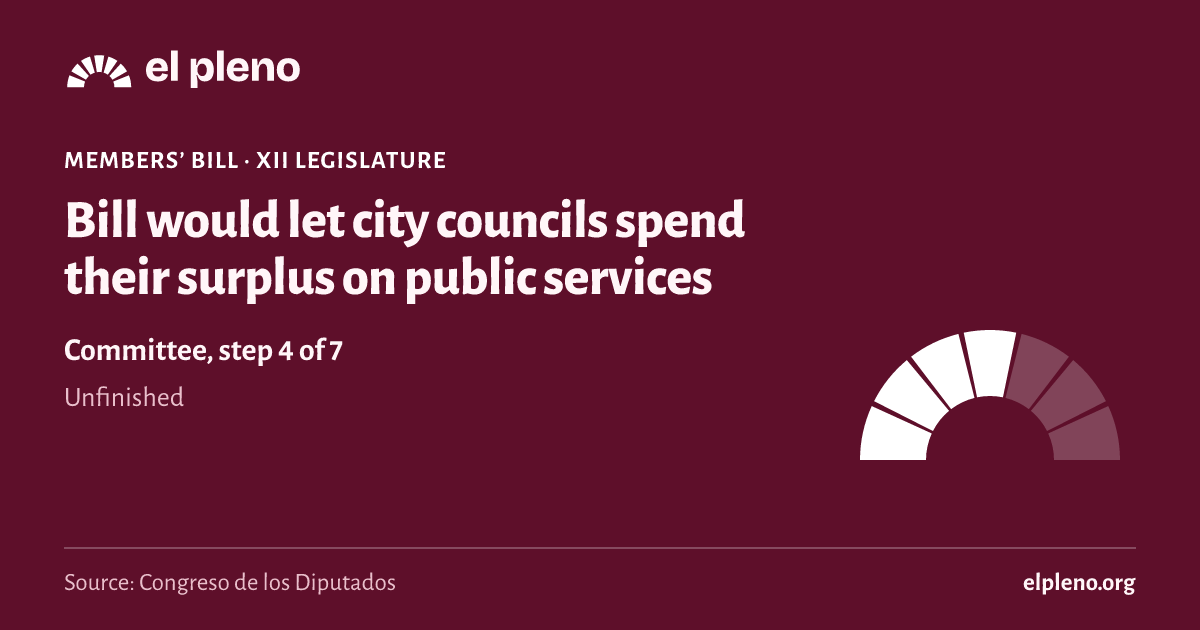
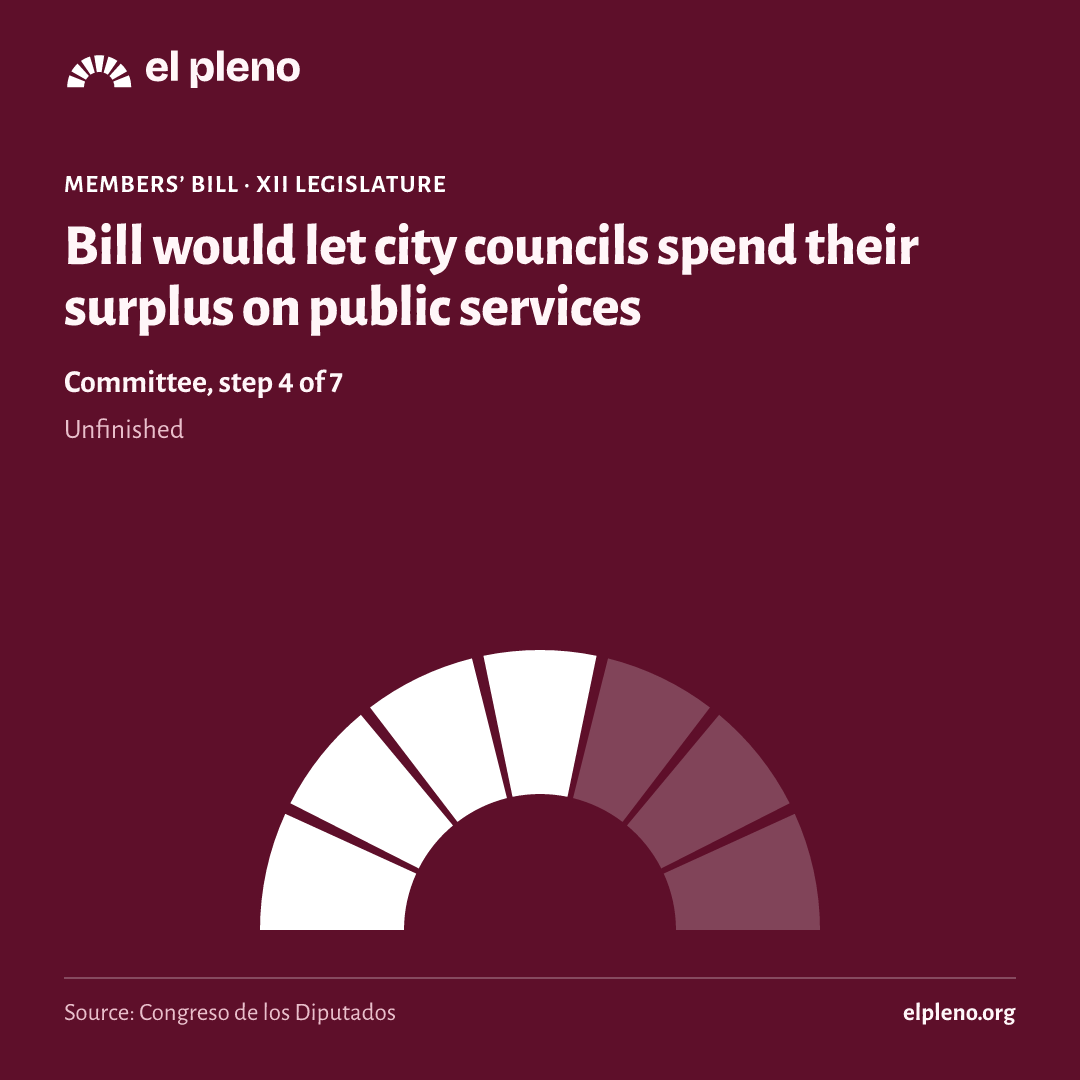
It took 4 of 7 steps. It reached Committee, and today it is unfinished.
- Introduced6 October 2017Someone registers the text in the Congreso.
- Admitted10 October 2017The Bureau of the Congreso accepts it and, for a members’ bill, the plenary decides whether to consider it.
- Amendments22 December 2017Groups propose changes.
- Committee2 November 2018A committee goes through the text in detail.
- Plenarynot reachedAll 350 deputies vote.
- Senatenot reachedThe Senate can pass it, amend it or veto it.
- BOEnot reachedIt is published in the Official State Gazette (BOE) and comes into force.
See the 12 official steps on a timeline
22 November 2018
How did the plenary vote?
Voted on: Amendment in the form of an alternative text to the Private member's bill for an Organic Law regarding the modification of the criteria for the application of the expenditure rule, submitted by the Popular Parliamentary Group in the Congress.
This law had 3 votes; this is the latest with every deputy’s vote. See them all
Source: Congreso de los Diputados, vote 16 of sitting 161· updated 10 Nov
Each dot is a seat. Tap one, or use the arrow keys, to see who it is.
Your province
How did the deputies from your province vote?
And your senators: the Senate does not link its votes to this law in its open data, so we cannot put them side by side here.
Or see how most of each province voted
- A Coruña Tie 4 yes · 4 no
- Albacete Tie 2 yes · 2 no
- Alicante/Alacant More votes in favour 7 yes · 5 no
- Almería More votes in favour 3 yes · 2 no
- Araba/Álava More votes against 1 yes · 2 no
- Asturias Tie 4 yes · 4 no
- Ávila More votes in favour 2 yes · 1 no
- Badajoz Tie 3 yes · 3 no
- Barcelona More votes against 8 yes · 22 no
- Bizkaia More votes against 1 yes · 7 no
- Burgos Tie 2 yes · 2 no
- Cáceres Tie 2 yes · 2 no
- Cádiz More votes against 4 yes · 5 no
- Cantabria More votes in favour 3 yes · 2 no
- Castellón/Castelló More votes in favour 3 yes · 2 no
- Ceuta More votes in favour 1 yes · 0 no
- Ciudad Real More votes in favour 3 yes · 2 no
- Córdoba Tie 3 yes · 3 no
- Cuenca More votes in favour 2 yes · 1 no
- Gipuzkoa More votes against 0 yes · 6 no
- Girona More votes against 0 yes · 5 no
- Granada More votes in favour 4 yes · 3 no
- Guadalajara More votes in favour 2 yes · 1 no
- Huelva More votes against 2 yes · 3 no
- Huesca More votes against 1 yes · 2 no
- Illes Balears Tie 4 yes · 4 no
- Jaén Tie 2 yes · 2 no
- La Rioja Tie 2 yes · 2 no
- Las Palmas More votes in favour 4 yes · 3 no
- León Tie 2 yes · 2 no
- Lleida More votes against 1 yes · 3 no
- Lugo Tie 2 yes · 2 no
- Madrid More votes in favour 21 yes · 15 no
- Málaga More votes in favour 6 yes · 5 no
- Melilla More votes in favour 1 yes · 0 no
- Murcia More votes in favour 7 yes · 3 no
- Navarra More votes against 2 yes · 3 no
- Ourense More votes in favour 3 yes · 1 no
- Palencia Tie 1 yes · 1 no
- Pontevedra More votes against 3 yes · 4 no
- Salamanca More votes in favour 3 yes · 1 no
- Santa Cruz de Tenerife More votes in favour 4 yes · 3 no
- Segovia More votes in favour 2 yes · 1 no
- Sevilla More votes against 4 yes · 7 no
- Soria Tie 1 yes · 1 no
- Tarragona More votes against 2 yes · 4 no
- Teruel More votes in favour 2 yes · 1 no
- Toledo Tie 3 yes · 3 no
- Valencia/València Tie 8 yes · 8 no
- Valladolid More votes in favour 3 yes · 2 no
- Zamora More votes in favour 2 yes · 1 no
- Zaragoza More votes in favour 4 yes · 2 no
More details: how each group and each province voted
The groups
Who voted in favour and who against?
In favour, most of Ciudadanos and Popular en el Congreso. Against, most of Socialista, Vasco (EAJ-PNV), Mixto, Gcup-ec-em and GER. 3 deputies voted differently from their group.
By province: in 23 most voted in favour; in 13, against.
Coloured by how most of each province’s deputies voted.
- In favour: 23
- Against: 13
- Tie: 16
| Group | Seats | How it voted |
|---|---|---|
| Socialista | 84 | 84 against |
| Vasco (EAJ-PNV) | 5 | 4 against · 1 did not vote |
| Mixto | 19 | 3 in favour · 13 against · 3 did not vote |
| Ciudadanos | 32 | 32 in favour |
| Gcup-ec-em | 67 | 65 against · 2 did not vote |
| GER | 9 | 9 against |
| Popular en el Congreso | 134 | 131 in favour · 3 did not vote |
What happens next
What happens now?
The legislature ended before it finished. To go on, someone would have to introduce it again in the new Cortes.
It has not been presented again yet.
Sources
Where does all this come from?
- Congreso de los Diputados, file 122/000132
Official title, type, author, dates and stage.
Retrieved 11 November 2026
- Congreso de los Diputados, vote 16 of sitting 161
The count and every seat’s vote.
Retrieved 10 November 2026
- The data comes from the open files of the Congreso, the Senate and the BOE, unaltered.
- Each deputy’s province is the one of their seat on the day of the vote.
- We only say “passed” or “rejected” when the majority needed is certain; otherwise we say which side had more votes.