What it is
Bill to protect everyone in Spain from discrimination
It is a members’ bill. Introduced by parliamentary groups, the Senate, regional governments or citizens. It was introduced on 28 February 2017. Introduced by: Grupo Parlamentario Socialista.
Official title: Private member's Comprehensive bill for equal treatment and non-discrimination.
Source: Congreso de los Diputados, file 122/000077· updated 11 Nov
Automatic summary, not yet reviewed
- The bill would guarantee everyone's right to equal treatment and non-discrimination, on grounds such as racial or ethnic origin, sex, age, disability, religion, sexual orientation or gender identity, illness or socioeconomic situation.
- The protection would cover many areas of life: employment, education, health care, social services, goods and services offered to the public, housing, places open to the public, sports, and advertising and the internet.
- The bill would define in detail the forms of discrimination: direct and indirect, by association, by error, multiple and intersectional, discriminatory harassment, retaliation and orders to discriminate. It would also regulate positive action measures.
- Victims would have the right to receive information, advice and free legal assistance before filing a complaint.
- The bill would create the Authority for Equal Treatment and Non-Discrimination, an independent body that would help victims, mediate disputes, investigate serious cases and could go to court.
- Anyone who discriminates could face fines from €300 to €500,000, depending on how serious the offense is. In very serious cases, additional penalties could apply, such as closing the establishment or stopping the activity.
- If a person claims discrimination and provides evidence, the accused party would have to give an objective and reasonable justification that their conduct was not discriminatory.
- The bill would create specialized sections for hate crimes in provincial prosecutor's offices and a Prosecutor against Hate Crimes and Discrimination at the State Prosecutor's Office.
Who it affects
- Anyone who suffers discrimination: They could receive information, free advice, help from the new Authority, and ask for compensation or for the discrimination to stop.
- Businesses and individuals selling goods or services, including housing rentals: They could not discriminate in access or conditions, and would risk fines from €300 to €500,000.
- Public administrations: They would have to guarantee equality in employment, education, health care, social services and housing, and cooperate with the new Authority.
- Human rights associations and organizations: They could defend affected people in court, with their authorization.
Words worth knowing
- Discriminación interseccional (intersectional discrimination)
- When several grounds of discrimination come together in the same person and create a specific form of discrimination.
- Ajustes razonables (reasonable accommodations)
- Necessary adaptations so that people with disabilities can exercise their rights on equal terms, as long as they do not impose a disproportionate burden.
- Medidas de acción positiva (positive action measures)
- Favorable treatment aimed at preventing or compensating a group's discrimination or disadvantage, while that situation lasts.
- Carga de la prueba (burden of proof)
- The duty to prove the facts you claim. The bill proposes that, if there is evidence of discrimination, the accused party must justify themselves.
- Legitimación (standing)
- The ability to go to court to defend a right.
It summarizes the drafting committee report. It is written by artificial intelligence and may contain mistakes: the official text is what counts. Read the official text · How we make summaries
Where it stands
How far did it get?
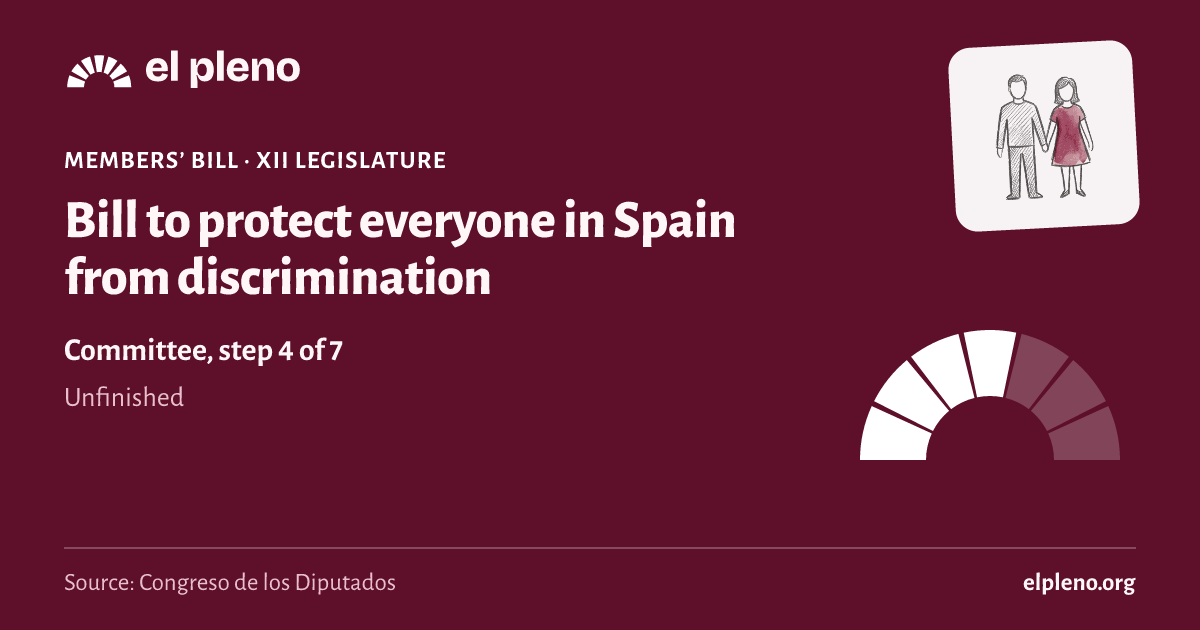
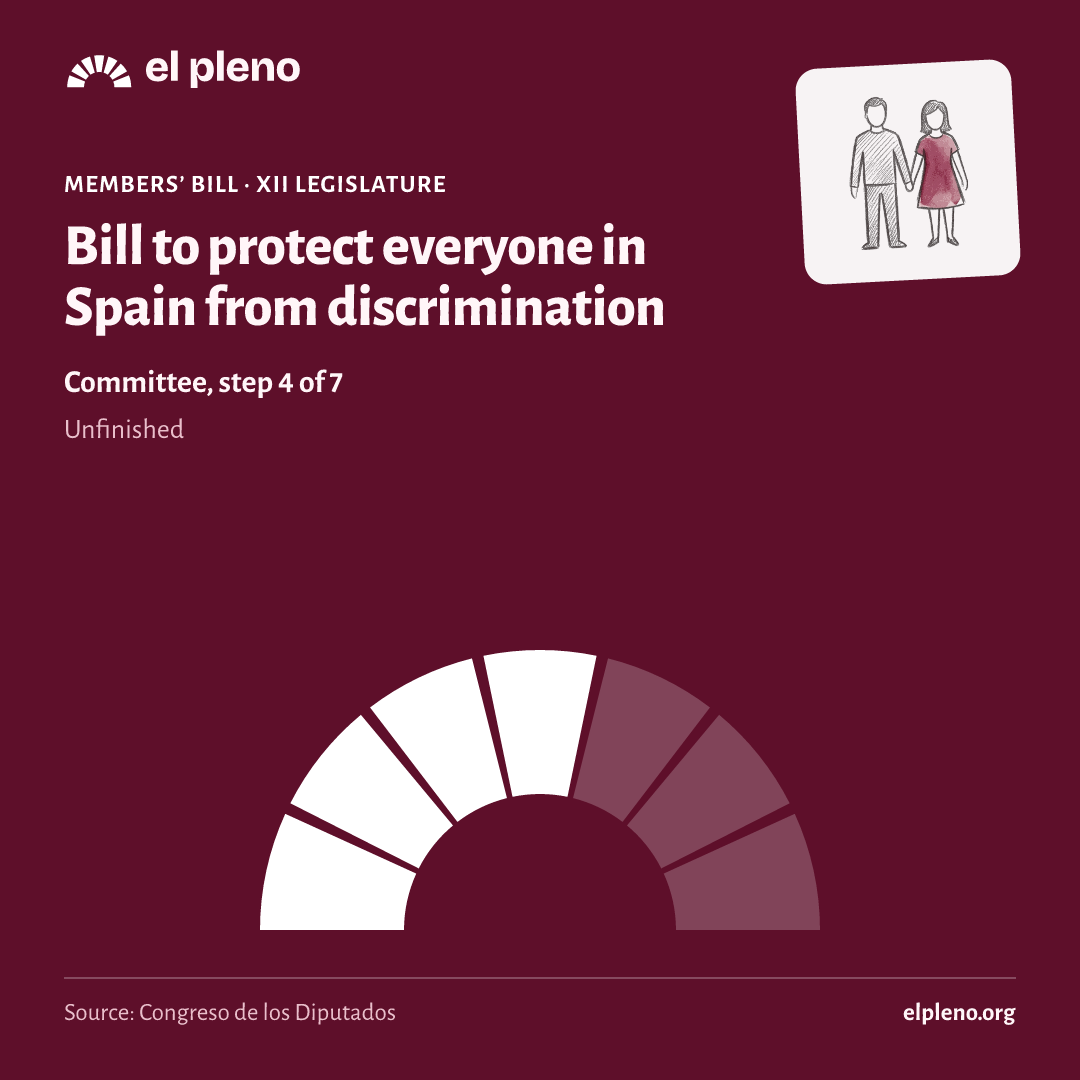
It took 4 of 7 steps. It reached Committee, and today it is unfinished.
- Introduced28 February 2017Someone registers the text in the Congreso.
- Admitted7 March 2017The Bureau of the Congreso accepts it and, for a members’ bill, the plenary decides whether to consider it.
- Amendments20 April 2018Groups propose changes.
- Committee3 October 2018A committee goes through the text in detail.
- Plenarynot reachedAll 350 deputies vote.
- Senatenot reachedThe Senate can pass it, amend it or veto it.
- BOEnot reachedIt is published in the Official State Gazette (BOE) and comes into force.
See the 11 official steps on a timeline
12 April 2018
How did the plenary vote?
Voted on: Private member's bill by the Socialist Parliamentary Group, Integral for equal treatment and non-discrimination.
Source: Congreso de los Diputados, vote 2 of sitting 110· updated 10 Nov
Each dot is a seat. Tap one, or use the arrow keys, to see who it is.
Your province
How did the deputies from your province vote?
And your senators: the Senate does not link its votes to this law in its open data, so we cannot put them side by side here.
Or see how most of each province voted
- A Coruña More votes in favour 8 yes · 0 no
- Albacete More votes in favour 4 yes · 0 no
- Alicante/Alacant More votes in favour 12 yes · 0 no
- Almería More votes in favour 6 yes · 0 no
- Araba/Álava More votes in favour 3 yes · 0 no
- Asturias More votes in favour 8 yes · 0 no
- Ávila More votes in favour 3 yes · 0 no
- Badajoz More votes in favour 6 yes · 0 no
- Barcelona More votes in favour 29 yes · 0 no
- Bizkaia More votes in favour 7 yes · 0 no
- Burgos More votes in favour 4 yes · 0 no
- Cáceres More votes in favour 4 yes · 0 no
- Cádiz More votes in favour 9 yes · 0 no
- Cantabria More votes in favour 5 yes · 0 no
- Castellón/Castelló More votes in favour 5 yes · 0 no
- Ceuta More votes in favour 1 yes · 0 no
- Ciudad Real More votes in favour 5 yes · 0 no
- Córdoba More votes in favour 6 yes · 0 no
- Cuenca More votes in favour 3 yes · 0 no
- Gipuzkoa More votes in favour 5 yes · 0 no
- Girona More votes in favour 6 yes · 0 no
- Granada More votes in favour 7 yes · 0 no
- Guadalajara More votes in favour 3 yes · 0 no
- Huelva More votes in favour 5 yes · 0 no
- Huesca More votes in favour 3 yes · 0 no
- Illes Balears More votes in favour 8 yes · 0 no
- Jaén More votes in favour 5 yes · 0 no
- La Rioja More votes in favour 4 yes · 0 no
- Las Palmas More votes in favour 7 yes · 0 no
- León More votes in favour 4 yes · 0 no
- Lleida More votes in favour 4 yes · 0 no
- Lugo More votes in favour 4 yes · 0 no
- Madrid More votes in favour 31 yes · 0 no
- Málaga More votes in favour 10 yes · 0 no
- Melilla More votes in favour 1 yes · 0 no
- Murcia More votes in favour 10 yes · 0 no
- Navarra More votes in favour 5 yes · 0 no
- Ourense More votes in favour 4 yes · 0 no
- Palencia More votes in favour 3 yes · 0 no
- Pontevedra More votes in favour 7 yes · 0 no
- Salamanca More votes in favour 4 yes · 0 no
- Santa Cruz de Tenerife More votes in favour 7 yes · 0 no
- Segovia More votes in favour 3 yes · 0 no
- Sevilla More votes in favour 12 yes · 0 no
- Soria More votes in favour 1 yes · 0 no
- Tarragona More votes in favour 6 yes · 0 no
- Teruel More votes in favour 3 yes · 0 no
- Toledo More votes in favour 5 yes · 0 no
- Valencia/València More votes in favour 16 yes · 0 no
- Valladolid More votes in favour 5 yes · 0 no
- Zamora More votes in favour 3 yes · 0 no
- Zaragoza More votes in favour 7 yes · 0 no
More details: how each group and each province voted
The groups
Who voted in favour and who against?
In favour, most of Socialista, Vasco (EAJ-PNV), Mixto, Ciudadanos, Gcup-ec-em, GER and Popular en el Congreso.
By province: in 52 most voted in favour; in 0, against.
Coloured by how most of each province’s deputies voted.
- In favour: 52
- Against: 0
| Group | Seats | How it voted |
|---|---|---|
| Socialista | 84 | 82 in favour · 2 did not vote |
| Vasco (EAJ-PNV) | 5 | 5 in favour |
| Mixto | 19 | 16 in favour · 3 did not vote |
| Ciudadanos | 32 | 32 in favour |
| Gcup-ec-em | 67 | 65 in favour · 2 did not vote |
| GER | 9 | 9 in favour |
| Popular en el Congreso | 134 | 127 in favour · 7 did not vote |
What happens next
What happens now?
The legislature ended before it finished. To go on, someone would have to introduce it again in the new Cortes.
It was presented again:
- XIII Legislature, Congreso de los Diputados· Unfinished Proposed law to protect everyone against discrimination
- XIV Legislature, Congreso de los Diputados· Passed New anti-discrimination law: what it guarantees and how it protects victims
- XIV Legislature, Senate Private member's bill on the comprehensive law for equal treatment and non-discrimination.
Presented before in:
- IX Legislature, Congreso de los Diputados· Unfinished Government bill for a comprehensive law on equal treatment and non-discrimination.
Sources
Where does all this come from?
- Congreso de los Diputados, file 122/000077
Official title, type, author, dates and stage.
Retrieved 11 November 2026
- Congreso de los Diputados, vote 2 of sitting 110
The count and every seat’s vote.
Retrieved 10 November 2026
- The data comes from the open files of the Congreso, the Senate and the BOE, unaltered.
- Each deputy’s province is the one of their seat on the day of the vote.
- We only say “passed” or “rejected” when the majority needed is certain; otherwise we say which side had more votes.