What it is
Bill to protect corruption whistleblowers and create an integrity authority
It is a members’ bill. Introduced by parliamentary groups, the Senate, regional governments or citizens. It was introduced on 15 September 2016. Introduced by: Grupo Parlamentario Ciudadanos.
Official title: Private member's bill for a Comprehensive Law on the Fight against Corruption and Protection of Whistleblowers.
Source: Congreso de los Diputados, file 122/000022· updated 11 Nov
Automatic summary, not yet reviewed
- The bill would recognize as whistleblowers senior officials, civil servants and other public sector staff who reveal information about crimes or administrative offenses, and would give them rights such as confidentiality, free legal advice, job protection and compensation for damages.
- Complaints would go through a confidential channel. Anonymous complaints and those not backed by documents or verified information would not be accepted, and the Authority would have fifteen days to open a reserved information procedure.
- Whistleblowers could request protection if they suffer harm for reporting: suspension of decisions that hurt them, a provisional transfer to another position, or a temporary leave with pay and the right to keep their job.
- The bill would create the Independent Public Integrity Authority, a fully independent body that would investigate conflicts of interest, incompatibilities and misuse of public funds, handle complaints and impose sanctions.
- Its President would be elected by the Congress of Deputies (Congreso de los Diputados) by a three-fifths majority, would serve a single six-year term, and could not have held political posts or leadership roles in parties or unions in the previous ten years.
- The bill would reform electoral law so that people indicted or convicted of serious corruption-related crimes could not stand on electoral lists, and sitting elected officials would automatically lose their seat if indicted.
- Senior officials could not hold bank accounts or financial assets in tax havens, would be automatically removed from office if indicted, and would face tougher financial sanctions.
- The bill would also bring more transparency (agendas of ministers and senior officials, contracts, institutional advertising), a public lobbyists registry with a code of conduct, a new crime of illicit enrichment, and a ban on pardons for corruption crimes.
Who it affects
- Public employees and public sector staff who report corruption: They would receive protection, confidentiality, free legal advice and job protection.
- Senior officials of the state administration: They would face more controls: no money in tax havens and automatic removal if indicted.
- Candidates and elected officials: They could not run for office or keep their seat if indicted for serious crimes.
- Lobbyists and organizations that influence public policy: They would have to register in a public registry and follow a code of conduct.
- Citizens in general: They would have more access to public information: agendas, contracts and advertising spending.
Words worth knowing
- Indemnidad laboral
- Guarantee that no one can harm your job or career because you filed a complaint.
- Responsabilidades por alcance
- Duty to pay for damages caused by illegal or negligent acts of a public official.
- Paraíso fiscal
- Tax haven: a country or territory with very low or no taxes, sometimes used to hide money.
- Lobby
- A person or organization that tries to influence public decisions on behalf of a private group.
- Enriquecimiento ilícito
- Illicit enrichment: a crime for a public official whose wealth grows without being able to explain where the money came from.
It summarizes the text as it was introduced. It is written by artificial intelligence and may contain mistakes: the official text is what counts. Read the official text · How we make summaries
Where it stands
How far did it get?
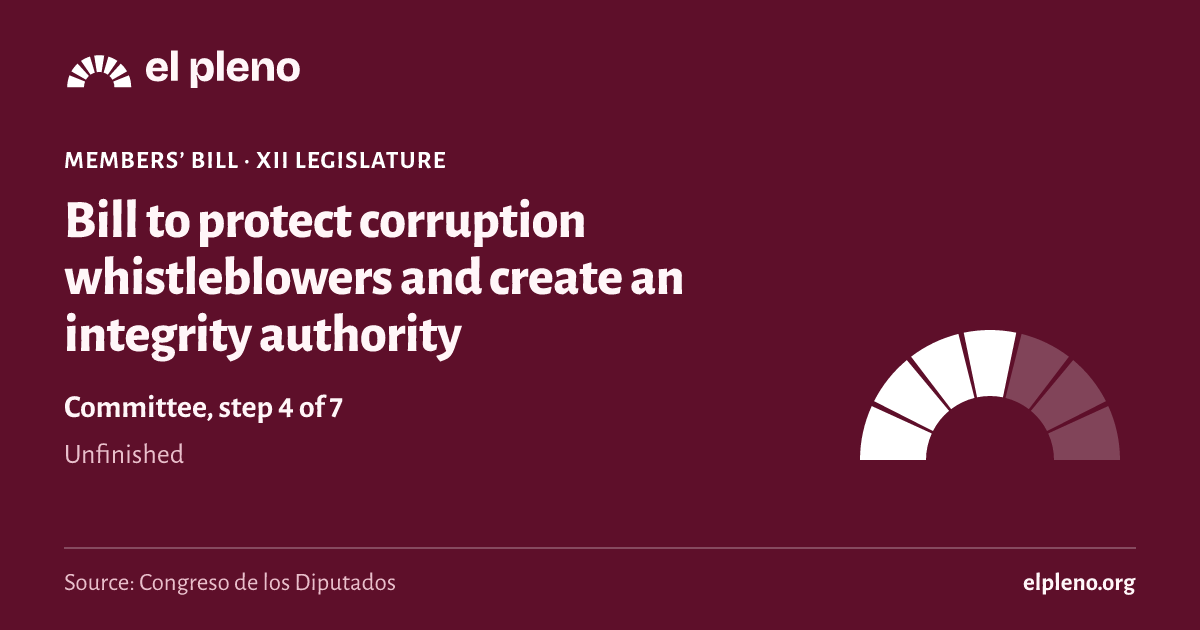
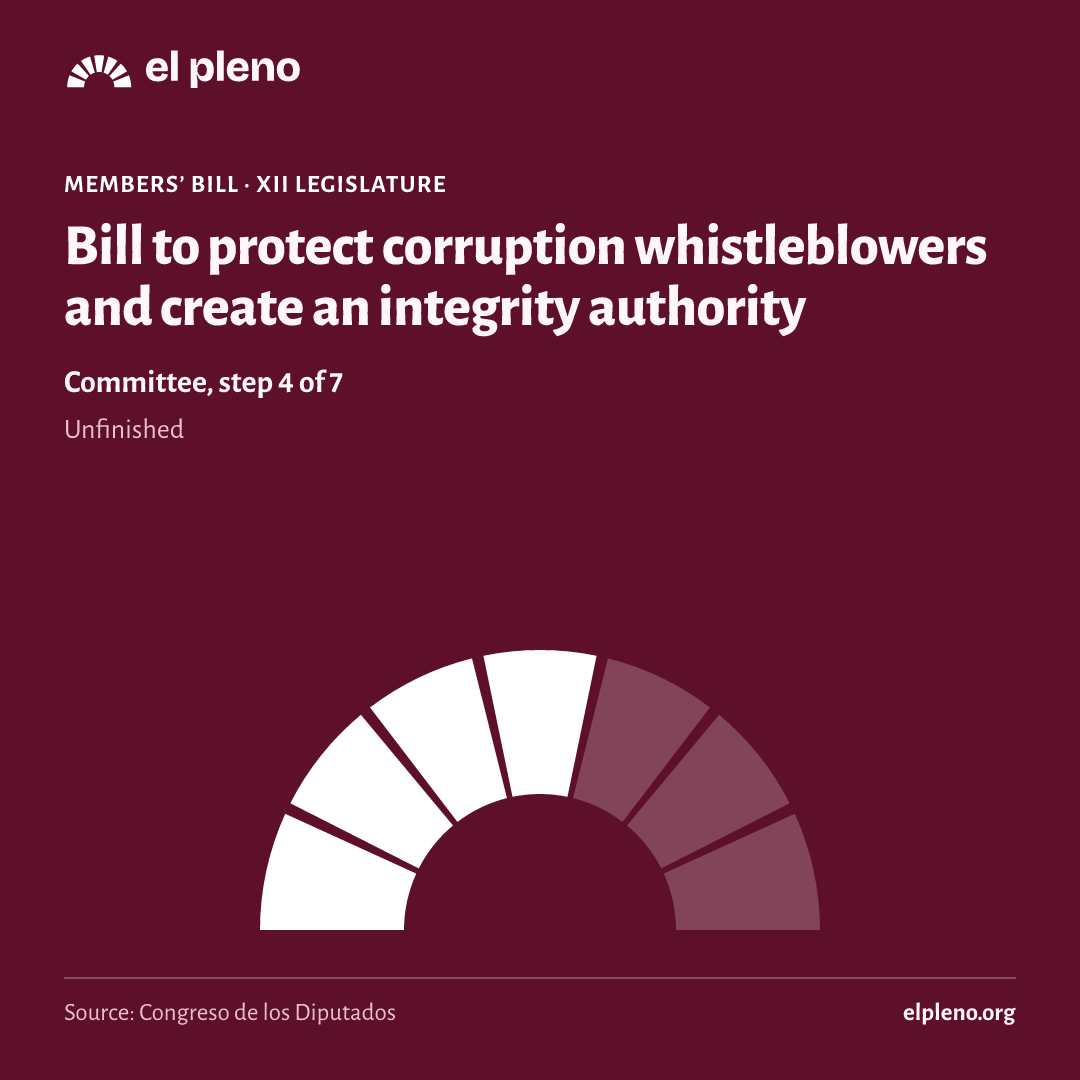
It took 4 of 7 steps. It reached Committee, and today it is unfinished.
- Introduced15 September 2016Someone registers the text in the Congreso.
- Admitted20 September 2016The Bureau of the Congreso accepts it and, for a members’ bill, the plenary decides whether to consider it.
- Amendments7 March 2017Groups propose changes.
- Committee29 November 2017A committee goes through the text in detail.
- Plenarynot reachedAll 350 deputies vote.
- Senatenot reachedThe Senate can pass it, amend it or veto it.
- BOEnot reachedIt is published in the Official State Gazette (BOE) and comes into force.
See the 10 official steps on a timeline
21 February 2017
How did the plenary vote?
Voted on: Private member's bill by the Ciudadanos Parliamentary Group, Comprehensive Act for the Fight against Corruption and Protection of Whistleblowers.
Source: Congreso de los Diputados, vote 1 of sitting 30· updated 10 Nov
Each dot is a seat. Tap one, or use the arrow keys, to see who it is.
Your province
How did the deputies from your province vote?
And your senators: the Senate does not link its votes to this law in its open data, so we cannot put them side by side here.
Or see how most of each province voted
- A Coruña More votes in favour 8 yes · 0 no
- Albacete More votes in favour 4 yes · 0 no
- Alicante/Alacant More votes in favour 12 yes · 0 no
- Almería More votes in favour 6 yes · 0 no
- Araba/Álava More votes in favour 3 yes · 0 no · 1 abst.
- Asturias More votes in favour 7 yes · 0 no
- Ávila More votes in favour 3 yes · 0 no
- Badajoz More votes in favour 6 yes · 0 no
- Barcelona More votes in favour 30 yes · 0 no
- Bizkaia More votes in favour 6 yes · 0 no · 2 abst.
- Burgos More votes in favour 4 yes · 0 no
- Cáceres More votes in favour 4 yes · 0 no
- Cádiz More votes in favour 9 yes · 0 no
- Cantabria More votes in favour 5 yes · 0 no
- Castellón/Castelló More votes in favour 5 yes · 0 no
- Ceuta More votes in favour 1 yes · 0 no
- Ciudad Real More votes in favour 5 yes · 0 no
- Córdoba More votes in favour 6 yes · 0 no
- Cuenca More votes in favour 3 yes · 0 no
- Gipuzkoa More votes in favour 4 yes · 0 no · 2 abst.
- Girona More votes in favour 6 yes · 0 no
- Granada More votes in favour 7 yes · 0 no
- Guadalajara More votes in favour 3 yes · 0 no
- Huelva More votes in favour 5 yes · 0 no
- Huesca More votes in favour 3 yes · 0 no
- Illes Balears More votes in favour 8 yes · 0 no
- Jaén More votes in favour 5 yes · 0 no
- La Rioja More votes in favour 4 yes · 0 no
- Las Palmas More votes in favour 7 yes · 0 no
- León More votes in favour 4 yes · 0 no
- Lleida More votes in favour 4 yes · 0 no
- Lugo More votes in favour 4 yes · 0 no
- Madrid More votes in favour 33 yes · 0 no
- Málaga More votes in favour 10 yes · 0 no
- Melilla More votes in favour 1 yes · 0 no
- Murcia More votes in favour 10 yes · 0 no
- Navarra More votes in favour 5 yes · 0 no
- Ourense More votes in favour 4 yes · 0 no
- Palencia More votes in favour 3 yes · 0 no
- Pontevedra More votes in favour 7 yes · 0 no
- Salamanca More votes in favour 4 yes · 0 no
- Santa Cruz de Tenerife More votes in favour 7 yes · 0 no
- Segovia More votes in favour 3 yes · 0 no
- Sevilla More votes in favour 12 yes · 0 no
- Soria More votes in favour 2 yes · 0 no
- Tarragona More votes in favour 6 yes · 0 no
- Teruel More votes in favour 3 yes · 0 no
- Toledo More votes in favour 6 yes · 0 no
- Valencia/València More votes in favour 16 yes · 0 no
- Valladolid More votes in favour 5 yes · 0 no
- Zamora More votes in favour 2 yes · 0 no
- Zaragoza More votes in favour 7 yes · 0 no
More details: how each group and each province voted
The groups
Who voted in favour and who against?
In favour, most of Socialista, Mixto, Ciudadanos, Gcup-ec-em, GER and Popular en el Congreso.
By province: in 52 most voted in favour; in 0, against.
Coloured by how most of each province’s deputies voted.
- In favour: 52
- Against: 0
| Group | Seats | How it voted |
|---|---|---|
| Socialista | 84 | 80 in favour · 4 did not vote |
| Vasco (EAJ-PNV) | 5 | 5 abst. |
| Mixto | 19 | 19 in favour |
| Ciudadanos | 32 | 31 in favour · 1 did not vote |
| Gcup-ec-em | 67 | 66 in favour · 1 did not vote |
| GER | 9 | 9 in favour |
| Popular en el Congreso | 134 | 132 in favour · 2 did not vote |
What happens next
What happens now?
The legislature ended before it finished. To go on, someone would have to introduce it again in the new Cortes.
It has not been presented again yet.
Sources
Where does all this come from?
- Congreso de los Diputados, file 122/000022
Official title, type, author, dates and stage.
Retrieved 11 November 2026
- Congreso de los Diputados, vote 1 of sitting 30
The count and every seat’s vote.
Retrieved 10 November 2026
- The data comes from the open files of the Congreso, the Senate and the BOE, unaltered.
- Each deputy’s province is the one of their seat on the day of the vote.
- We only say “passed” or “rejected” when the majority needed is certain; otherwise we say which side had more votes.