

What it is
Bill to strengthen telecom users' rights in Spain
It is a members’ bill. Introduced by parliamentary groups, the Senate, regional governments or citizens. It was introduced on 13 December 2011. Introduced by: Grupo Parlamentario Socialista.
Official title: Private member's bill amending Law 32/2003, of November 3, General Law on Telecommunications.
Source: Congreso de los Diputados, file 122/000001· updated 11 Nov
Automatic summary, not yet reviewed
- The bill would incorporate into Spanish law the 2009 European directives on electronic communications, which improve consumer rights, Internet access and data protection.
- It would require that switching providers while keeping your phone number take at most one business day, with compensation for delays or abuse.
- It introduces functional separation: if competition persistently fails, the Telecommunications Market Commission could force the dominant operator to separate its network from its retail services.
- It strengthens universal service: broadband Internet access of at least 1 Mbit per second, equivalent access for people with disabilities, and free emergency calls, including 112 and 016.
- Operators would have to notify the Spanish Data Protection Agency without undue delay of any personal data breach, and also notify the affected person if it could harm them.
- It recognizes user rights such as net neutrality, meaning Internet traffic cannot be blocked or slowed based on content, plus a free procedure to settle disputes with operators.
- It amends the Information Society Services Law to require user consent before storing or accessing files on the user's computer, such as Cookies Files or programs stored on the user's computer that save and retrieve information about their browsing..
- It extends the statute of limitations for minor offenses from six months to one year and details inspection powers and the penalty regime for the sector.
Who it affects
- Phone and Internet users: Could switch providers in one business day keeping their number, use a free dispute procedure, and see net neutrality protected.
- People with disabilities and older people: Would get equivalent access to telecom services and accessibility conditions set by regulation.
- Telecom operators: Would face new security duties, data breach notifications, deadlines for network deployment and possible functional separation.
- Spanish Data Protection Agency: Would be strengthened as a regulatory authority and receive notifications of personal data breaches.
Words worth knowing
- Servicio universal (universal service)
- A basic set of telecom services guaranteed to everyone at an affordable price, regardless of where they live.
- Separación funcional (functional separation)
- An exceptional duty for the dominant operator to run its network independently from its retail services.
- Dominio público radioeléctrico (radioelectric public domain)
- Radio waves, owned by the State and used through permits.
- Cookies
- Files or programs stored on the user's computer that save and retrieve information about their browsing.
It summarizes the text as it was introduced. It is written by artificial intelligence and may contain mistakes: the official text is what counts. Read the official text · How we make summaries
Where it stands
How far did it get?
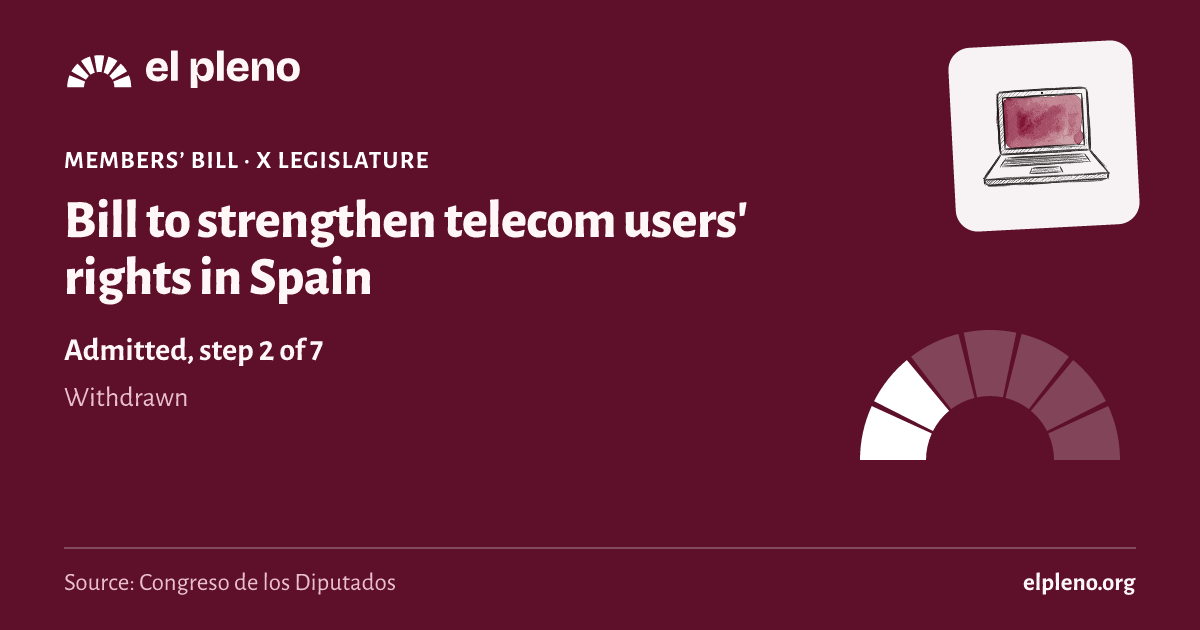
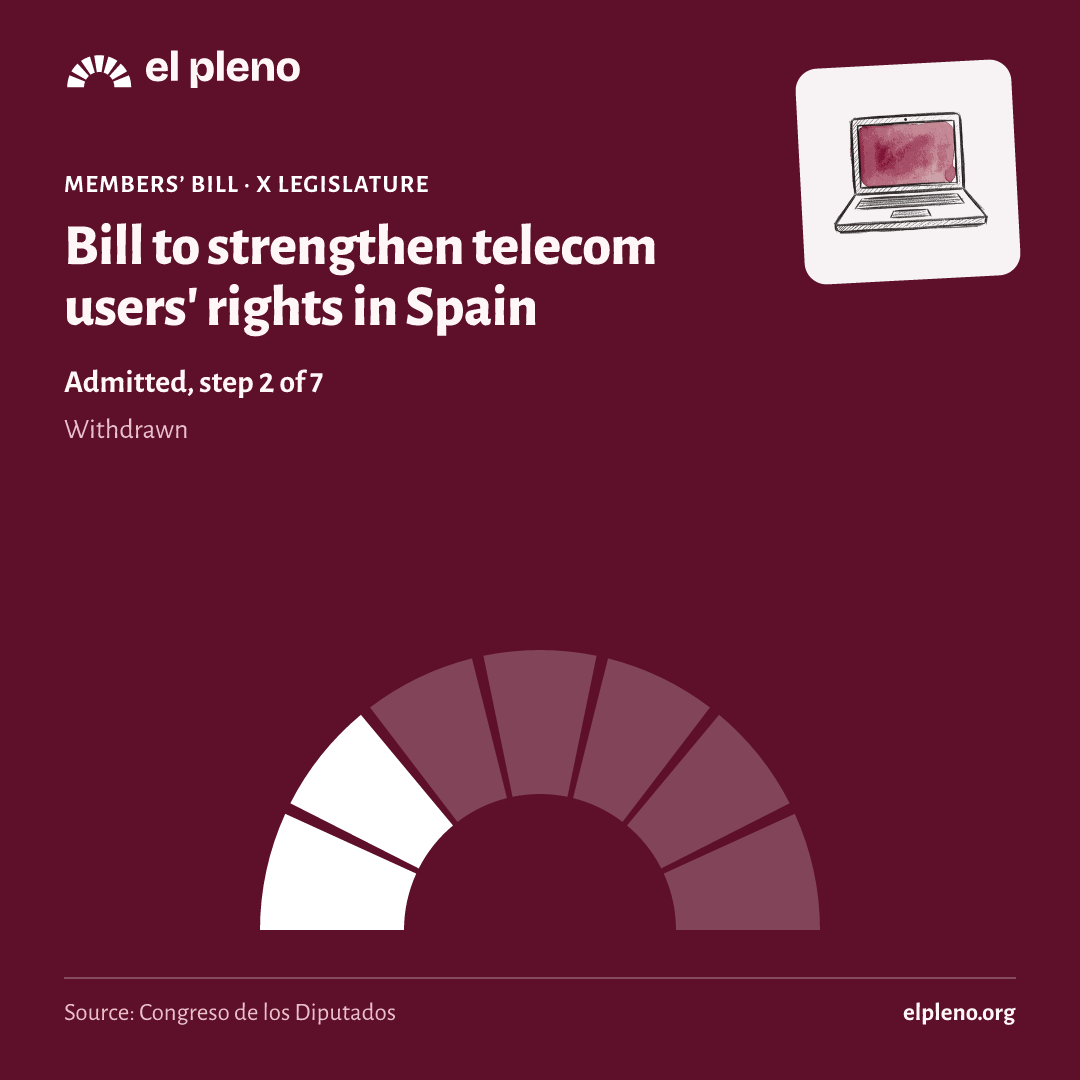
It took 2 of 7 steps. It reached Admitted, and today it is withdrawn.
- Introduced13 December 2011Someone registers the text in the Congreso.
- Admitted21 December 2011The Bureau of the Congreso accepts it and, for a members’ bill, the plenary decides whether to consider it.
- Amendmentsnot reachedGroups propose changes.
- Committeenot reachedA committee goes through the text in detail.
- Plenarynot reachedThe deputies vote, usually in the plenary; some laws are passed by a committee without going to it.
- Senatenot reachedThe Senate can pass it, amend it or veto it.
- BOEnot reachedThe King gives royal assent and it is published in the Official State Gazette (BOE). It comes into force on the date it sets, or after 20 days if it sets none.
See the 6 official steps on a timeline
Was there a plenary vote?
We have no plenary vote linked to this law in the Congreso’s data.
What happens next
What happens now?
Whoever introduced it withdrew it, or it was merged into another one. It goes no further.
Presented before in:
- IX Legislature, Congreso de los Diputados· Unfinished Government bill amending Law 32/2003, of November 3, General Law on Telecommunications.
Sources
Where does all this come from?
- Congreso de los Diputados, file 122/000001
Official title, type, author, dates and stage.
Retrieved 11 November 2026
- The data comes from the open files of the Congreso, the Senate and the BOE, unaltered.
- Each deputy’s province is the one of their seat on the day of the vote.
- We only say “passed” or “rejected” when the majority needed is certain; otherwise we say which side had more votes.