What it is
Bill to improve health care and benefits for people with ALS
It is a members’ bill. Introduced by parliamentary groups, the Senate, regional governments or citizens. It was introduced on 21 July 2026. Introduced by: Comunidad Autónoma de Cataluña - Parlamento.
Official title: Private member's bill to amend Law 3/2024, of October 30, to improve the quality of life of people with amyotrophic lateral sclerosis and other diseases or processes of high complexity and irreversible course, and other rules regarding the care of people in a situation of dependency.
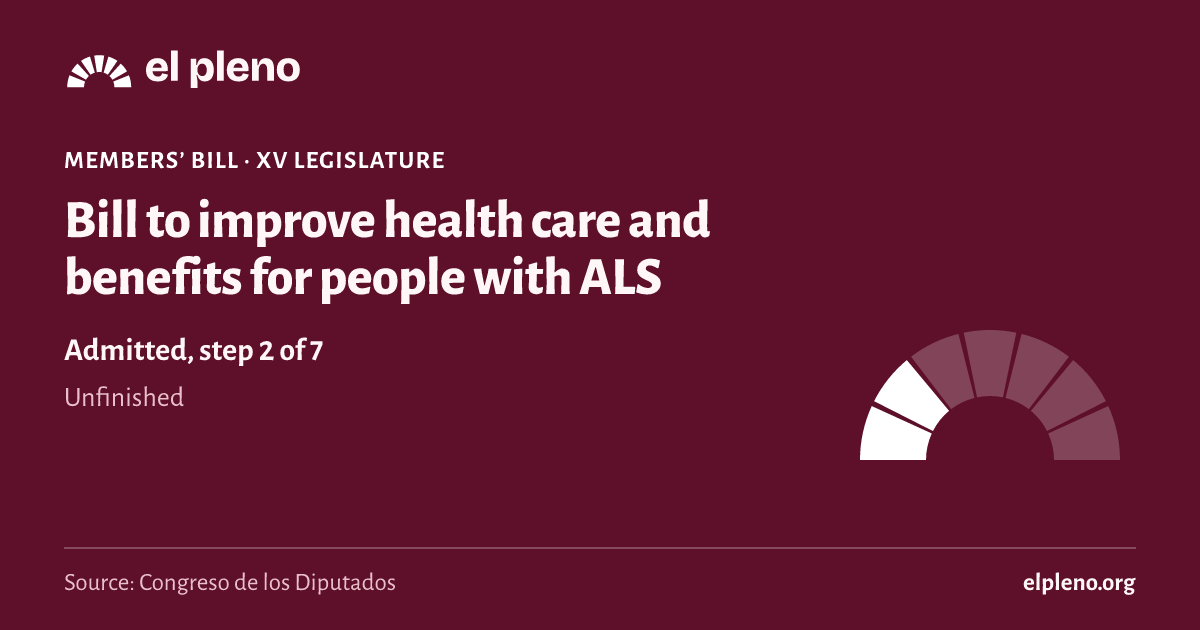
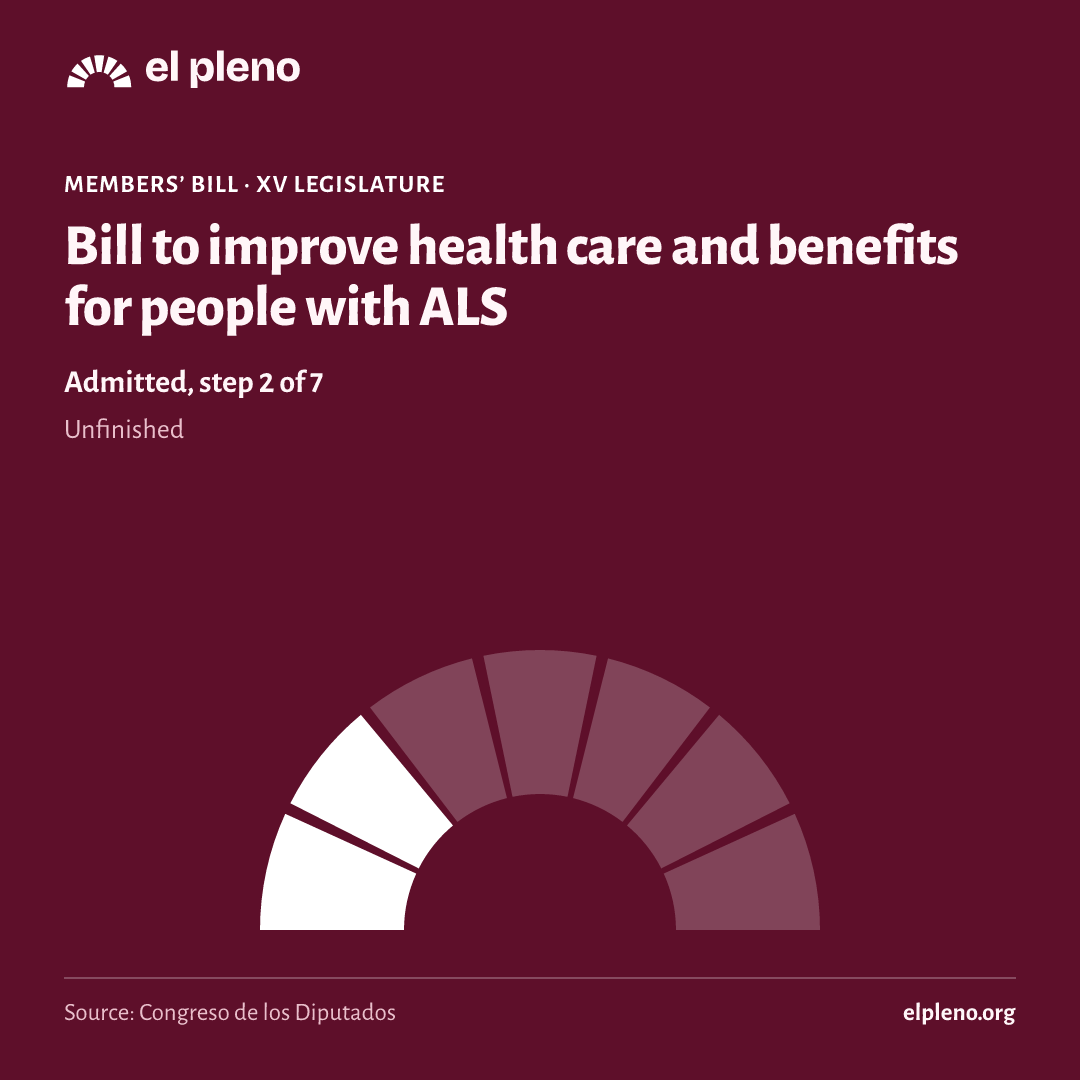
Source: Congreso de los Diputados, file 125/000016· updated 11 Nov
Automatic summary, not yet reviewed
- The bill would classify benefits needed for vital functions, such as mechanical ventilation or assisted feeding, as health care rather than social services, and provide them through the health system instead of the dependency system.
- It would give people with ALS and similar conditions the right to continuous, comprehensive and specialized health care, including 24-hour home care when clinically necessary, and make their benefits compatible with the dependency system and free of copays.
- It creates a new grade III+ of extreme dependency for people with ALS or other high-complexity conditions in advanced stages. These people would have a minimum level of protection guaranteed by the State, access to economic benefits, and no copays.
- It updates the minimum amounts of economic benefits in the dependency system to include grade III+, setting them at €3,200, compared with €200 for grade III.
- It establishes that benefits meant to guarantee vital functions would not be subject to the beneficiary's economic participation, and that the State would pay 50% of the cost increases for grade III+ benefits when the maximum amounts are not enough.
- The bill ensures that disability grade reviews would not delay access to rights, and requires that any implementing rules respect the health care nature of these benefits, which the dependency system could not replace or limit.
Who it affects
- People with ALS or other high-complexity, irreversible conditions: They would have guaranteed health care, copay-free benefits and automatic access from diagnosis.
- People with grade III+ extreme dependency: They would receive a State-guaranteed minimum level of protection and minimum amounts of €3,200.
- Families and family caregivers: The benefit for care in the family environment would be restored, with support, training and supervision.
- Autonomous communities (regional governments): The State would cover 50% of cost increases for grade III+ benefits.
Words worth knowing
- Sistema para la Autonomía y Atención a la Dependencia (SAAD)
- Public system that recognizes and funds support for people who need help with daily life due to dependency.
- Copago
- The share of the cost of a public service paid by the person receiving it (copay).
- Complemento de gran invalidez
- Extra payment from Social Security for people who need another person for essential daily activities.
- Disfagia
- Difficulty swallowing food or liquids.
- Prestación económica vinculada al servicio
- Economic benefit given to pay for a specific care service, such as home help.
It summarizes the text as it was introduced. It is written by artificial intelligence and may contain mistakes: the official text is what counts. Read the official text · How we make summaries
Where it stands
How far did it get?
It took 2 of 7 steps. It reached Admitted, and today it is unfinished.
- Introduced21 July 2026Someone registers the text in the Congreso.
- Admitted23 July 2026The Bureau of the Congreso accepts it and, for a members’ bill, the plenary decides whether to consider it.
- Amendmentsnot reachedGroups propose changes.
- Committeenot reachedA committee goes through the text in detail.
- Plenarynot reachedAll 350 deputies vote.
- Senatenot reachedThe Senate can pass it, amend it or veto it.
- BOEnot reachedIt is published in the Official State Gazette (BOE) and comes into force.
See the 5 official steps on a timeline
Was there a plenary vote?
We have no plenary vote linked to this law in the Congreso’s data.
What happens next
What happens now?
The legislature ended before it finished. To go on, someone would have to introduce it again in the new Cortes.
It has not been presented again yet.
Sources
Where does all this come from?
- Congreso de los Diputados, file 125/000016
Official title, type, author, dates and stage.
Retrieved 11 November 2026
- Congreso de los Diputados, procedure
The date of each step, with its official wording.
Retrieved 12 November 2026
- The data comes from the open files of the Congreso, the Senate and the BOE, unaltered.
- Each deputy’s province is the one of their seat on the day of the vote.
- We only say “passed” or “rejected” when the majority needed is certain; otherwise we say which side had more votes.