What it is
Bill proposes cutting the nuclear waste fee paid by power plants
It is a members’ bill. Introduced by parliamentary groups, the Senate, regional governments or citizens. It was introduced on 23 July 2025. Introduced by: Comunidad Autónoma de Extremadura - Asamblea.
Official title: Private member's bill amending the sixth additional provision of Law 54/1997, of November 27, on the Electricity Sector.
Source: Congreso de los Diputados, file 125/000012· updated 11 Nov
Automatic summary, not yet reviewed
- The bill would lower the fixed unit rate that operating nuclear power plants pay to fund ENRESA Spanish public company that manages radioactive waste and the decommissioning of nuclear power plants.'s service, setting it at 0.669 euro cents per kWh. It currently stands at 1.036 euro cents per kWh after a nearly 30% increase approved by the Government in 2024.
- The authors argue that the nuclear sector's tax burden exceeds all its operating costs combined, making plants such as Almaraz unviable and forcing their closure, which would raise household electricity bills.
- The proposed law would take effect the day after its publication in the Official State Gazette and is issued under the State's exclusive authority over the economic management of the electricity system.
Who it affects
- Companies that own operating nuclear power plants: They would pay less under the public charge that funds radioactive waste management and plant decommissioning.
- Electricity consumers: According to the bill, nuclear production costs, which are passed on to bills, would fall.
- Municipalities hosting nuclear plants or storage facilities: The payments they receive are funded by this same charge, whose rate would be cut.
Words worth knowing
- ENRESA
- Spanish public company that manages radioactive waste and the decommissioning of nuclear power plants.
- Prestación patrimonial de carácter público no tributario
- A mandatory payment made by nuclear plants to fund a public service, which is not technically a tax.
- Tarifa fija unitaria
- A fixed amount in euro cents per kilowatt hour generated, used to calculate what each plant pays.
- Proposición de ley
- A bill: a text proposing a law that has not yet been passed and is not in force.
It summarizes the text as it was introduced. It is written by artificial intelligence and may contain mistakes: the official text is what counts. Read the official text · How we make summaries
Where it stands
How far did it get?
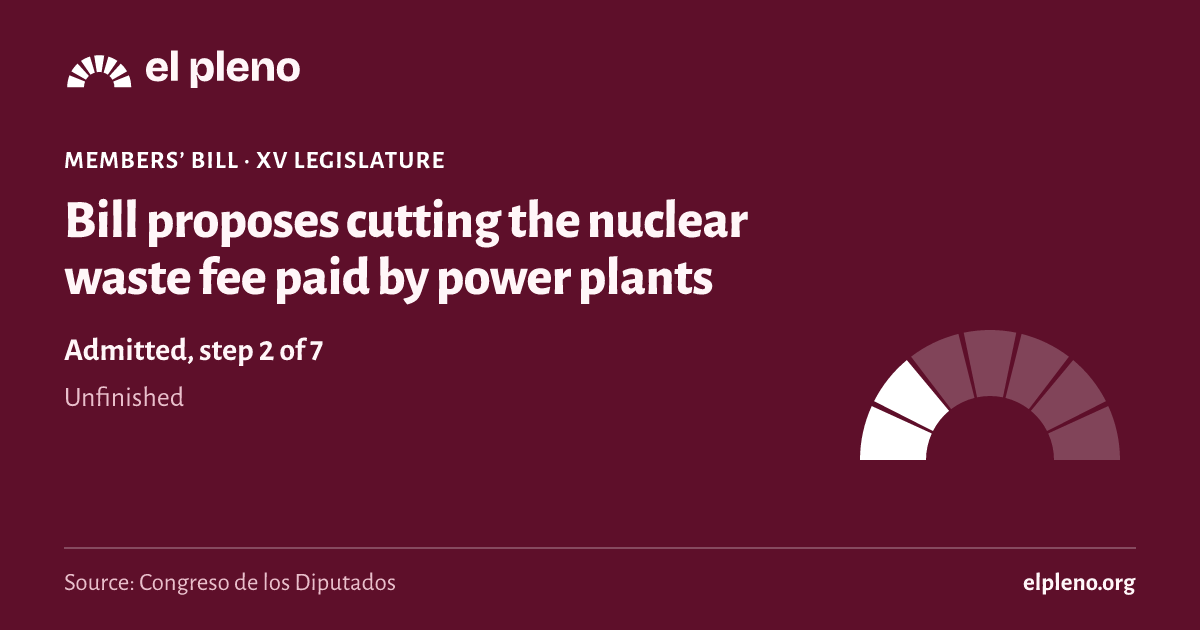
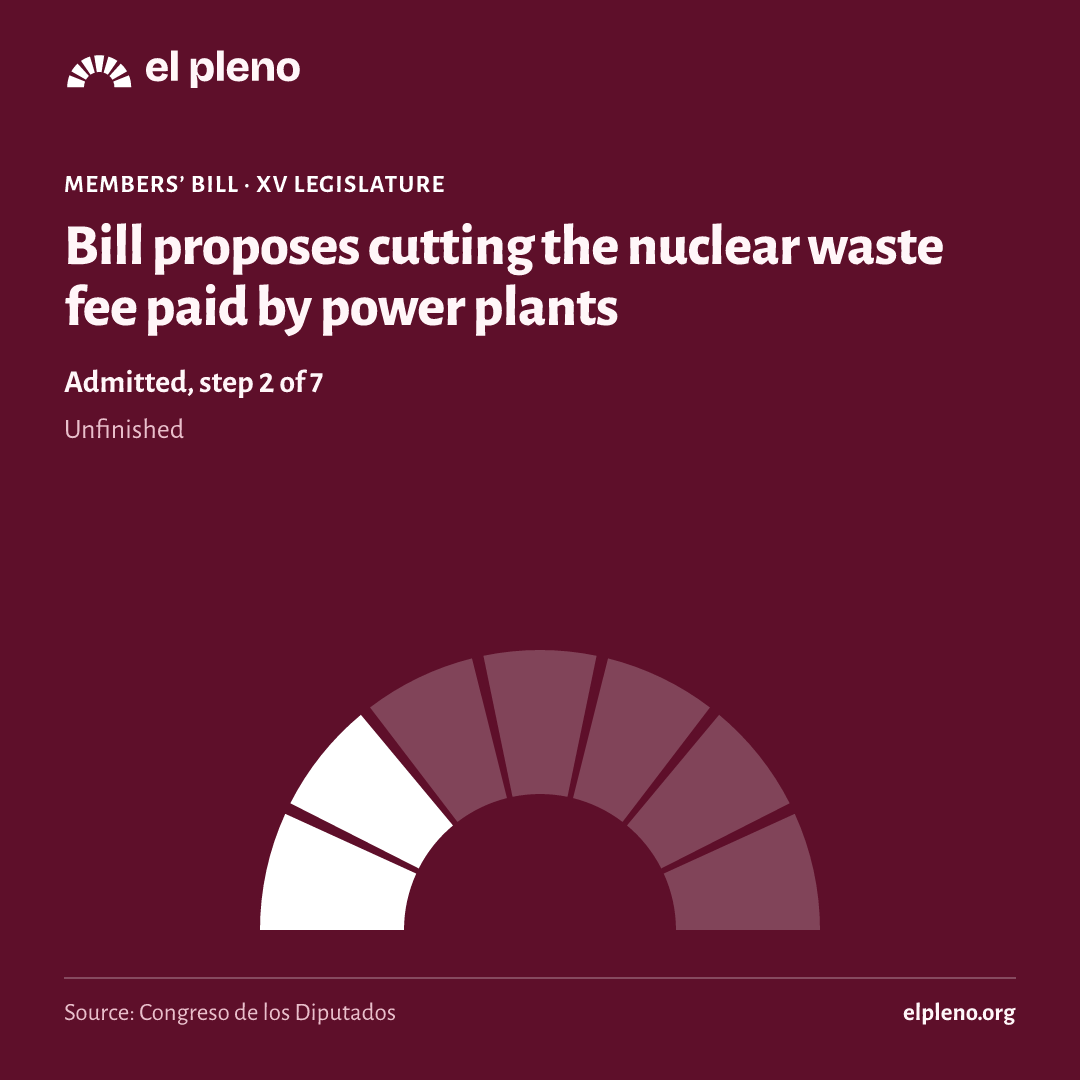
It took 2 of 7 steps. It reached Admitted, and today it is unfinished.
- Introduced23 July 2025Someone registers the text in the Congreso.
- Admitted26 August 2025The Bureau of the Congreso accepts it and, for a members’ bill, the plenary decides whether to consider it.
- Amendmentsnot reachedGroups propose changes.
- Committeenot reachedA committee goes through the text in detail.
- Plenarynot reachedAll 350 deputies vote.
- Senatenot reachedThe Senate can pass it, amend it or veto it.
- BOEnot reachedIt is published in the Official State Gazette (BOE) and comes into force.
See the 6 official steps on a timeline
Was there a plenary vote?
We have no plenary vote linked to this law in the Congreso’s data.
What happens next
What happens now?
The legislature ended before it finished. To go on, someone would have to introduce it again in the new Cortes.
It has not been presented again yet.
Sources
Where does all this come from?
- Congreso de los Diputados, file 125/000012
Official title, type, author, dates and stage.
Retrieved 11 November 2026
- Congreso de los Diputados, procedure
The date of each step, with its official wording.
Retrieved 13 November 2026
- The data comes from the open files of the Congreso, the Senate and the BOE, unaltered.
- Each deputy’s province is the one of their seat on the day of the vote.
- We only say “passed” or “rejected” when the majority needed is certain; otherwise we say which side had more votes.