What it is
Bill to let judges choose the judicial members of the judges' council
It is a members’ bill. Introduced by parliamentary groups, the Senate, regional governments or citizens. It was introduced on 12 June 2026. Introduced by: Senado.
Official title: Organic Private member's bill to amend Organic Law 6/1985, of 1 July, on the Judiciary, to change the model for the election of the members of the General Council of the Judiciary.
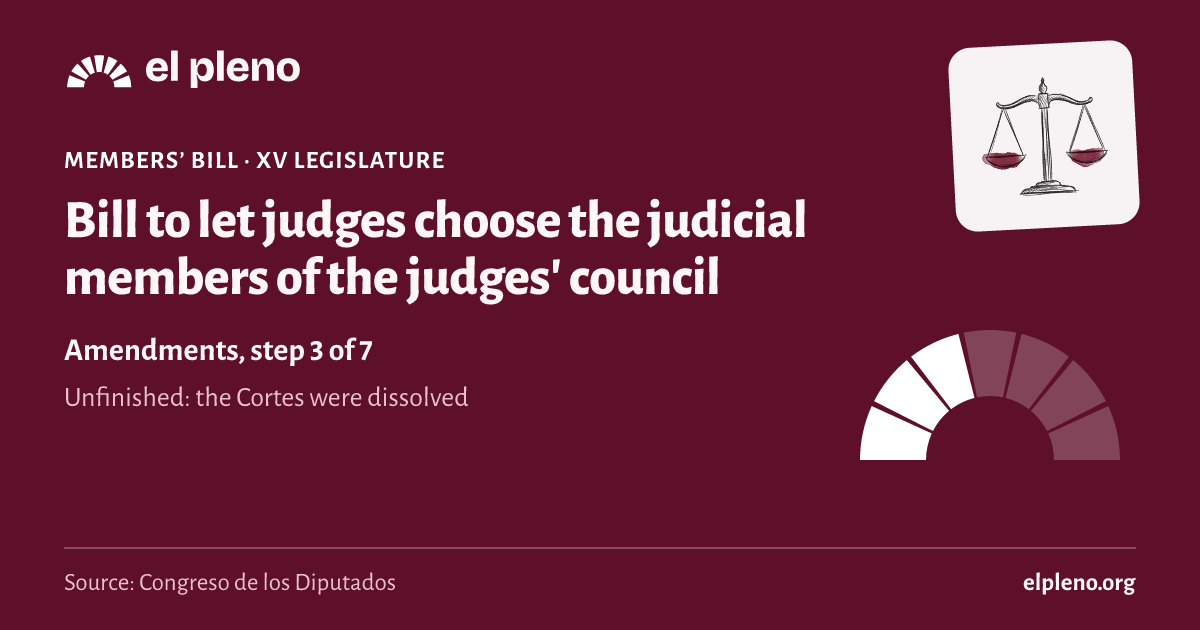
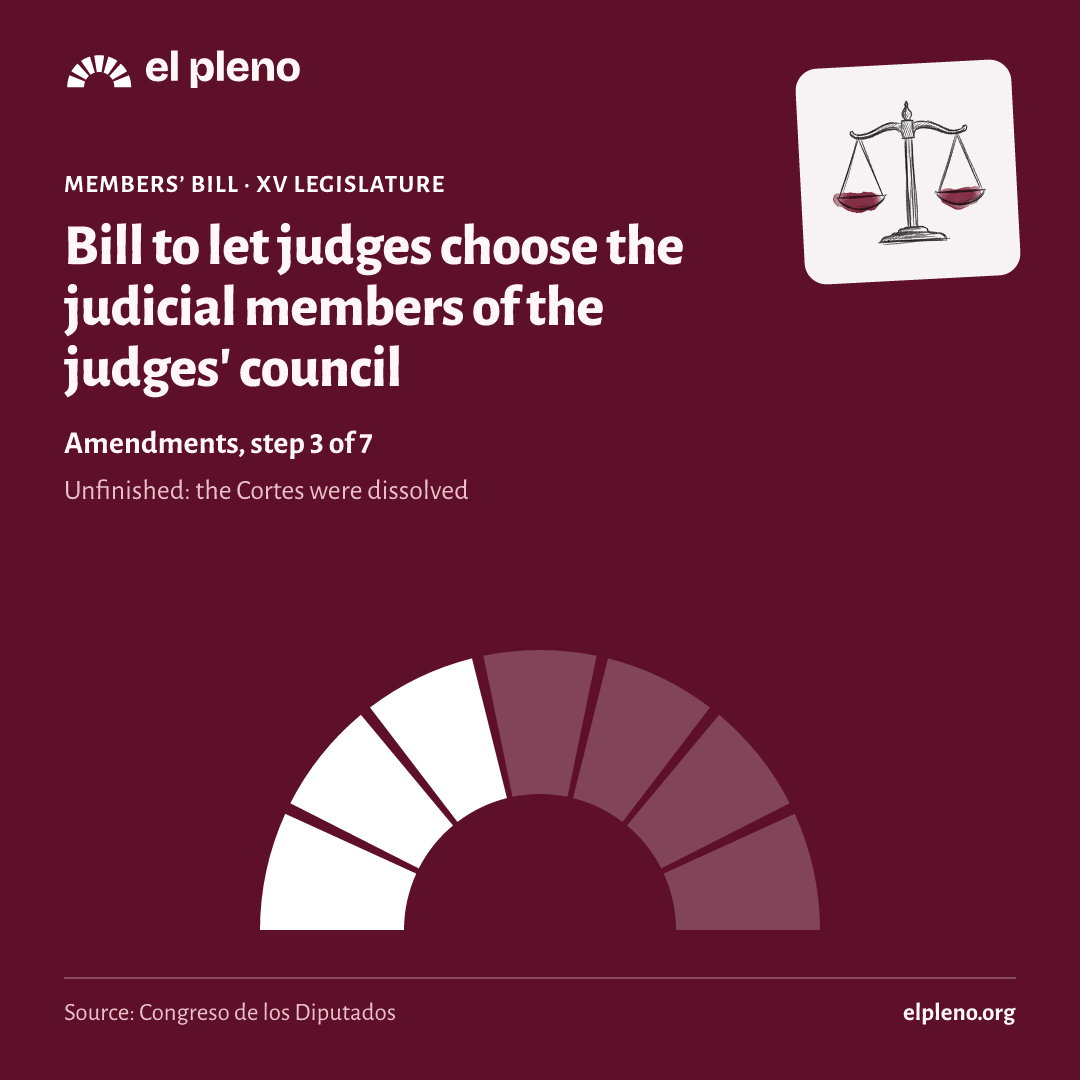
Source: Congreso de los Diputados, file 124/000046· updated 11 Nov
Automatic summary, not yet reviewed
- The bill would change how the twelve council members who come from the judiciary are chosen: instead of being picked by Congress and the Senate, they would be elected by serving judges and magistrates themselves, voting in person or by certified mail. The eight members from the lawyers' category would still be chosen by the chambers with a three-fifths majority.
- All serving judges and magistrates could vote and run as candidates, except those who held certain political offices in the previous five years, such as minister, secretary of state, regional minister, mayor or member of parliament. Outgoing council members could not be elected either.
- The election would use a single district for the whole country and a ballot with one open list: each voter could mark up to eight of the twelve candidates. Seats would be reserved by category (three Supreme Court magistrates, three with more than fifteen years of seniority, and six with no seniority requirement), and at least 40% of those elected would have to be women and 40% men.
- Candidates could be put forward by individual judges (with twenty endorsements or the backing of a judicial association) or by the associations themselves, which could back one full slate or up to eight individual candidates. Each candidate would run with an alternate and would have to publish their résumé and proposals on the council's website.
- A new electoral board would be created, chaired by the most senior chamber president of the Supreme Court, to run the whole process: proclaiming candidates, receiving mail-in votes, counting ballots and declaring the winners. Its decisions on candidacies and proclamations could be appealed to the Supreme Court.
- The new system would apply from the call for the next renewal, three months before the current council's five-year term expires. The law would take effect the day after its publication in the official state gazette.
Who it affects
- Serving judges and magistrates: They would elect the twelve judicial members of the council, voting in person or by mail.
- Judicial associations: They could put forward full slates or endorse up to eight individual candidates.
- Distinguished legal professionals: They would still be eligible as council members chosen by Congress and the Senate, with more than fifteen years of professional practice.
- Congress of Deputies and Senate: They would stop choosing the judicial members but would keep electing the eight legal professionals.
- General Council of the Judiciary (Consejo General del Poder Judicial): It would have to approve the electoral rules by a three-fifths majority and provide support and resources for the election.
Words worth knowing
- Vocal
- Each of the twenty non-presiding members of the General Council of the Judiciary.
- Turno judicial and turno de juristas
- The two origins of council members: twelve come from the judiciary and eight are legal professionals chosen by the chambers.
- Sufragio activo y pasivo
- Active suffrage is the right to vote; passive suffrage is the right to run as a candidate.
- Junta Electoral
- The body that organizes and oversees the election: it proclaims candidates, counts the votes and declares the winners.
- Recurso contencioso-administrativo
- A court appeal against decisions of public bodies, in this case heard by the Supreme Court.
It summarizes the text as it was introduced. It is written by artificial intelligence and may contain mistakes: the official text is what counts. Read the official text · How we make summaries
Where it stands
How far did it get?
It took 3 of 7 steps. It reached Amendments, and today it is unfinished.
- Introduced12 June 2026Someone registers the text in the Congreso.
- Admitted16 June 2026The Bureau of the Congreso accepts it and, for a members’ bill, the plenary decides whether to consider it.
- Amendments19 June 2026Groups propose changes.
- Committeenot reachedA committee goes through the text in detail.
- Plenarynot reachedAll 350 deputies vote.
- Senatenot reachedThe Senate can pass it, amend it or veto it.
- BOEnot reachedIt is published in the Official State Gazette (BOE) and comes into force.
See the 5 official steps on a timeline
Was there a plenary vote?
We have no plenary vote linked to this law in the Congreso’s data.
What happens next
What happens now?
The legislature ended before it finished. To go on, someone would have to introduce it again in the new Cortes.
It has not been presented again yet.
The same initiative in the other chamber:
Sources
Where does all this come from?
- Congreso de los Diputados, file 124/000046
Official title, type, author, dates and stage.
Retrieved 11 November 2026
- Congreso de los Diputados, procedure
The date of each step, with its official wording.
Retrieved 12 November 2026
- The data comes from the open files of the Congreso, the Senate and the BOE, unaltered.
- Each deputy’s province is the one of their seat on the day of the vote.
- We only say “passed” or “rejected” when the majority needed is certain; otherwise we say which side had more votes.