What it is
Bill to clarify that cutting utilities to squatters is not coercion
It is a members’ bill. Introduced by parliamentary groups, the Senate, regional governments or citizens. It was introduced on 21 November 2025. Introduced by: Senado.
Official title: Private member's bill, Organic Law amending Organic Law 10/1995, of November 23, of the Penal Code.
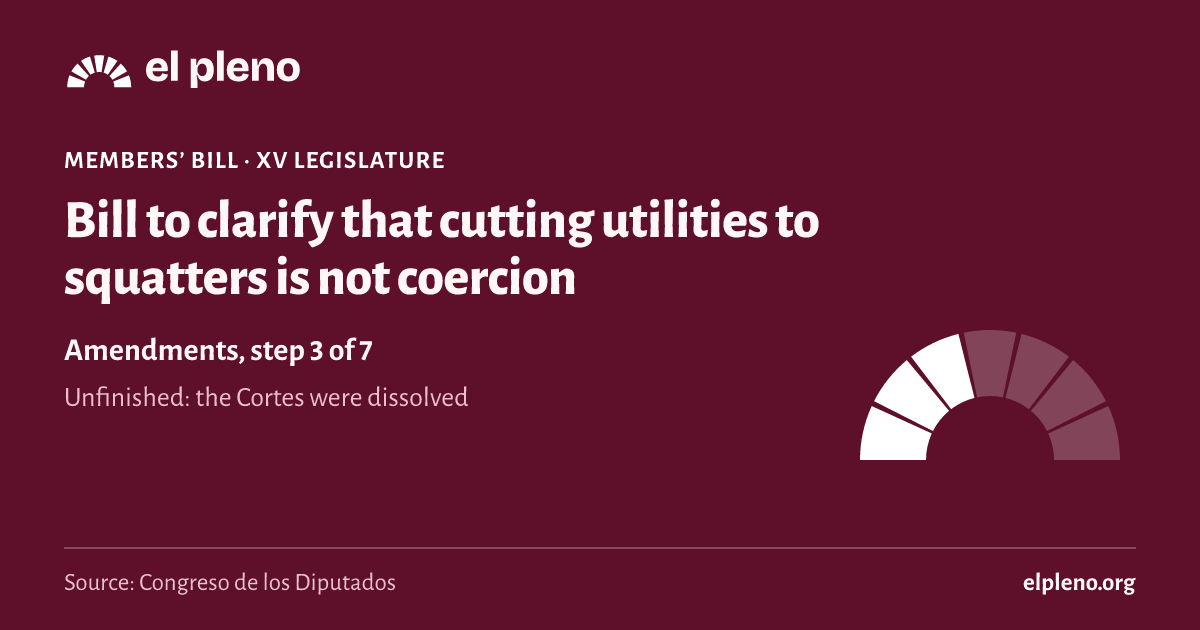
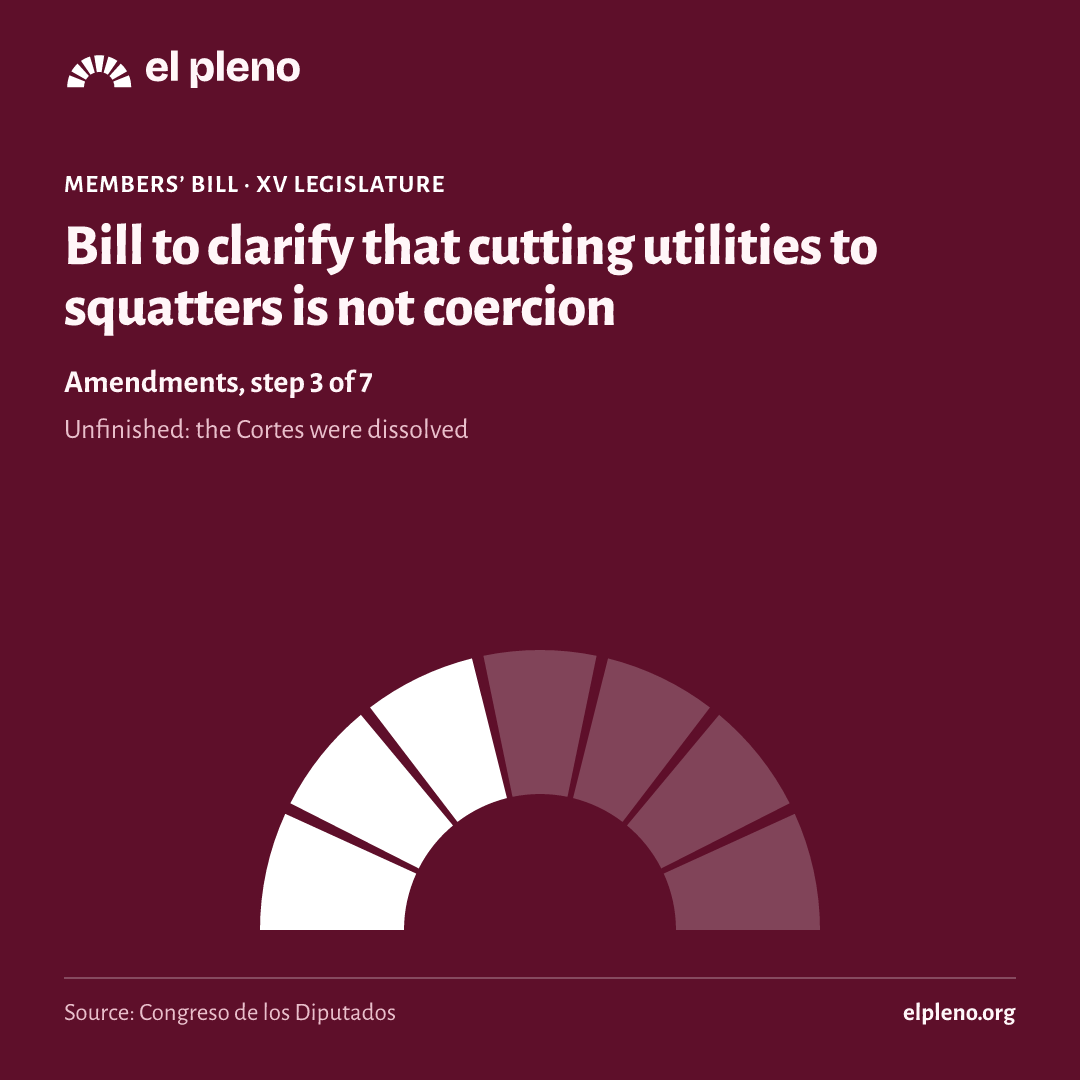
Source: Congreso de los Diputados, file 124/000039· updated 11 Nov
Automatic summary, not yet reviewed
- The bill would add a paragraph to Article 172.1 of the Criminal Code stating that cutting utilities to a property occupied illegally can in no case be considered the crime of coercion.
- The rest of Article 172.1 would stay the same: coercion is punishable by six months to three years in prison or a fine of 12 to 24 months, with harsher penalties if a fundamental right or the legitimate enjoyment of a home is blocked.
- If passed, the law would take effect the day after its publication in the Official State Gazette (Boletín Oficial del Estado).
Who it affects
- Owners of homes or properties occupied illegally: They could cut off utilities without risking a coercion charge.
- People who occupy properties illegally: They could be left without power or water, and the shutoff would not be a crime.
- Judges and courts: They would have a clear legal standard to apply across Spain.
Words worth knowing
- Coacción (coercion)
- The crime of forcing someone, through violence or pressure, to do something they do not want or to not do something the law does not forbid.
- Usurpación (usurpation)
- Taking over or using a property without the consent of its rightful owner.
- Allanamiento de morada (breaking into a dwelling)
- Entering someone's home or staying there against their will.
- Proposición de ley (bill)
- A proposed new law or change to a law that still must be debated and approved by the Congress and the Senate.
It summarizes the text as it was introduced. It is written by artificial intelligence and may contain mistakes: the official text is what counts. Read the official text · How we make summaries
Where it stands
How far did it get?
It took 3 of 7 steps. It reached Amendments, and today it is unfinished.
- Introduced21 November 2025Someone registers the text in the Congreso.
- Admitted25 November 2025The Bureau of the Congreso accepts it and, for a members’ bill, the plenary decides whether to consider it.
- Amendments28 November 2025Groups propose changes.
- Committeenot reachedA committee goes through the text in detail.
- Plenarynot reachedAll 350 deputies vote.
- Senatenot reachedThe Senate can pass it, amend it or veto it.
- BOEnot reachedIt is published in the Official State Gazette (BOE) and comes into force.
See the 5 official steps on a timeline
Was there a plenary vote?
We have no plenary vote linked to this law in the Congreso’s data.
What happens next
What happens now?
The legislature ended before it finished. To go on, someone would have to introduce it again in the new Cortes.
It has not been presented again yet.
Sources
Where does all this come from?
- Congreso de los Diputados, file 124/000039
Official title, type, author, dates and stage.
Retrieved 11 November 2026
- Congreso de los Diputados, procedure
The date of each step, with its official wording.
Retrieved 12 November 2026
- The data comes from the open files of the Congreso, the Senate and the BOE, unaltered.
- Each deputy’s province is the one of their seat on the day of the vote.
- We only say “passed” or “rejected” when the majority needed is certain; otherwise we say which side had more votes.