What it is
Bill would tighten immigrant regularization and deportation rules
It is a members’ bill. Introduced by parliamentary groups, the Senate, regional governments or citizens. It was introduced on 21 November 2025. Introduced by: Senado.
Official title: Private member's bill, Organic Law amending Organic Law 4/2000, of January 11, on the rights and freedoms of foreigners in Spain and their social integration, to restrict the regularization of illegal immigrants through long-term residence.
Source: Congreso de los Diputados, file 124/000038· updated 11 Nov
Automatic summary, not yet reviewed
- The bill, introduced by the Mixed Group in the Senate at the request of VOX senators, seeks to restrict regularization through "Arraigo A figure that lets an irregular migrant get a residence permit by proving time in Spain and integration." and toughen immigration law. It is not an approved law: it is being processed in the Congress of Deputies (Congreso de los Diputados), where the Labor, Social Economy, Inclusion, Social Security and Migration Committee has been asked to issue a report, with amendments due by December 18, 2025.
- It removes arraigo as a path to regularization: it repeals Article 53.1.a) and Articles 69 to 72 of the Aliens Law, and requires temporary residence applicants to have no criminal record in Spain or in their previous countries of residence. A criminal record in the integration report would, by itself and automatically, mean denial of the permit.
- It expands deportation grounds: being convicted, inside or outside Spain, of a serious crime, a less serious crime, or three minor crimes would justify deportation. It also allows permanent entry bans for those posing a serious threat to public order or security, and raises the maximum stay in immigration detention centers to 180 days.
- It limits appeals and the effect of asylum claims: if the Administration misses the deadline, appeals against returns and expulsions would not suspend enforcement, and an asylum request would only pause the process for fifteen days.
- It amends the Penal Code so that sentences imposed on foreign nationals for a serious crime, a less serious crime, or three minor crimes would be replaced by deportation from Spain, with very limited exceptions.
Who it affects
- Foreign nationals in an irregular situation in Spain: They would lose the arraigo path to regularization, and detentions and deportations would increase.
- Foreign nationals convicted of crimes: Their prison sentences could be replaced by deportation, with an entry ban.
- Asylum seekers facing return or deportation: Their claim would only pause the process for fifteen days.
- Autonomous Communities and town councils: They would have to issue integration reports that include the applicant's criminal record.
Words worth knowing
- Arraigo
- A figure that lets an irregular migrant get a residence permit by proving time in Spain and integration.
- Ley de Extranjería
- Organic Law 4/2000, which regulates the rights and residence conditions of foreign nationals in Spain.
- Centro de internamiento de extranjeros
- Facility where foreign nationals are held while awaiting deportation.
- Proposición de ley orgánica
- A bill to amend a law affecting fundamental rights; it needs an absolute majority in the Congress of Deputies to pass.
It summarizes the text as it was introduced. It is written by artificial intelligence and may contain mistakes: the official text is what counts. Read the official text · How we make summaries
Where it stands
How far did it get?
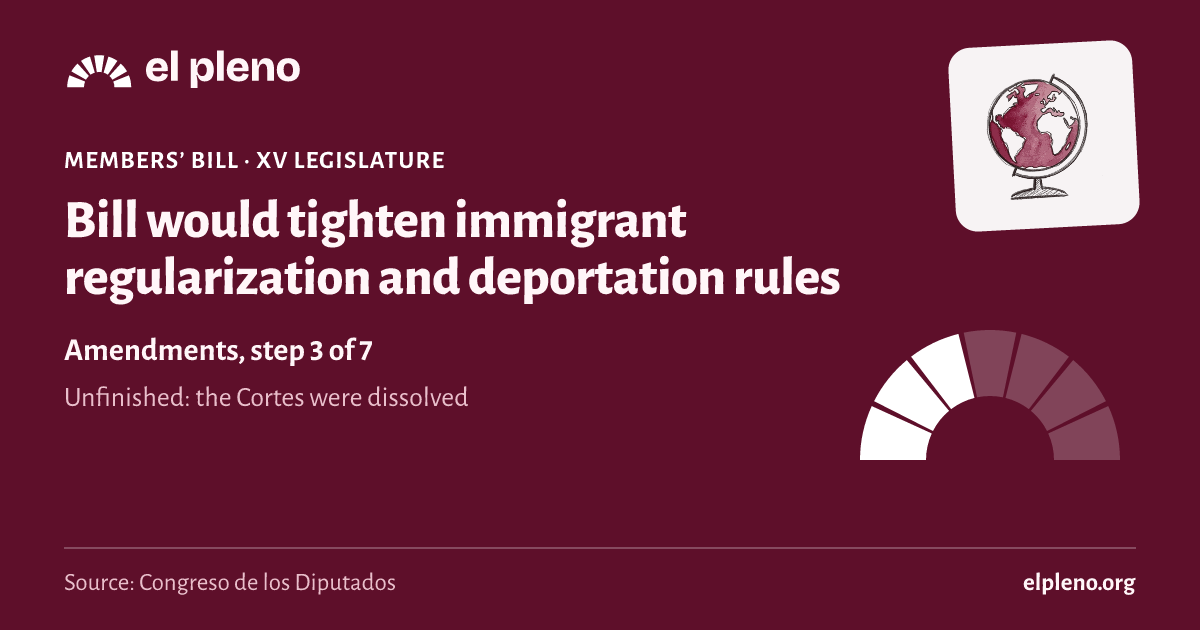
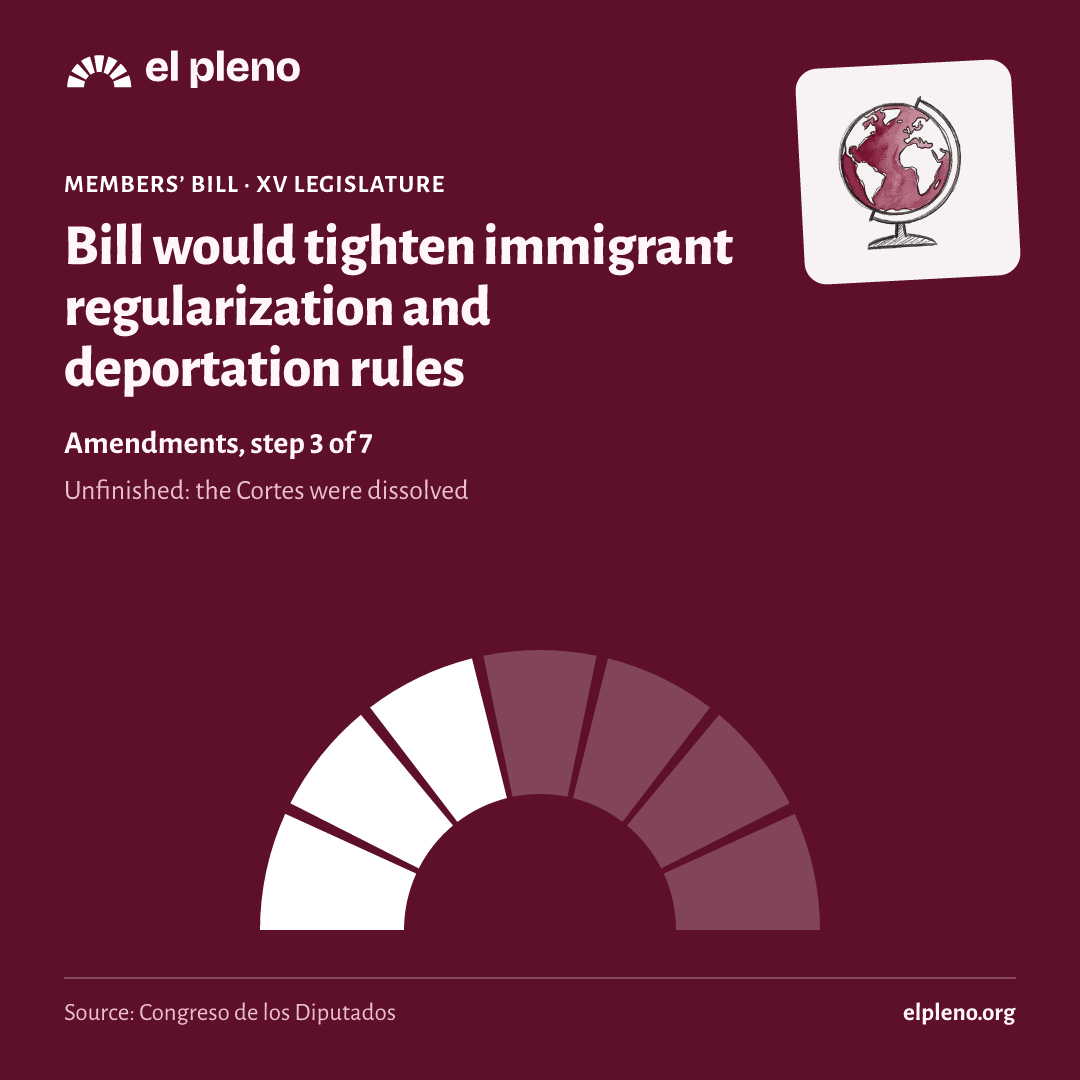
It took 3 of 7 steps. It reached Amendments, and today it is unfinished.
- Introduced21 November 2025Someone registers the text in the Congreso.
- Admitted25 November 2025The Bureau of the Congreso accepts it and, for a members’ bill, the plenary decides whether to consider it.
- Amendments28 November 2025Groups propose changes.
- Committeenot reachedA committee goes through the text in detail.
- Plenarynot reachedAll 350 deputies vote.
- Senatenot reachedThe Senate can pass it, amend it or veto it.
- BOEnot reachedIt is published in the Official State Gazette (BOE) and comes into force.
See the 5 official steps on a timeline
Was there a plenary vote?
We have no plenary vote linked to this law in the Congreso’s data.
What happens next
What happens now?
The legislature ended before it finished. To go on, someone would have to introduce it again in the new Cortes.
It has not been presented again yet.
The same initiative in the other chamber:
Sources
Where does all this come from?
- Congreso de los Diputados, file 124/000038
Official title, type, author, dates and stage.
Retrieved 11 November 2026
- Congreso de los Diputados, procedure
The date of each step, with its official wording.
Retrieved 12 November 2026
- The data comes from the open files of the Congreso, the Senate and the BOE, unaltered.
- Each deputy’s province is the one of their seat on the day of the vote.
- We only say “passed” or “rejected” when the majority needed is certain; otherwise we say which side had more votes.