What it is
Proposal to let small businesses deduct local business tax from corporate tax
It is a members’ bill. Introduced by parliamentary groups, the Senate, regional governments or citizens. It was introduced on 20 June 2025. Introduced by: Senado.
Official title: Private member's bill for the reduction of tax pressure on SMEs and self-employed workers.
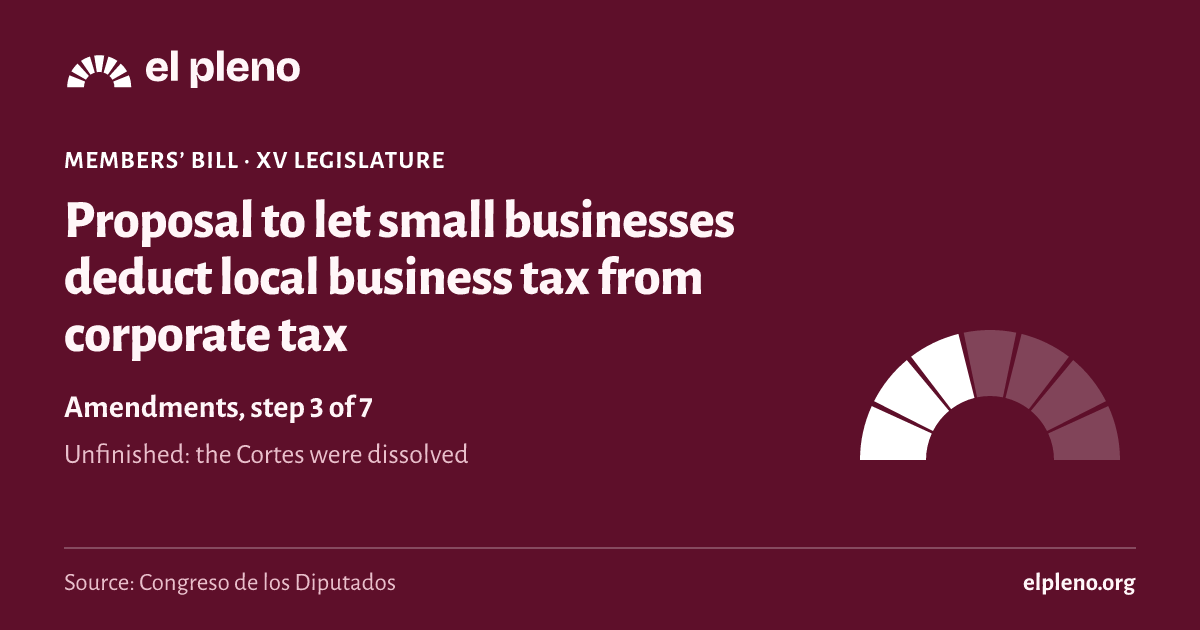
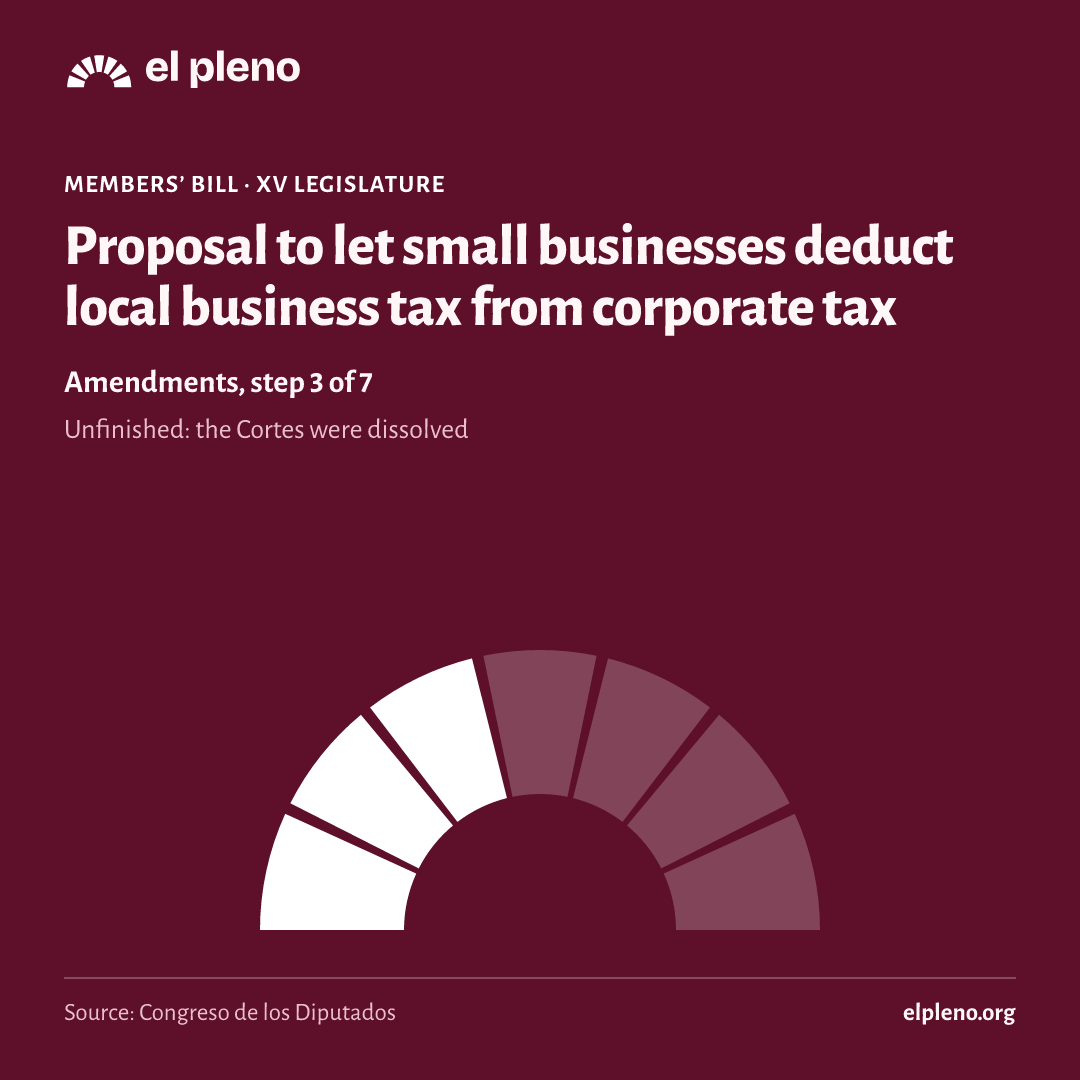
Source: Congreso de los Diputados, file 124/000032· updated 11 Nov
Automatic summary, not yet reviewed
- The bill would add a new article to the Corporate income tax The personal income tax (IRPF in Spain): what people pay on what they earn from work, business or savings. Law so that small and medium-sized companies could deduct the amounts paid as the Economic Activities Tax from their corporate tax bill. The deduction could not exceed the full tax liability, and any leftover could be applied over the following ten years, with payment proven through official receipts.
- Businesses with net turnover under €2,000,000, both individuals and companies, would be exempt from the Economic Activities Tax. A new provision would also guarantee that city councils keep collecting the full amount of that tax despite the deduction.
- The bill would adjust how taxable installed capacity is calculated and how sectors declared to be in crisis are taxed during restructuring. It would also clarify that the deduction does not change the classification and rate criteria of the Economic Activities Tax.
Who it affects
- Small and medium-sized businesses and self-employed workers: They could deduct the Economic Activities Tax from their corporate tax, and the smallest ones would be exempt from it.
- City councils: They would keep collecting the full amount of the tax, with no reduction in their revenue.
- Sectors declared to be in crisis: They would adjust their tax payments to their new operating pace.
Words worth knowing
- IAE (Impuesto sobre Actividades Económicas)
- A tax paid by anyone running a business or professional activity in Spain.
- Impuesto sobre Sociedades
- The corporate income tax paid by companies on their profits.
- Cuota íntegra
- The tax amount before any deductions are applied.
- Importe neto de la cifra de negocios
- The company's annual turnover, calculated under the Spanish Commercial Code.
- Potencia instalada
- The power of an industry's equipment, used to calculate its Economic Activities Tax bill.
- income tax
- The personal income tax (IRPF in Spain): what people pay on what they earn from work, business or savings.
It summarizes the text as it was introduced. It is written by artificial intelligence and may contain mistakes: the official text is what counts. Read the official text · How we make summaries
Where it stands
How far did it get?
It took 3 of 7 steps. It reached Amendments, and today it is unfinished.
- Introduced20 June 2025Someone registers the text in the Congreso.
- Admitted24 June 2025The Bureau of the Congreso accepts it and, for a members’ bill, the plenary decides whether to consider it.
- Amendments27 June 2025Groups propose changes.
- Committeenot reachedA committee goes through the text in detail.
- Plenarynot reachedAll 350 deputies vote.
- Senatenot reachedThe Senate can pass it, amend it or veto it.
- BOEnot reachedIt is published in the Official State Gazette (BOE) and comes into force.
See the 5 official steps on a timeline
Was there a plenary vote?
We have no plenary vote linked to this law in the Congreso’s data.
What happens next
What happens now?
The legislature ended before it finished. To go on, someone would have to introduce it again in the new Cortes.
It has not been presented again yet.
The same initiative in the other chamber:
- XV Legislature, Senate Private member's bill for the reduction of tax pressure on SMEs and self-employed workers.
Sources
Where does all this come from?
- Congreso de los Diputados, file 124/000032
Official title, type, author, dates and stage.
Retrieved 11 November 2026
- Congreso de los Diputados, procedure
The date of each step, with its official wording.
Retrieved 12 November 2026
- The data comes from the open files of the Congreso, the Senate and the BOE, unaltered.
- Each deputy’s province is the one of their seat on the day of the vote.
- We only say “passed” or “rejected” when the majority needed is certain; otherwise we say which side had more votes.