What it is
Bill proposes tax breaks and relief for farmers and ranchers
It is a members’ bill. Introduced by parliamentary groups, the Senate, regional governments or citizens. It was introduced on 24 April 2025. Introduced by: Senado.
Official title: Private member's bill to reform the taxation of the primary sector.
Source: Congreso de los Diputados, file 124/000024· updated 11 Nov
Automatic summary, not yet reviewed
- The bill would raise from 2,000 to 3,000 euros per year the limit for provisions and hard-to-justify expenses available to owners of farm, livestock or forestry operations taxed under simplified direct assessment in personal income tax The personal income tax (IRPF in Spain): what people pay on what they earn from work, business or savings..
- Owners of farm or livestock operations could choose to be taxed on the average income of the current year and the two previous years, with a minimum duration of three years and the option to revoke the choice.
- The bill would raise to 325,000 euros the income limit for special tax regimes in personal income tax and VAT, and to 250,000 euros the purchase limit for farmers, ranchers and foresters, to offset the effect of inflation.
- Direct aid from the central government, autonomous communities and local entities approved in 2025 and 2026 to offset droughts, floods or rising costs would not count as taxable income under personal income tax or corporate tax.
- Under VAT, taxpayers in the special agriculture, livestock and fishing regime could deduct in 2025 and 2026 the tax paid on investment goods, and a new deduction of 25 percent of farm insurance premiums would be added. Flat-rate compensation would also rise to 13.5 percent for farm or forestry products and 12 percent for livestock or fishing products in 2025 and 2026.
- The Productivity Council and the Independent Authority for Fiscal Responsibility would have six months to analyze red tape in the sector and public agricultural policies. The law would apply in 2025 and 2026 and would take effect the day after publication in the Official State Gazette.
Who it affects
- Farmers, ranchers and forestry operators: They would pay less tax: more deductible expenses, three-year average taxation and VAT deductions.
- Fishers: They would get a higher flat-rate VAT compensation and higher limits in the special regime.
- Farm and livestock companies: Public aid from 2025 and 2026 would no longer be taxed under corporate tax.
Words worth knowing
- IRPF
- Impuesto sobre la Renta de las Personas Físicas: Spain's personal income tax, paid by individuals on their income.
- IVA
- Impuesto sobre el Valor Añadido: Spain's VAT, the tax added to the price of most purchases.
- Estimación directa
- A way of calculating tax based on actual yearly income and expenses.
- Régimen especial
- Simpler or more favorable tax rules for certain groups, such as farmers and ranchers.
- Compensación a tanto alzado
- A fixed percentage farmers or ranchers receive on top of the sale price to cover the VAT on their expenses.
- income tax
- The personal income tax (IRPF in Spain): what people pay on what they earn from work, business or savings.
It summarizes the text as it was introduced. It is written by artificial intelligence and may contain mistakes: the official text is what counts. Read the official text · How we make summaries
Where it stands
How far did it get?
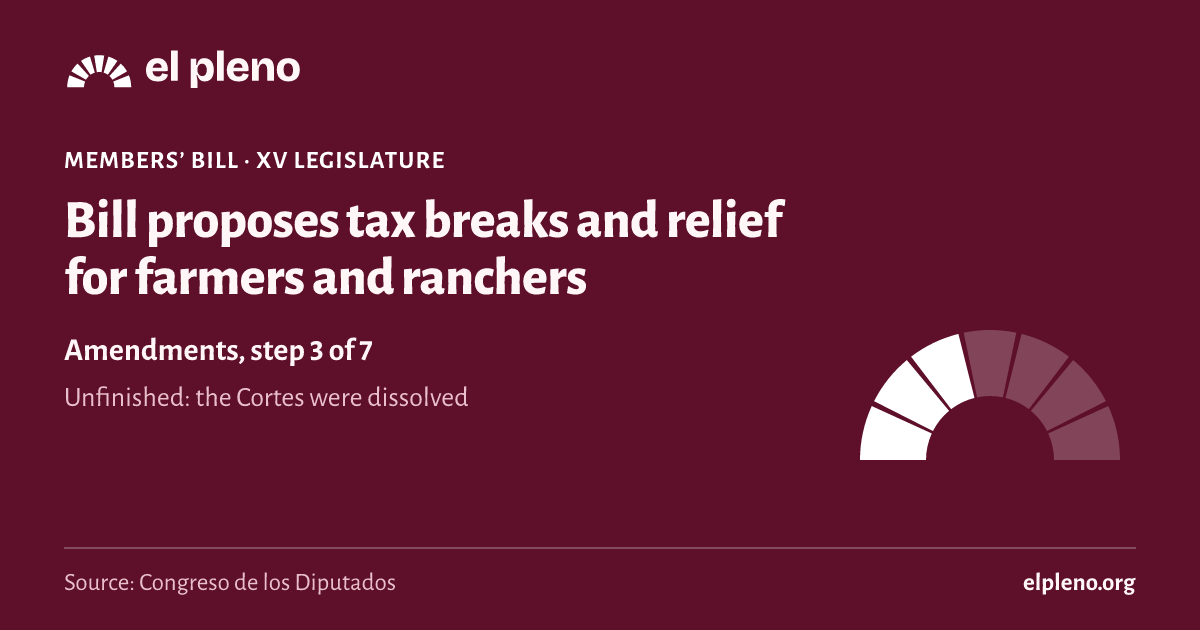
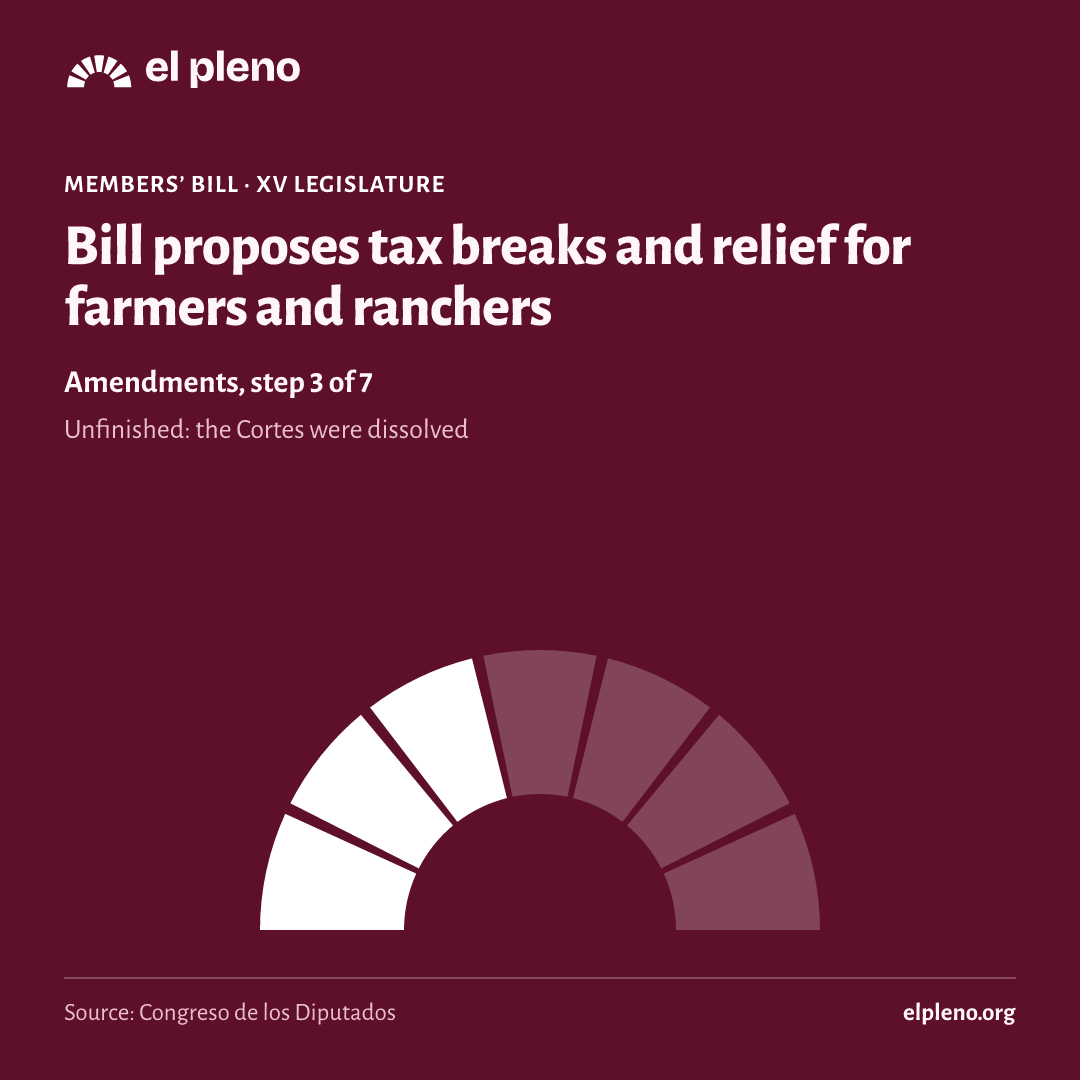
It took 3 of 7 steps. It reached Amendments, and today it is unfinished.
- Introduced24 April 2025Someone registers the text in the Congreso.
- Admitted6 May 2025The Bureau of the Congreso accepts it and, for a members’ bill, the plenary decides whether to consider it.
- Amendments9 May 2025Groups propose changes.
- Committeenot reachedA committee goes through the text in detail.
- Plenarynot reachedAll 350 deputies vote.
- Senatenot reachedThe Senate can pass it, amend it or veto it.
- BOEnot reachedIt is published in the Official State Gazette (BOE) and comes into force.
See the 5 official steps on a timeline
Was there a plenary vote?
We have no plenary vote linked to this law in the Congreso’s data.
What happens next
What happens now?
The legislature ended before it finished. To go on, someone would have to introduce it again in the new Cortes.
It has not been presented again yet.
The same initiative in the other chamber:
- XV Legislature, Senate Private member's bill to reform the taxation of the primary sector.
Sources
Where does all this come from?
- Congreso de los Diputados, file 124/000024
Official title, type, author, dates and stage.
Retrieved 11 November 2026
- Congreso de los Diputados, procedure
The date of each step, with its official wording.
Retrieved 12 November 2026
- The data comes from the open files of the Congreso, the Senate and the BOE, unaltered.
- Each deputy’s province is the one of their seat on the day of the vote.
- We only say “passed” or “rejected” when the majority needed is certain; otherwise we say which side had more votes.