What it is
Proposal to remove the mandatory waste collection fee
It is a members’ bill. Introduced by parliamentary groups, the Senate, regional governments or citizens. It was introduced on 27 February 2025. Introduced by: Senado.
Official title: Private member's bill to amend Law 7/2022, of April 8, on waste and contaminated soils for a circular economy.
Source: Congreso de los Diputados, file 124/000018· updated 11 Nov
Automatic summary, not yet reviewed
- The bill would remove the obligation for local entities to charge a fee or charge for waste collection and treatment services, by deleting sections 3, 4 and 5 of Article 11 of Law 7/2022.
- It would also delete the first final provision of Law 7/2022, which had amended the consolidated text of the Local Finance Law.
- If approved, the law would enter into force the day after its publication in the Official State Gazette.
- According to the statement of reasons, Law 7/2022 requires municipalities to charge, from April 10, 2025, a fee covering the full cost of the waste service. The promoters argue the EU directive does not impose this, that it invades local autonomy, and that it could discourage recycling.
Who it affects
- Municipalities and local entities: They would no longer be required to charge a waste fee covering the full cost of the service.
- Citizens: They would not have to pay 100% of the cost of the waste service through the fee.
- The Popular Parliamentary Group in the Senate: It is the sponsor of this bill to amend Law 7/2022.
Words worth knowing
- Tasa
- A fee paid to a public administration in exchange for a specific service, such as waste collection.
- Prestación patrimonial de carácter público no tributaria
- A mandatory payment to a public administration that is neither a tax nor a fee, used to fund a service.
- Entidades locales
- Local administrations such as municipalities and provincial councils, which manage local services.
- Autonomía local
- The ability of municipalities to organize and manage their own affairs and resources.
- Proposición de ley
- A bill: a text proposed to be passed as a law, not yet in force.
It summarizes the text as it was introduced. It is written by artificial intelligence and may contain mistakes: the official text is what counts. Read the official text · How we make summaries
Where it stands
How far did it get?
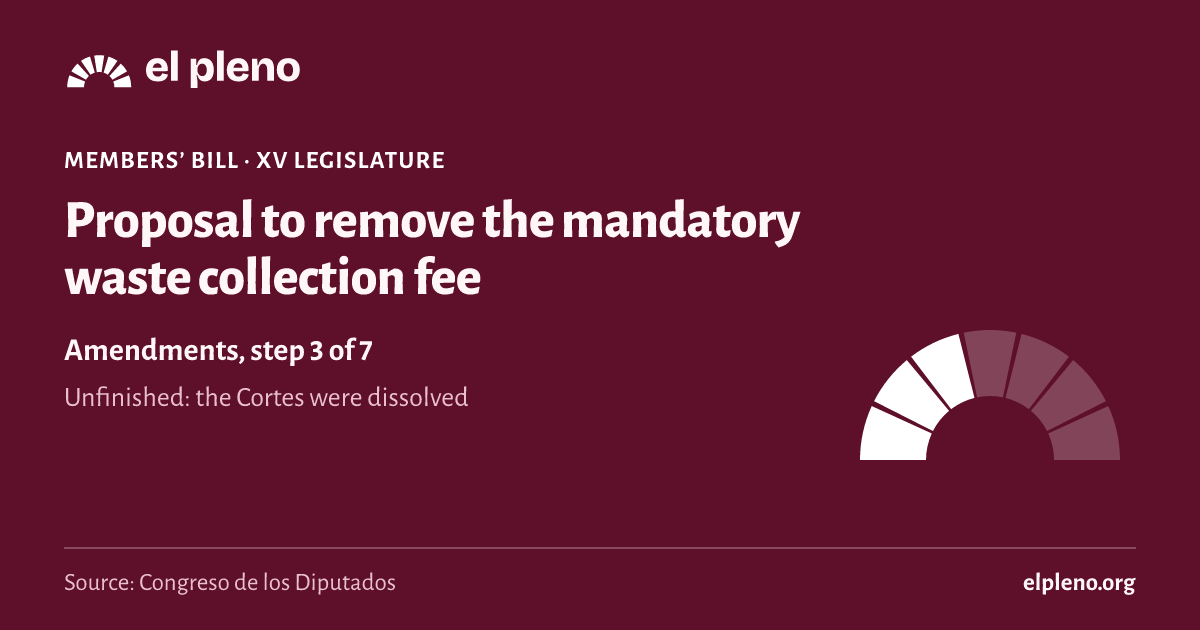
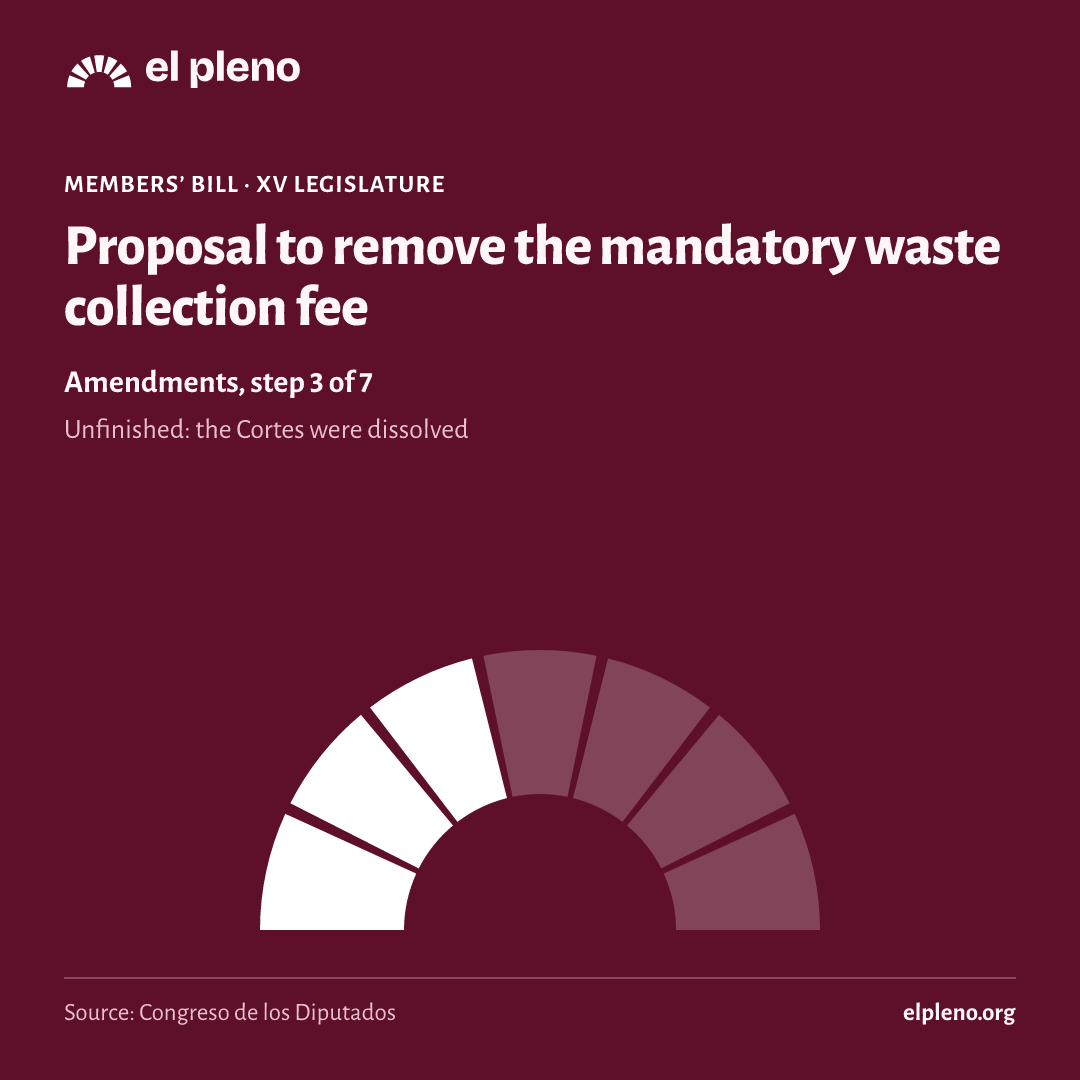
It took 3 of 7 steps. It reached Amendments, and today it is unfinished.
- Introduced27 February 2025Someone registers the text in the Congreso.
- Admitted11 March 2025The Bureau of the Congreso accepts it and, for a members’ bill, the plenary decides whether to consider it.
- Amendments14 March 2025Groups propose changes.
- Committeenot reachedA committee goes through the text in detail.
- Plenarynot reachedAll 350 deputies vote.
- Senatenot reachedThe Senate can pass it, amend it or veto it.
- BOEnot reachedIt is published in the Official State Gazette (BOE) and comes into force.
See the 5 official steps on a timeline
Was there a plenary vote?
We have no plenary vote linked to this law in the Congreso’s data.
What happens next
What happens now?
The legislature ended before it finished. To go on, someone would have to introduce it again in the new Cortes.
It has not been presented again yet.
The same initiative in the other chamber:
Sources
Where does all this come from?
- Congreso de los Diputados, file 124/000018
Official title, type, author, dates and stage.
Retrieved 11 November 2026
- Congreso de los Diputados, procedure
The date of each step, with its official wording.
Retrieved 12 November 2026
- The data comes from the open files of the Congreso, the Senate and the BOE, unaltered.
- Each deputy’s province is the one of their seat on the day of the vote.
- We only say “passed” or “rejected” when the majority needed is certain; otherwise we say which side had more votes.