What it is
Bill to expand the cases the Audiencia Nacional A Spanish court based in Madrid that tries serious nationwide crimes, such as terrorism or major drug cases. can try
It is a members’ bill. Introduced by parliamentary groups, the Senate, regional governments or citizens. It was introduced on 31 May 2024. Introduced by: Senado.
Official title: Private member's bill for an Organic Law amending Organic Law 6/1985, of July 1, on the Judiciary, regarding the delimitation of the competences of the National Court for the trial of crimes of drug trafficking, money laundering, and human trafficking by criminal organizations.
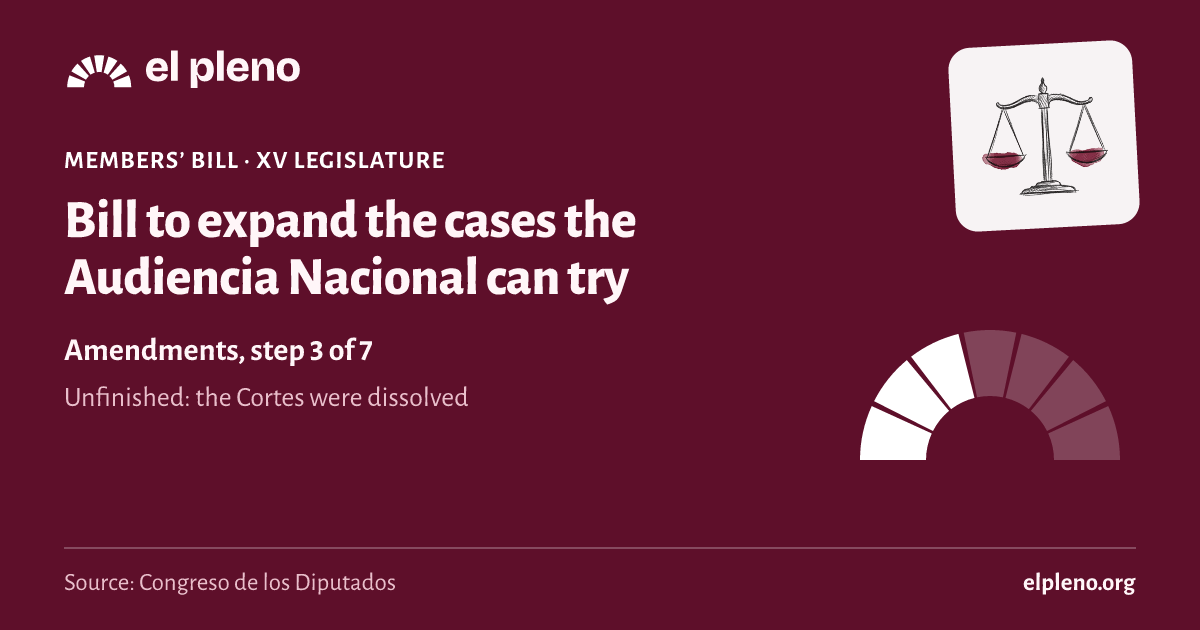
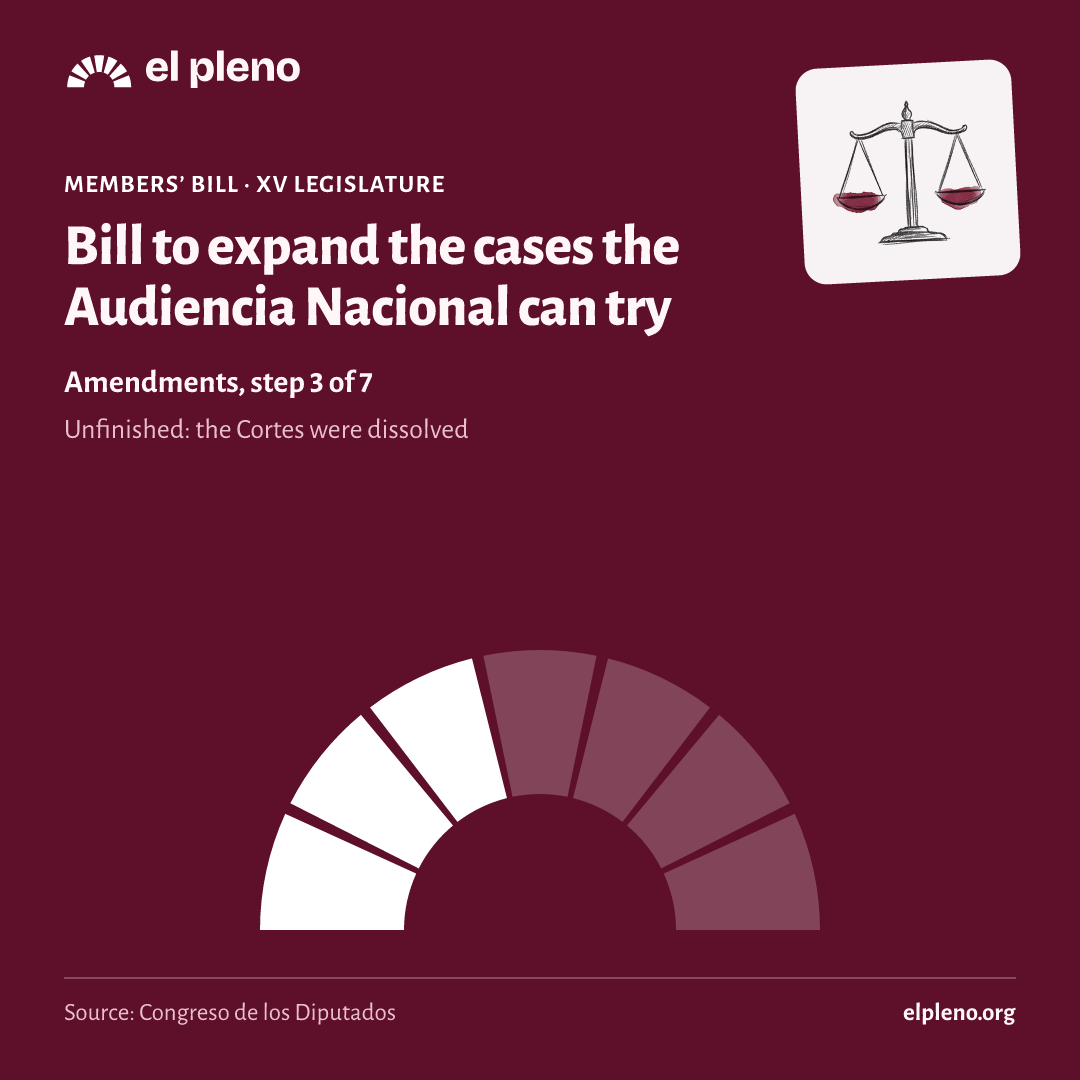
Source: Congreso de los Diputados, file 124/000010· updated 11 Nov
Automatic summary, not yet reviewed
- The bill, sent by the Senate, would change Article 65 of the organic law A law on fundamental rights, the electoral system or other matters the Constitution reserves. It needs an absolute majority in the Congreso: 176 votes. on the Judiciary to clarify which drug trafficking crimes the Audiencia Nacional handles. The goal is for it to take on large transnational cases, not only those spanning several provinces.
- The text argues that large drug trafficking networks have evolved and can operate within a single province. Today, many serious cases are not investigated by the Audiencia Nacional and lack proper resources and specialized judges.
- The bill would rewrite Article 65. Under it, the Audiencia Nacional would try drug trafficking committed by criminal organizations, money laundering linked to those crimes, and human trafficking and smuggling by criminal organizations when they affect places under different Audiencias.
- The bill would also include terrorism offenses in the law, which already belong to the Audiencia Nacional under a 1977 royal decree, to end scattered rules. The law would take effect the day after its publication in the Official State Gazette.
Who it affects
- Judges and prosecutors of the Audiencia Nacional: They would handle serious drug trafficking, money laundering and trafficking cases, even without effects in several provinces.
- People investigated for drug trafficking, money laundering or human trafficking: They could be tried by the Audiencia Nacional in more situations than now.
- State law enforcement bodies: They would investigate these cases with the resources and specialization of the Audiencia Nacional.
Words worth knowing
- Audiencia Nacional
- A Spanish court based in Madrid that tries serious nationwide crimes, such as terrorism or major drug cases.
- Blanqueo de capitales
- Money laundering: making money from a crime look legal.
- Trata de personas
- Human trafficking: recruiting and exploiting people, for example through forced labor.
- Pluriprovincialidad
- When the effects of a crime reach several provinces.
- Proposición de Ley Orgánica
- A bill proposing to change an organic law, a special type of Spanish law. It is not law until passed.
- organic law
- A law on fundamental rights, the electoral system or other matters the Constitution reserves. It needs an absolute majority in the Congreso: 176 votes.
It summarizes the text as it was introduced. It is written by artificial intelligence and may contain mistakes: the official text is what counts. Read the official text · How we make summaries
Where it stands
How far did it get?
It took 3 of 7 steps. It reached Amendments, and today it is unfinished.
- Introduced31 May 2024Someone registers the text in the Congreso.
- Admitted5 June 2024The Bureau of the Congreso accepts it and, for a members’ bill, the plenary decides whether to consider it.
- Amendments7 June 2024Groups propose changes.
- Committeenot reachedA committee goes through the text in detail.
- Plenarynot reachedAll 350 deputies vote.
- Senatenot reachedThe Senate can pass it, amend it or veto it.
- BOEnot reachedIt is published in the Official State Gazette (BOE) and comes into force.
See the 5 official steps on a timeline
Was there a plenary vote?
We have no plenary vote linked to this law in the Congreso’s data.
What happens next
What happens now?
The legislature ended before it finished. To go on, someone would have to introduce it again in the new Cortes.
It has not been presented again yet.
The same initiative in the other chamber:
Sources
Where does all this come from?
- Congreso de los Diputados, file 124/000010
Official title, type, author, dates and stage.
Retrieved 11 November 2026
- Congreso de los Diputados, procedure
The date of each step, with its official wording.
Retrieved 12 November 2026
- The data comes from the open files of the Congreso, the Senate and the BOE, unaltered.
- Each deputy’s province is the one of their seat on the day of the vote.
- We only say “passed” or “rejected” when the majority needed is certain; otherwise we say which side had more votes.