What it is
Bill to protect traditional coastal towns from the Coastal Law
It is a members’ bill. Introduced by parliamentary groups, the Senate, regional governments or citizens. It was introduced on 15 March 2024. Introduced by: Senado.
Official title: Private member's bill regarding the amendment of Law 22/1988, of July 28, on Coasts, to allow the survival of traditional typology coastal urban complexes on land that has become public maritime-terrestrial domain.
Source: Congreso de los Diputados, file 124/000006· updated 11 Nov
Automatic summary, not yet reviewed
- The bill adds a new provision to the Coastal Law (Ley de Costas) allowing traditional residential or commercial building groups to be recognized as "urban nuclei with special ethnological values".
- For that recognition, the town council (Ayuntamiento) must certify the cultural, historical or ethnological values of the nucleus, with a favorable opinion from the Autonomous Community. The building group must also be integrated into the coastal setting and must have existed before becoming public domain.
- Recognized nuclei would be removed from the maritime-terrestrial public domain through a boundary survey, and would be governed as if they were in the protection easement zone. The Government would also have to protect their seafront when planning works.
- The law would take effect the day after its publication in the Official State Gazette (Boletín Oficial del Estado), and the economic cost would be estimated by the relevant ministry.
Who it affects
- Residents and businesses in traditional coastal nuclei that have become part of the maritime-terrestrial public domain.: They could avoid eviction or demolition of their homes or premises.
- Town councils where these nuclei are located.: They must certify the values of the nucleus and request its recognition.
- Autonomous Communities.: They must issue a favorable report on the values of the proposed nucleus.
- The Government.: It would have to consider protecting the seafront of these nuclei when planning works.
Words worth knowing
- Dominio público marítimo-terrestre (maritime-terrestrial public domain)
- Beach and coastal areas owned by the State for public use, not private.
- Deslinde (boundary survey)
- Procedure that sets where the State's public domain begins and ends on the coast.
- Zona de servidumbre de protección (protection easement zone)
- Strip next to the public domain where people can own property, but with limits on its use.
- Valores etnológicos (ethnological values)
- Values linked to the culture and traditional ways of life of a place.
It summarizes the text as it was introduced. It is written by artificial intelligence and may contain mistakes: the official text is what counts. Read the official text · How we make summaries
Where it stands
How far did it get?
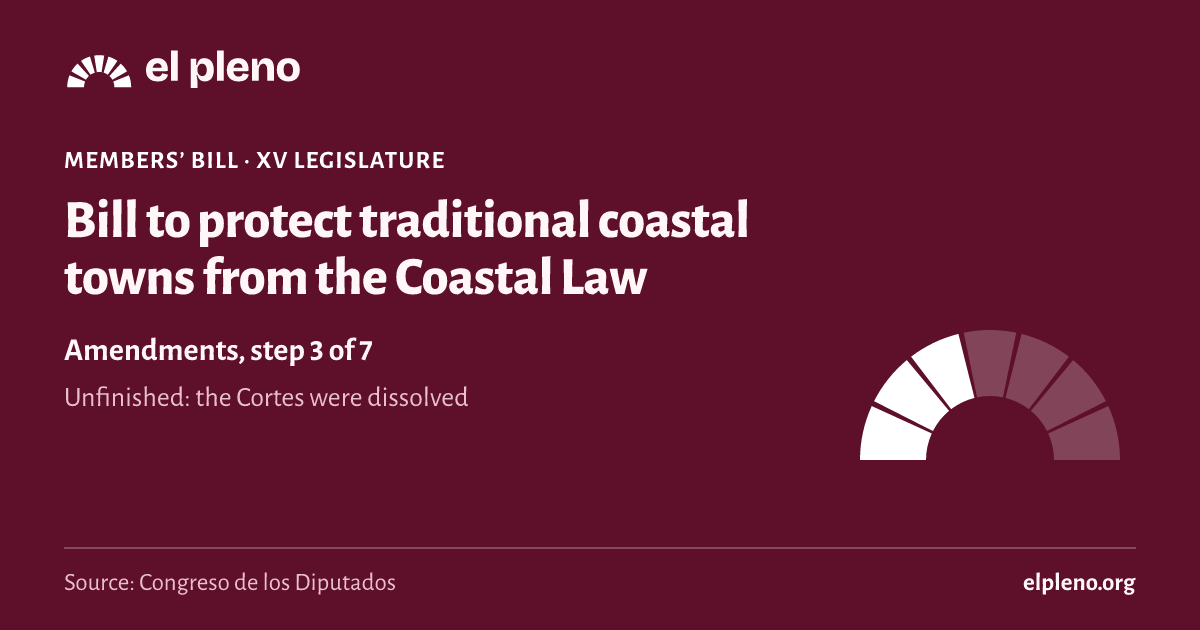
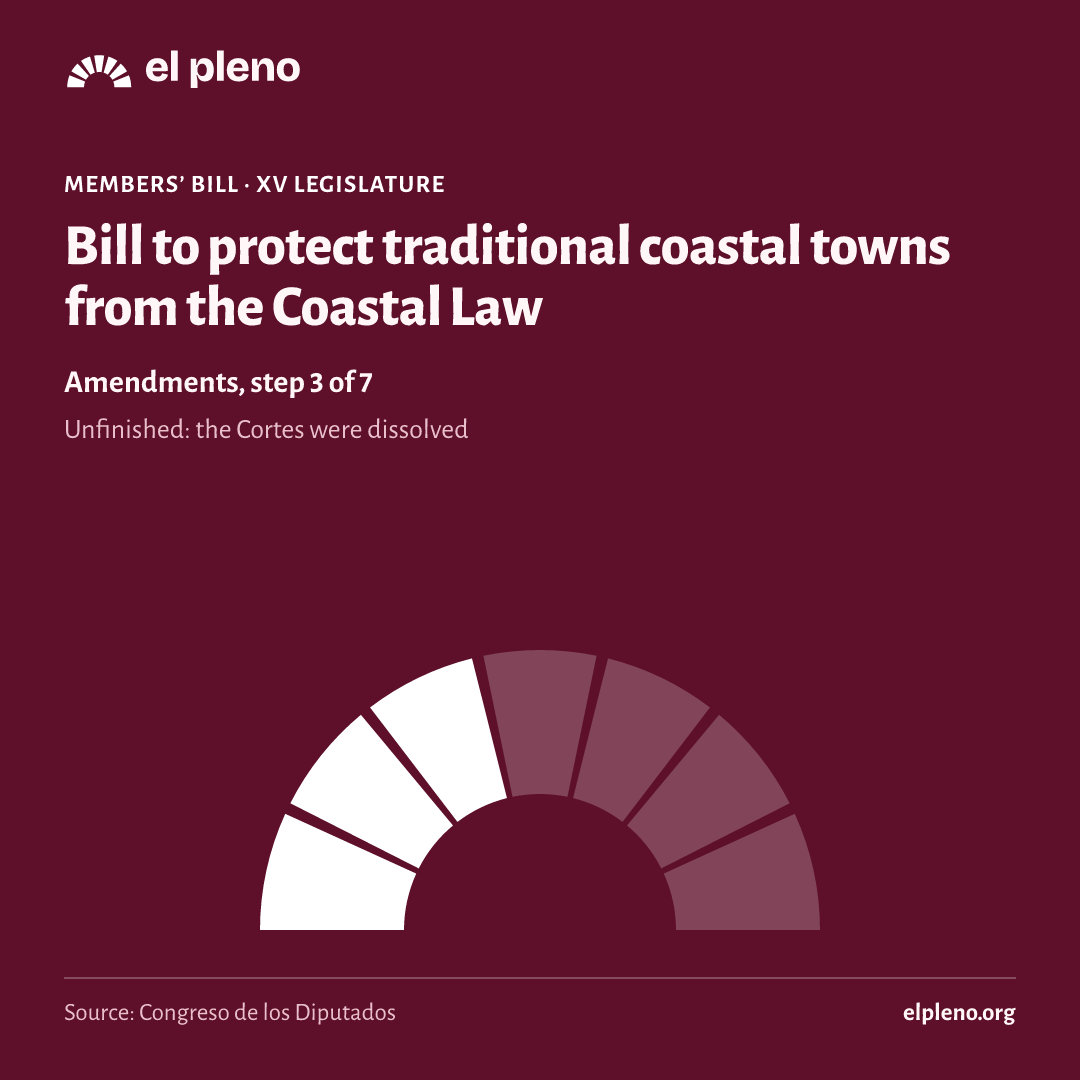
It took 3 of 7 steps. It reached Amendments, and today it is unfinished.
- Introduced15 March 2024Someone registers the text in the Congreso.
- Admitted19 March 2024The Bureau of the Congreso accepts it and, for a members’ bill, the plenary decides whether to consider it.
- Amendments22 March 2024Groups propose changes.
- Committeenot reachedA committee goes through the text in detail.
- Plenarynot reachedAll 350 deputies vote.
- Senatenot reachedThe Senate can pass it, amend it or veto it.
- BOEnot reachedIt is published in the Official State Gazette (BOE) and comes into force.
See the 5 official steps on a timeline
Was there a plenary vote?
We have no plenary vote linked to this law in the Congreso’s data.
What happens next
What happens now?
The legislature ended before it finished. To go on, someone would have to introduce it again in the new Cortes.
It has not been presented again yet.
The same initiative in the other chamber:
- XV Legislature, Senate Private member's bill regarding the amendment of Law 22/1988, of July 28, on Coasts, to allow the survival of traditional typology coastal urban complexes on land that has become public maritime-terrestrial domain.
- XV Legislature, Senate Private member's bill regarding the amendment of Law 22/1988, of July 28, on Coasts, to allow the survival of traditional typology coastal urban complexes on land that has become public maritime-terrestrial domain.
Presented before in:
- XIV Legislature, Senate Private member's bill regarding the amendment of Law 22/1988, of July 28, on Coasts, to allow the survival of traditional typology coastal urban complexes on land that has become public maritime-terrestrial domain.
- XIV Legislature, Senate Private member's bill regarding the amendment of Law 22/1988, of July 28, on Coasts, to allow the survival of traditional typology coastal urban complexes on land that has become public maritime-terrestrial domain.
Sources
Where does all this come from?
- Congreso de los Diputados, file 124/000006
Official title, type, author, dates and stage.
Retrieved 11 November 2026
- Congreso de los Diputados, procedure
The date of each step, with its official wording.
Retrieved 12 November 2026
- The data comes from the open files of the Congreso, the Senate and the BOE, unaltered.
- Each deputy’s province is the one of their seat on the day of the vote.
- We only say “passed” or “rejected” when the majority needed is certain; otherwise we say which side had more votes.