What it is
Bill would expand reviewable life imprisonment to more serious crimes
It is a members’ bill. Introduced by parliamentary groups, the Senate, regional governments or citizens. It was introduced on 23 February 2024. Introduced by: Senado.
Official title: Private member's bill, Organic Law amending Organic Law 10/1995, of November 23, of the Penal Code.
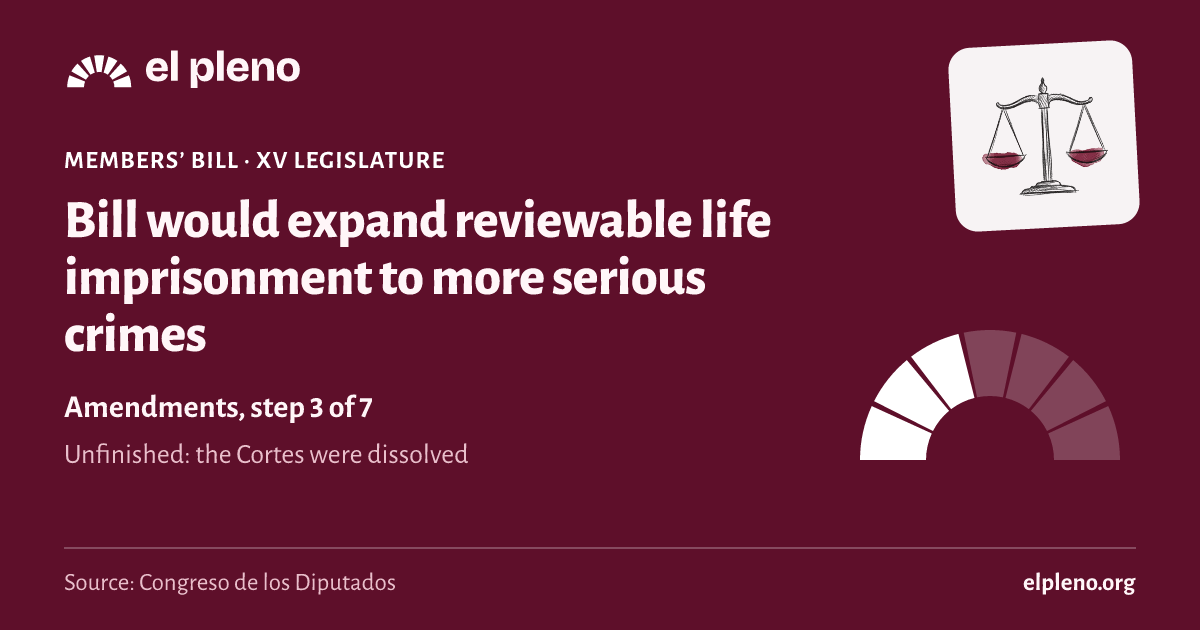
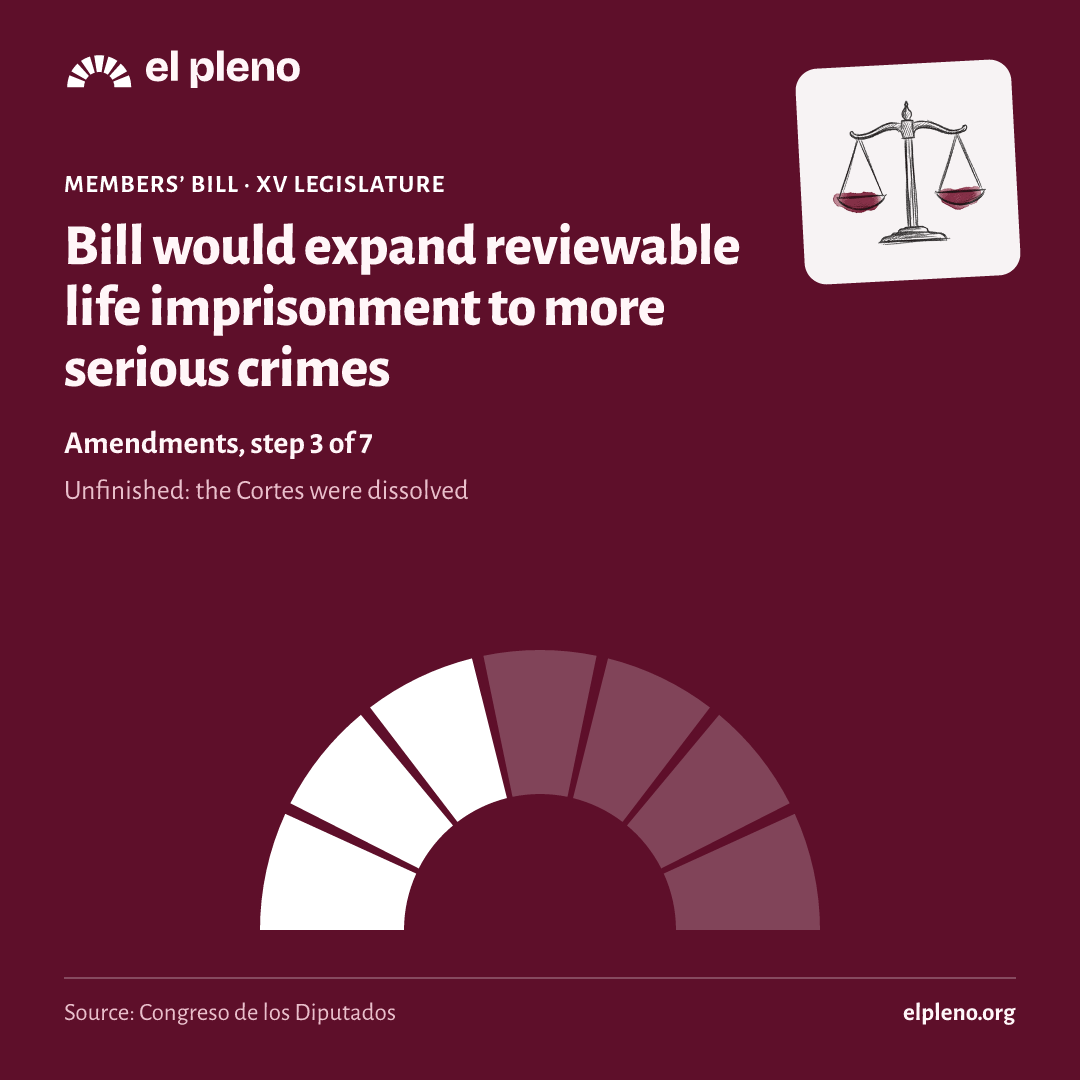
Source: Congreso de los Diputados, file 124/000004· updated 11 Nov
Automatic summary, not yet reviewed
- The bill would impose reviewable life imprisonment on anyone convicted of crimes against life or sexual freedom whose sentences add up to 100 years or more.
- It would add new cases where murder can carry reviewable life imprisonment: when it follows a sex crime, unlawful detention or kidnapping; when the offender hides or destroys the body to hinder the investigation; or when the victim is a spouse, ex-partner, relative or especially vulnerable person in the offender's care.
- It would also punish repeat serious sexual abuse offenses with reviewable life imprisonment.
- Today this penalty exists only for eight very serious cases, such as terrorist murder or genocide. The bill's explanatory statement argues it should be expanded to protect society and deliver sentences seen as fair.
Who it affects
- People convicted of very serious crimes against life or sexual freedom: Could receive reviewable life imprisonment in more cases than now.
- Victims of domestic or gender violence and their relatives: Murdering a spouse, ex-partner, relative or person in one's care could carry this penalty.
- Minors and people with disabilities in public or private facilities: If murdered while in someone's custody, the crime could carry reviewable life imprisonment.
Words worth knowing
- Prisión permanente revisable
- Reviewable life imprisonment, the harshest penalty in the Spanish Criminal Code. It is not life without parole: after a minimum of 25 to 35 years, a court can review it and grant release if there are guarantees the person will not reoffend.
- Ley Orgánica
- Organic law, a type of Spanish law reserved for major matters such as the Criminal Code, requiring a special majority in Congress.
- Tercer grado
- Third-degree prison regime, allowing the sentence to be served with more freedom, such as holding a job or spending part of the day outside prison.
- Proposición de ley
- A bill, the starting text of the lawmaking process. It is not yet approved or in force.
It summarizes the text as it was introduced. It is written by artificial intelligence and may contain mistakes: the official text is what counts. Read the official text · How we make summaries
Where it stands
How far did it get?
It took 3 of 7 steps. It reached Amendments, and today it is unfinished.
- Introduced23 February 2024Someone registers the text in the Congreso.
- Admitted27 February 2024The Bureau of the Congreso accepts it and, for a members’ bill, the plenary decides whether to consider it.
- Amendments1 March 2024Groups propose changes.
- Committeenot reachedA committee goes through the text in detail.
- Plenarynot reachedAll 350 deputies vote.
- Senatenot reachedThe Senate can pass it, amend it or veto it.
- BOEnot reachedIt is published in the Official State Gazette (BOE) and comes into force.
See the 5 official steps on a timeline
Was there a plenary vote?
We have no plenary vote linked to this law in the Congreso’s data.
What happens next
What happens now?
The legislature ended before it finished. To go on, someone would have to introduce it again in the new Cortes.
It has not been presented again yet.
Sources
Where does all this come from?
- Congreso de los Diputados, file 124/000004
Official title, type, author, dates and stage.
Retrieved 11 November 2026
- Congreso de los Diputados, procedure
The date of each step, with its official wording.
Retrieved 12 November 2026
- The data comes from the open files of the Congreso, the Senate and the BOE, unaltered.
- Each deputy’s province is the one of their seat on the day of the vote.
- We only say “passed” or “rejected” when the majority needed is certain; otherwise we say which side had more votes.