What it is
Bill to tax fortunes above 50 million euros
It is a members’ bill. Introduced by parliamentary groups, the Senate, regional governments or citizens. It was introduced on 16 September 2026. Introduced by: Grupo Parlamentario Plurinacional SUMAR.
Official title: Private member's bill to create the Levy on the Concentration of Wealth.
Source: Congreso de los Diputados, file 122/000303· updated 11 Nov
Automatic summary, not yet reviewed
- The bill would create the Levy on Wealth Concentration, a non-tax public patrimonial charge for individuals with net wealth above 50 million euros. A single 3% rate would apply to the amount above that threshold.
- The revenue would go to a new Childhood Protection Fund, intended to finance a universal child-rearing benefit for people under 18. The Government would have to send Parliament a bill on that benefit within six months.
- Exempt items would include historic heritage, certain artworks held in public deposit, artists' own works, household goods, and the main home up to 300,000 euros. There would be no general exemption for business assets or company shares.
- Residents in Spain would pay on all their wealth, and non-residents only on assets in Spain. Anyone moving abroad would remain subject for five years, unless exceptions in the law apply.
- The levy would be coordinated with the Wealth Tax and the Temporary Solidarity Tax on Great Fortunes through deductions to avoid paying twice on the same assets. It would also set a maximum marginal rate of 3.5% in the Wealth Tax for the base above 50 million euros.
- The levy would accrue on December 31 each year, would be managed by the State, and could not be transferred to the autonomous communities. The first accrual would be on December 31 of the year after the law takes effect.
Who it affects
- Individuals with net wealth above 50 million euros, resident in Spain: They would have to file a return and pay 3% on the amount above that threshold.
- Non-residents with assets in Spain: They would pay only on assets located or exercisable in Spanish territory.
- Families with children under 18: They would benefit from the universal child-rearing benefit financed by the new Fund.
- Non-residents without a representative in Spain: They face a fixed fine of 100,000 euros if they fail to appoint one.
Words worth knowing
- Prestación patrimonial pública de carácter no tributario
- An obligation to pay money to the State that, under the bill, is not technically a tax but a contribution tied to a specific purpose.
- Devengo
- The moment the debt is calculated, here December 31 of each year.
- Obligación personal y obligación real
- Personal liability covers residents on all their assets; real liability covers non-residents only on assets in Spain.
- Autoliquidación
- Self-assessment: taxpayers themselves calculate and file the amount due.
It summarizes the text as it was introduced. It is written by artificial intelligence and may contain mistakes: the official text is what counts. Read the official text · How we make summaries
Where it stands
How far did it get?
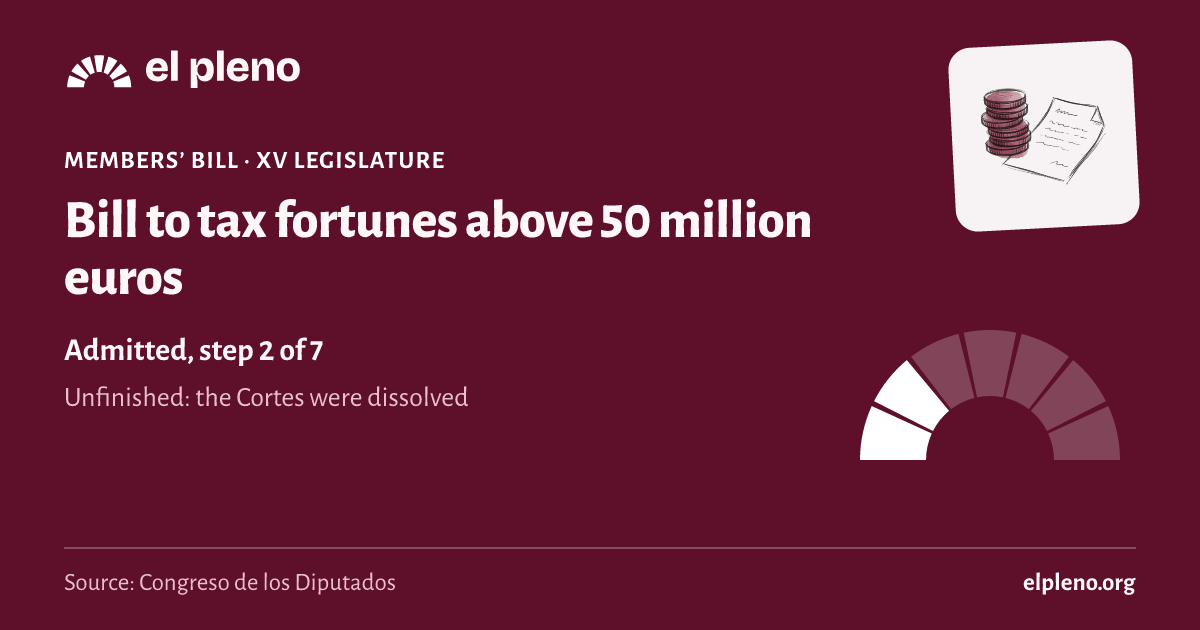
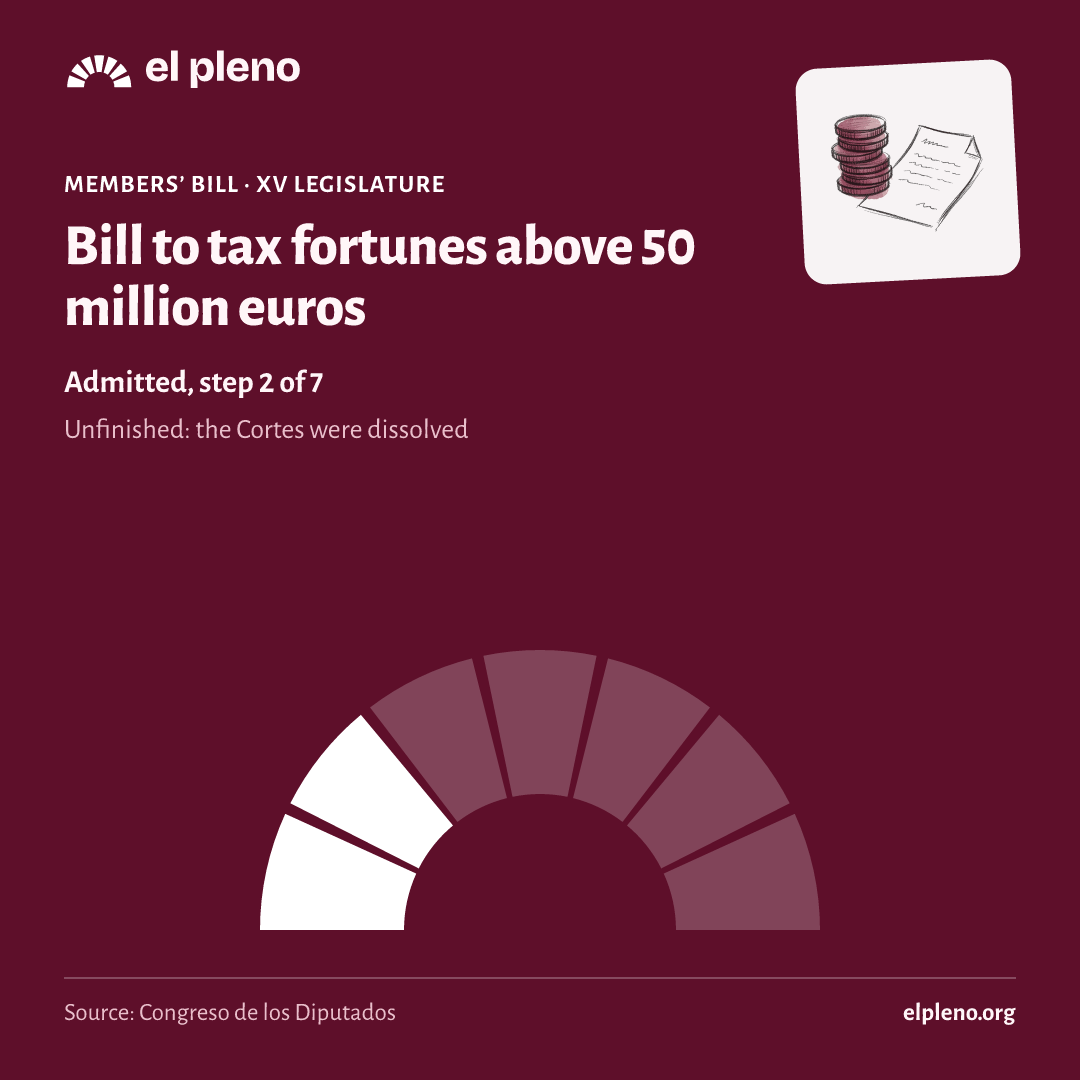
It took 2 of 7 steps. It reached Admitted, and today it is unfinished.
- Introduced16 September 2026Someone registers the text in the Congreso.
- Admitted22 September 2026The Bureau of the Congreso accepts it and, for a members’ bill, the plenary decides whether to consider it.
- Amendmentsnot reachedGroups propose changes.
- Committeenot reachedA committee goes through the text in detail.
- Plenarynot reachedAll 350 deputies vote.
- Senatenot reachedThe Senate can pass it, amend it or veto it.
- BOEnot reachedIt is published in the Official State Gazette (BOE) and comes into force.
See the 5 official steps on a timeline
Was there a plenary vote?
We have no plenary vote linked to this law in the Congreso’s data.
What happens next
What happens now?
The legislature ended before it finished. To go on, someone would have to introduce it again in the new Cortes.
It has not been presented again yet.
Sources
Where does all this come from?
- Congreso de los Diputados, file 122/000303
Official title, type, author, dates and stage.
Retrieved 11 November 2026
- Congreso de los Diputados, procedure
The date of each step, with its official wording.
Retrieved 13 November 2026
- The data comes from the open files of the Congreso, the Senate and the BOE, unaltered.
- Each deputy’s province is the one of their seat on the day of the vote.
- We only say “passed” or “rejected” when the majority needed is certain; otherwise we say which side had more votes.