What it is
The bill would regulate professional practice of Criminology
It is a members’ bill. Introduced by parliamentary groups, the Senate, regional governments or citizens. It was introduced on 15 September 2026. Introduced by: Grupo Parlamentario Socialista Grupo Parlamentario Plurinacional SUMAR.
Official title: Private member's bill regulating the professional practice of Criminology.
Source: Congreso de los Diputados, file 122/000302· updated 11 Nov
Automatic summary, not yet reviewed
- The bill would allow only people holding an official university degree in Criminology, or a recognized foreign degree, to practice criminology, and would bind any public or private employer to this requirement.
- It defines criminologists' competencies: researching crime, preventing it, assisting victims, preparing reports and taking part in rehabilitation programs, always without taking over the functions of other professions.
- It would create professional associations (colegios) of Criminology and a General Council as the national body for representation and coordination, with duties including the code of ethics, disciplinary powers and a public National Register of Criminology.
- Membership of the professional association would be mandatory to act before the courts, unless working for public administrations or public entities.
- It sets up a sanctioning system with very serious, serious and minor offenses, penalties ranging from a warning to permanent disbarment from practice, and a procedure with deadlines, appeals and limitation periods.
- Public administrations would have two years to adapt their job classifications, and the law would enter into force six months after publication in the Official State Gazette.
Who it affects
- People with a Criminology degree: They could practice under a regulated framework, with duties of association membership, continuing training and professional secrecy.
- Private companies and entities: They could only hire criminologists with the official degree, and could set up professional companies.
- Public administrations: They would have to adapt their job openings and positions to include the criminologist profile.
- The general public: People could check a public register to see who is qualified to practice criminology.
Words worth knowing
- Colegiación
- Registering with the professional association (colegio), an official body that groups practitioners and checks that they follow the rules.
- Código deontológico
- Set of ethical and professional conduct rules that members of a professional association must follow.
- Homologar un título
- Official recognition that a foreign university degree is equivalent to a Spanish one.
- Non bis in idem
- Rule that forbids punishing someone twice for the same facts.
It summarizes the text as it was introduced. It is written by artificial intelligence and may contain mistakes: the official text is what counts. Read the official text · How we make summaries
Where it stands
How far did it get?
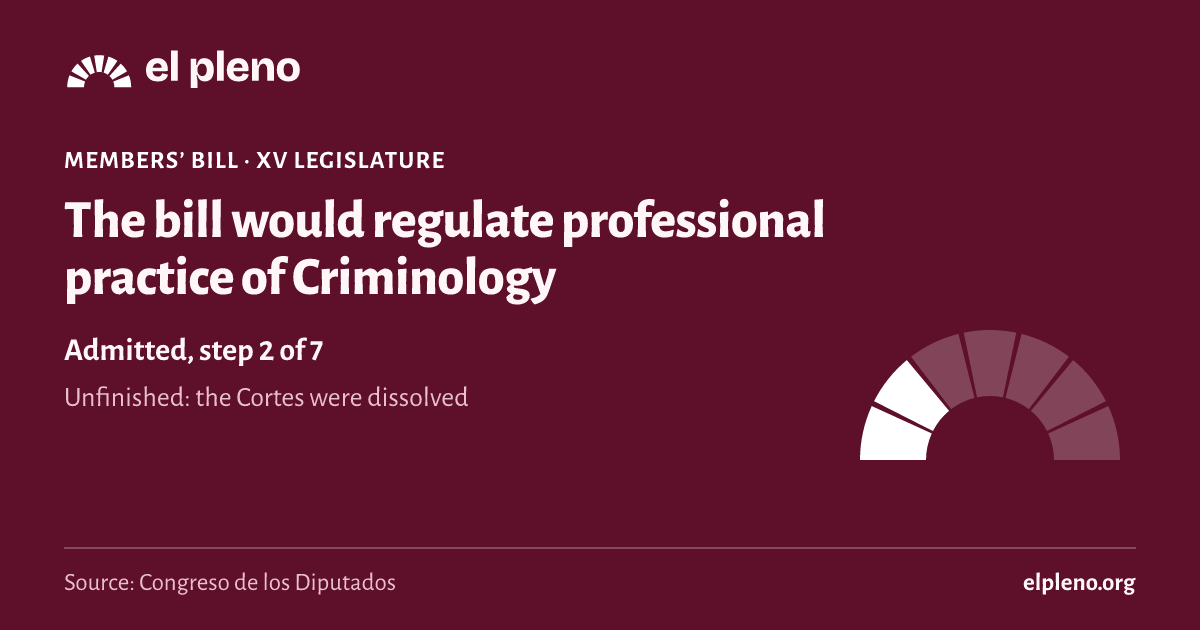
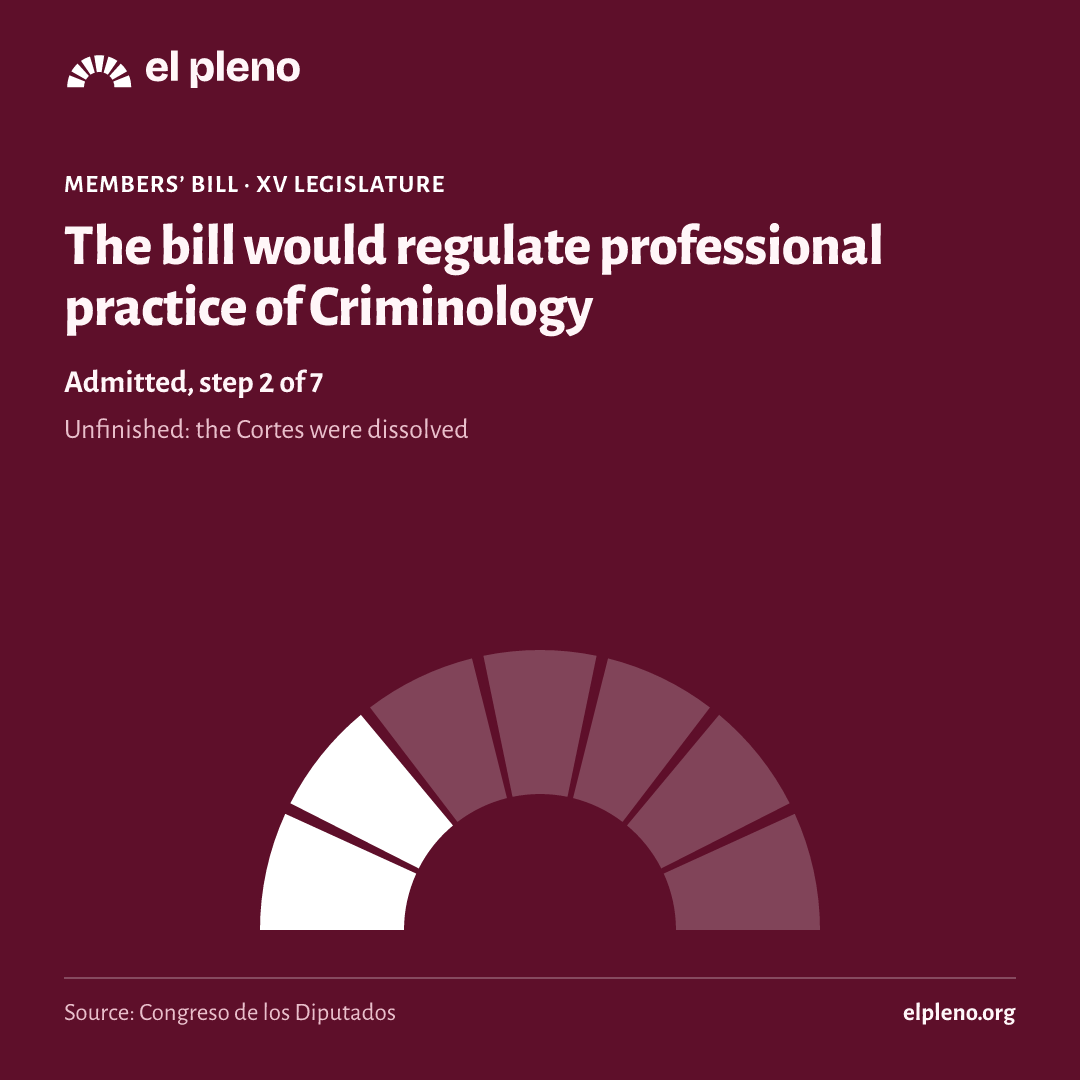
It took 2 of 7 steps. It reached Admitted, and today it is unfinished.
- Introduced15 September 2026Someone registers the text in the Congreso.
- Admitted22 September 2026The Bureau of the Congreso accepts it and, for a members’ bill, the plenary decides whether to consider it.
- Amendmentsnot reachedGroups propose changes.
- Committeenot reachedA committee goes through the text in detail.
- Plenarynot reachedAll 350 deputies vote.
- Senatenot reachedThe Senate can pass it, amend it or veto it.
- BOEnot reachedIt is published in the Official State Gazette (BOE) and comes into force.
See the 5 official steps on a timeline
Was there a plenary vote?
We have no plenary vote linked to this law in the Congreso’s data.
What happens next
What happens now?
The legislature ended before it finished. To go on, someone would have to introduce it again in the new Cortes.
It has not been presented again yet.
Sources
Where does all this come from?
- Congreso de los Diputados, file 122/000302
Official title, type, author, dates and stage.
Retrieved 11 November 2026
- Congreso de los Diputados, procedure
The date of each step, with its official wording.
Retrieved 12 November 2026
- The data comes from the open files of the Congreso, the Senate and the BOE, unaltered.
- Each deputy’s province is the one of their seat on the day of the vote.
- We only say “passed” or “rejected” when the majority needed is certain; otherwise we say which side had more votes.