What it is
Earlier retirement for National Police, Civil Guard and customs officers
It is a members’ bill. Introduced by parliamentary groups, the Senate, regional governments or citizens. It was introduced on 11 September 2026. Introduced by: Grupo Parlamentario Popular en el Congreso.
Official title: Private member's bill to amend Royal Legislative Decree 8/2015, of October 30, approving the Consolidated Text of the General Social Security Law, with the aim of including members of the National Police and the Civil Guard, and officials of the Customs Surveillance Service, within the groups that enjoy a reducing coefficient of the retirement age due to the danger of their work.
Source: Congreso de los Diputados, file 122/000301· updated 11 Nov
Automatic summary, not yet reviewed
- The bill would add a new provision to the General Social Security Law recognizing the National Police, the Civil Guard and the Customs Surveillance Service as entitled to a retirement age reduction coefficient due to the dangerous nature of their work.
- The retirement age would be reduced by applying a 0.20 coefficient to the full years actually worked in those bodies. No one could retire before age 60, except those who prove 35 or more years of activity, who could retire at 59.
- The reduction period would count as contributions to calculate the pension amount, and an additional contribution rate would apply to both employer and worker. The system would only take effect once the Government funds it in the next State Budgets.
- The law would take effect the day after its publication in the BOE, except for measures with budgetary cost, which would wait until the following fiscal year.
Who it affects
- Members of the National Police Corps (Cuerpo de la Policía Nacional): Could retire before the ordinary age and count that time as contributions.
- Members of the Civil Guard (Guardia Civil): Could retire before the ordinary age and count that time as contributions.
- Officials of the Customs Surveillance Service (Servicio de Vigilancia Aduanera): Could retire before the ordinary age and count that time as contributions.
- Employers and the workers themselves in these bodies: Would pay an additional contribution rate on the common contingencies contribution base.
Words worth knowing
- Coeficiente reductor (reduction coefficient)
- A percentage applied to years worked to calculate how much the retirement age can be moved forward.
- Base reguladora (regulatory base)
- The amount used as a reference to calculate the pension amount.
- Contingencias comunes (common contingencies)
- Ordinary risks covered by Social Security, such as retirement or illness, as opposed to workplace accidents.
- Hecho causante (triggering event)
- The moment the conditions for the pension are met, in this case retirement.
It summarizes the text as it was introduced. It is written by artificial intelligence and may contain mistakes: the official text is what counts. Read the official text · How we make summaries
Where it stands
How far did it get?
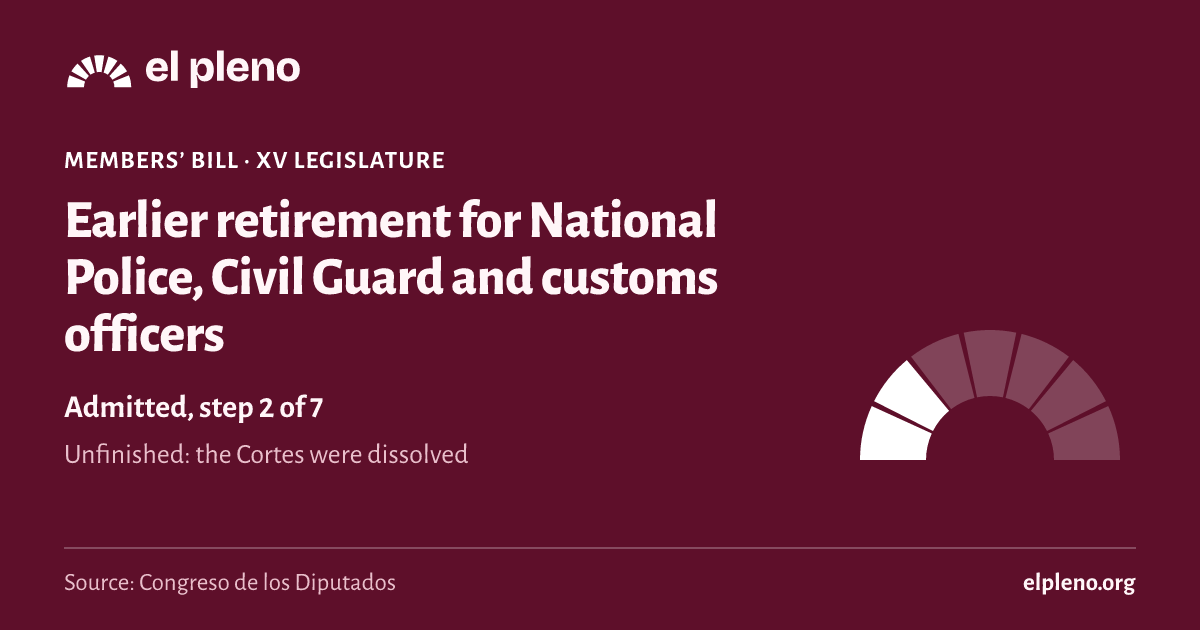
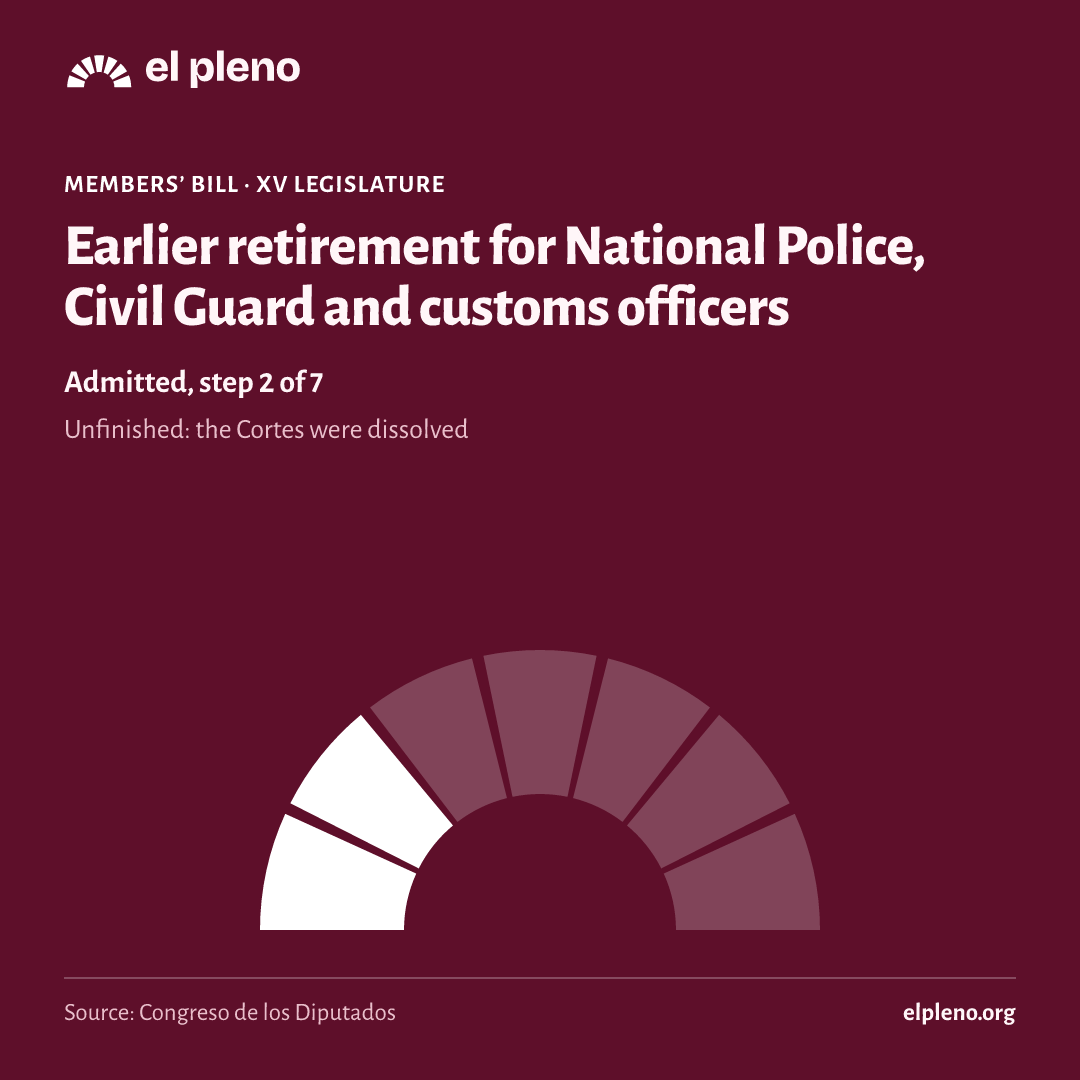
It took 2 of 7 steps. It reached Admitted, and today it is unfinished.
- Introduced11 September 2026Someone registers the text in the Congreso.
- Admitted15 September 2026The Bureau of the Congreso accepts it and, for a members’ bill, the plenary decides whether to consider it.
- Amendmentsnot reachedGroups propose changes.
- Committeenot reachedA committee goes through the text in detail.
- Plenarynot reachedAll 350 deputies vote.
- Senatenot reachedThe Senate can pass it, amend it or veto it.
- BOEnot reachedIt is published in the Official State Gazette (BOE) and comes into force.
See the 5 official steps on a timeline
Was there a plenary vote?
We have no plenary vote linked to this law in the Congreso’s data.
What happens next
What happens now?
The legislature ended before it finished. To go on, someone would have to introduce it again in the new Cortes.
It has not been presented again yet.
Sources
Where does all this come from?
- Congreso de los Diputados, file 122/000301
Official title, type, author, dates and stage.
Retrieved 11 November 2026
- Congreso de los Diputados, procedure
The date of each step, with its official wording.
Retrieved 12 November 2026
- The data comes from the open files of the Congreso, the Senate and the BOE, unaltered.
- Each deputy’s province is the one of their seat on the day of the vote.
- We only say “passed” or “rejected” when the majority needed is certain; otherwise we say which side had more votes.