What it is
Bill would transfer state immigration powers to Catalonia
It is a members’ bill. Introduced by parliamentary groups, the Senate, regional governments or citizens. It was introduced on 26 August 2026. Introduced by: Grupo Parlamentario Junts per Catalunya.
Official title: Private member's bill for an Organic Law delegating to the Autonomous Community of Catalonia state competences in matters of immigration.
Source: Congreso de los Diputados, file 122/000299· updated 11 Nov
Automatic summary, not yet reviewed
- The bill, introduced by Junts per Catalunya and accepted for processing in the Congress of Deputies (Congreso de los Diputados), proposes delegating state immigration powers to the Generalitat de Catalunya, under Article 150.2 of the Constitution. It is not an approved law.
- Catalonia would handle applications for long-term stay for academic activities, temporary residence (to live or live and work) and long-term residence, including renewals, terminations and appeals against these decisions.
- Catalonia would manage collective hiring of workers abroad: it would set annual priority occupations, collect requests from employers and unions, and take part in selection committees under agreements between Spain and third countries.
- The bill would delegate the enforcement of immigration sanctions for people living in Catalonia, including cases with expulsion or return, and the full management of Foreigner Detention Centers, including their direction, inspection and transfers within the territory.
- The Mossos d'Esquadra police force would take on security duties in ports and airports, border control for access to the Schengen area, and issuance of identity documents for foreigners, coordinated with the State through the Security Board (Junta de Seguridad). The force would grow by 26,800 officers by 2032.
- The transfer of staff, assets and budget would have to happen within six months of the law taking effect, and the law would enter into force the day after its publication in the Official State Gazette (Boletín Oficial del Estado).
Who it affects
- Foreigners who want to live, study or work in Catalonia: They would process their stay and residence permits with the Generalitat instead of the State.
- Employers and unions in Catalonia: They would send their requests for hiring workers abroad to the Generalitat.
- Foreigners living in Catalonia facing immigration sanction proceedings: The regional government would handle these proceedings, including expulsions and returns.
- People held in Foreigner Detention Centers in Catalonia: The centers would be fully managed by the Generalitat.
- Mossos d'Esquadra: They would take on security duties in ports and airports, border control and human trafficking cases, with a planned increase of 26,800 officers by 2032.
Words worth knowing
- Ley orgánica (organic law)
- A type of Spanish law reserved for major matters, requiring special majorities to pass.
- Delegación de competencias (delegation of powers)
- The State lets another administration, here the Generalitat, exercise powers that belong to it.
- Estatut d'autonomia (Statute of Autonomy)
- Catalonia's basic rulebook, setting out its institutions and powers.
- Centro de Internamiento de Extranjeros (CIE)
- A facility where foreigners are detained, for example while awaiting expulsion.
- Espacio Schengen (Schengen area)
- A group of European countries with no border checks between them.
It summarizes the text as it was introduced. It is written by artificial intelligence and may contain mistakes: the official text is what counts. Read the official text · How we make summaries
Where it stands
How far did it get?
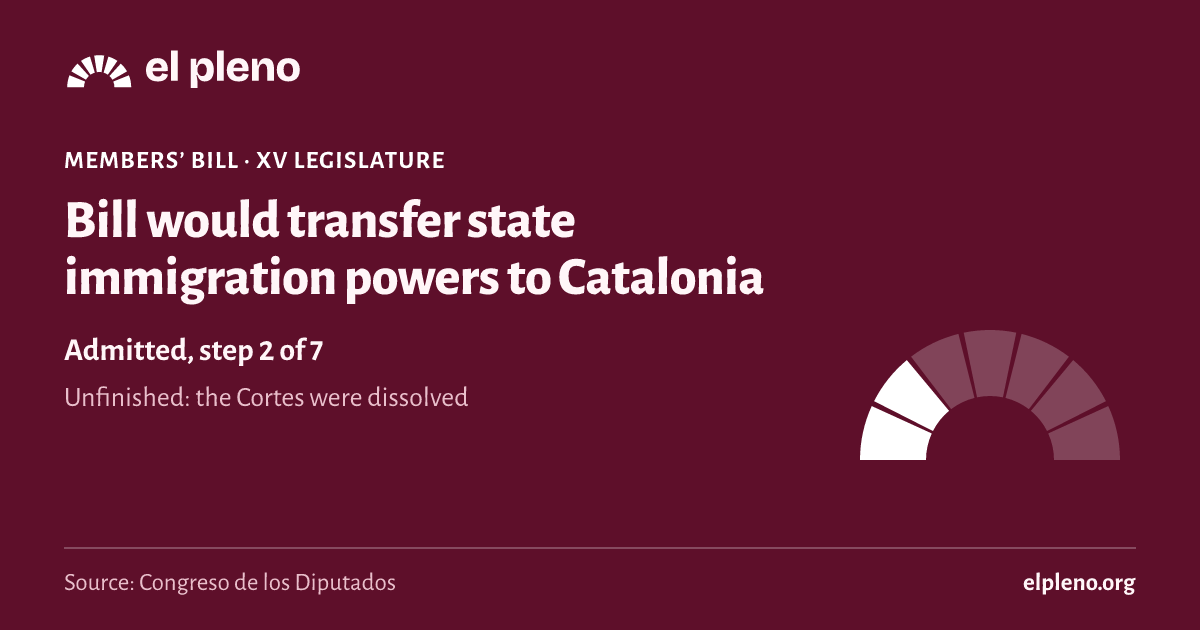
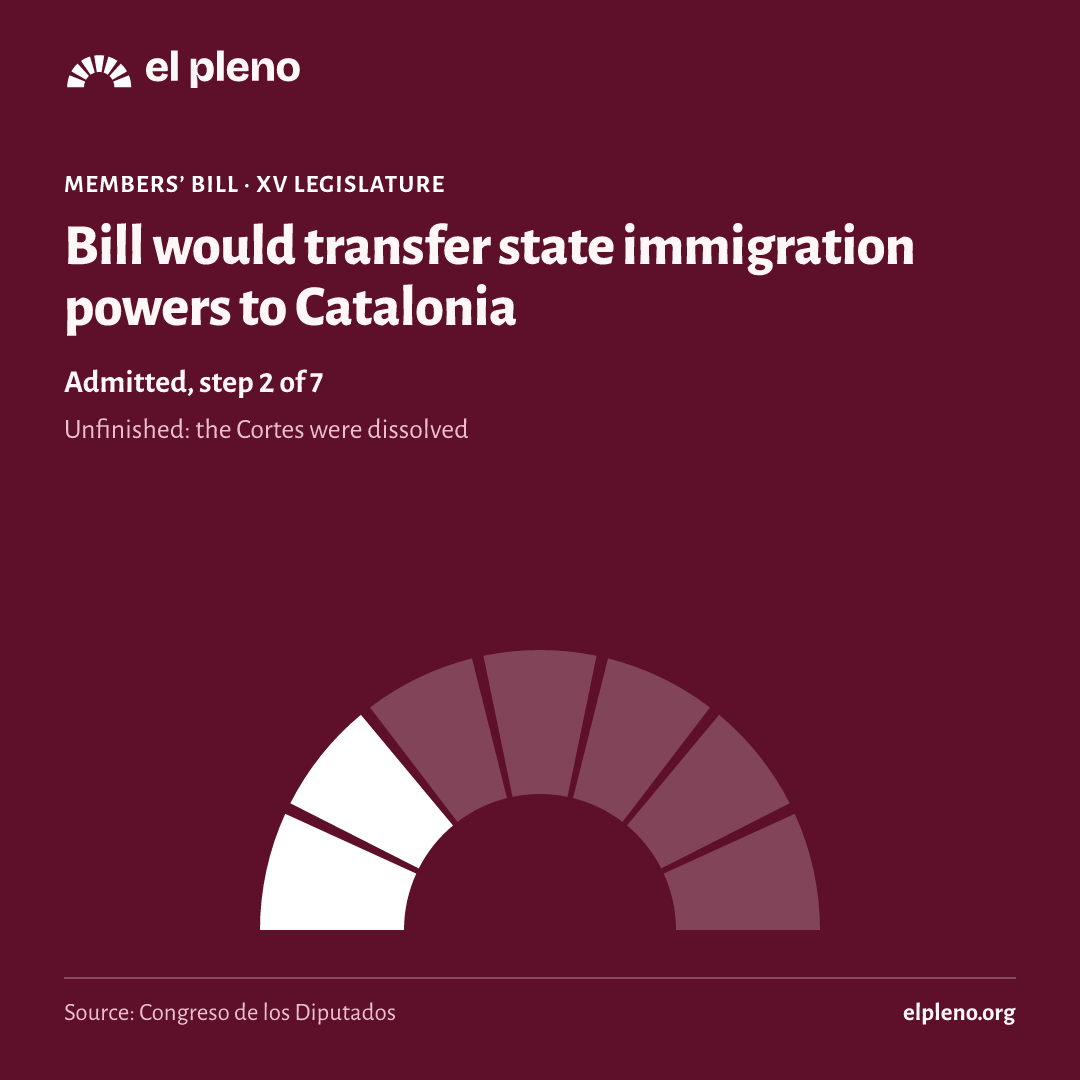
It took 2 of 7 steps. It reached Admitted, and today it is unfinished.
- Introduced26 August 2026Someone registers the text in the Congreso.
- Admitted8 September 2026The Bureau of the Congreso accepts it and, for a members’ bill, the plenary decides whether to consider it.
- Amendmentsnot reachedGroups propose changes.
- Committeenot reachedA committee goes through the text in detail.
- Plenarynot reachedAll 350 deputies vote.
- Senatenot reachedThe Senate can pass it, amend it or veto it.
- BOEnot reachedIt is published in the Official State Gazette (BOE) and comes into force.
See the 5 official steps on a timeline
Was there a plenary vote?
We have no plenary vote linked to this law in the Congreso’s data.
What happens next
What happens now?
The legislature ended before it finished. To go on, someone would have to introduce it again in the new Cortes.
It has not been presented again yet.
Sources
Where does all this come from?
- Congreso de los Diputados, file 122/000299
Official title, type, author, dates and stage.
Retrieved 11 November 2026
- Congreso de los Diputados, procedure
The date of each step, with its official wording.
Retrieved 12 November 2026
- The data comes from the open files of the Congreso, the Senate and the BOE, unaltered.
- Each deputy’s province is the one of their seat on the day of the vote.
- We only say “passed” or “rejected” when the majority needed is certain; otherwise we say which side had more votes.