

What it is
Proposal to expand border turnbacks in Ceuta and Melilla
It is a members’ bill. Introduced by parliamentary groups, the Senate, regional governments or citizens. It was introduced on 16 July 2026. Introduced by: Grupo Parlamentario Popular en el Congreso.
Official title: Private member's bill for an Organic Law amending Additional Provision Ten of Organic Law 4/2000, of January 11, on the rights and freedoms of foreigners in Spain and their social integration, regarding border rejection in the cities of Ceuta and Melilla.
Source: Congreso de los Diputados, file 122/000298· updated 11 Nov
Automatic summary, not yet reviewed
- The bill responds to a Spanish Supreme Court ruling of June 29, 2026 that limits border turnbacks to people trying to enter by climbing border containment structures, such as fences.
- The bill would allow foreign nationals detected or intercepted on the land or maritime border line of Ceuta or Melilla, during an irregular entry attempt, to be turned back to prevent their entry into Spain, regardless of the means used.
- Turnbacks would have to respect international human rights law, European Union law and the principle of non-refoulement. International protection requests would be filed at designated spots at border crossings.
- If passed, the law would take effect the day after its publication in the official state gazette (Boletín Oficial del Estado).
Who it affects
- Foreign nationals detected on the border line of Ceuta or Melilla: Could be turned back at the land or maritime border if they try to enter Ceuta or Melilla irregularly.
- People seeking international protection at those borders: Could file their requests at designated spots at border crossings.
- Security forces operating at the borders of Ceuta and Melilla: Could apply border turnbacks to sea entries as well, with the required safeguards.
Words worth knowing
- Rechazo en frontera
- Turning back a person at the border when they are detected trying to cross irregularly, without starting a deportation process.
- Principio de no devolución
- Non-refoulement: the ban on returning someone to a place where they could face persecution or inhuman treatment.
- Protección internacional
- International protection, such as asylum, requested from Spain due to persecution or other dangers in the person's home country.
- Proposición de Ley Orgánica
- A bill to amend an organic law, introduced by a parliamentary group and not yet passed.
It summarizes the text as it was introduced. It is written by artificial intelligence and may contain mistakes: the official text is what counts. Read the official text · How we make summaries
Where it stands
How far did it get?
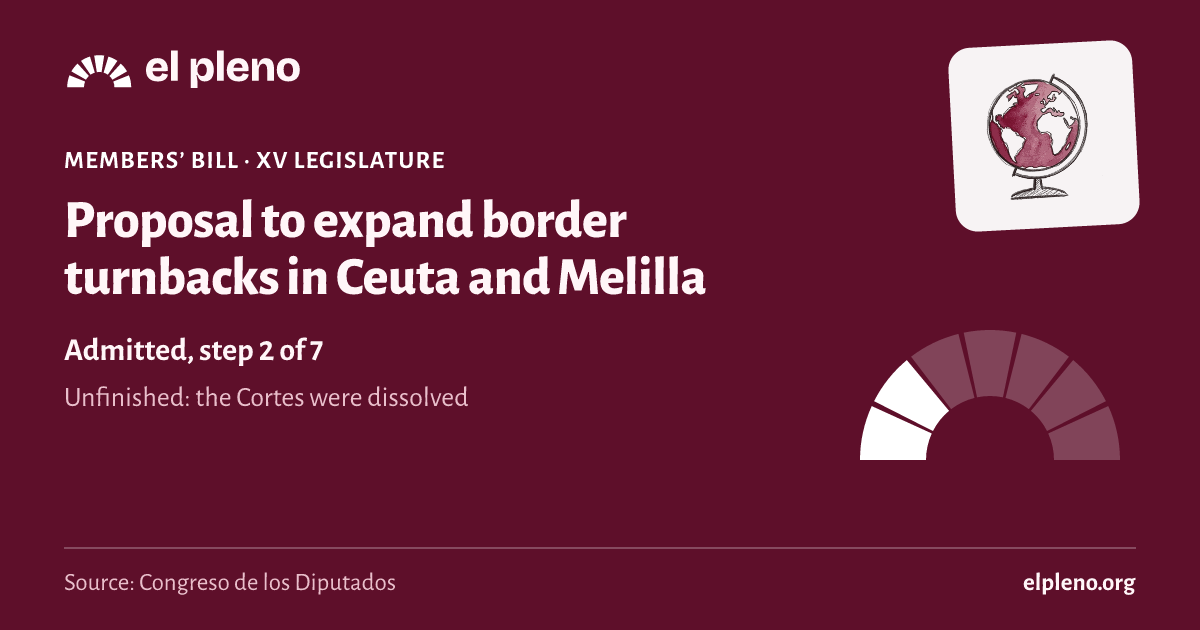
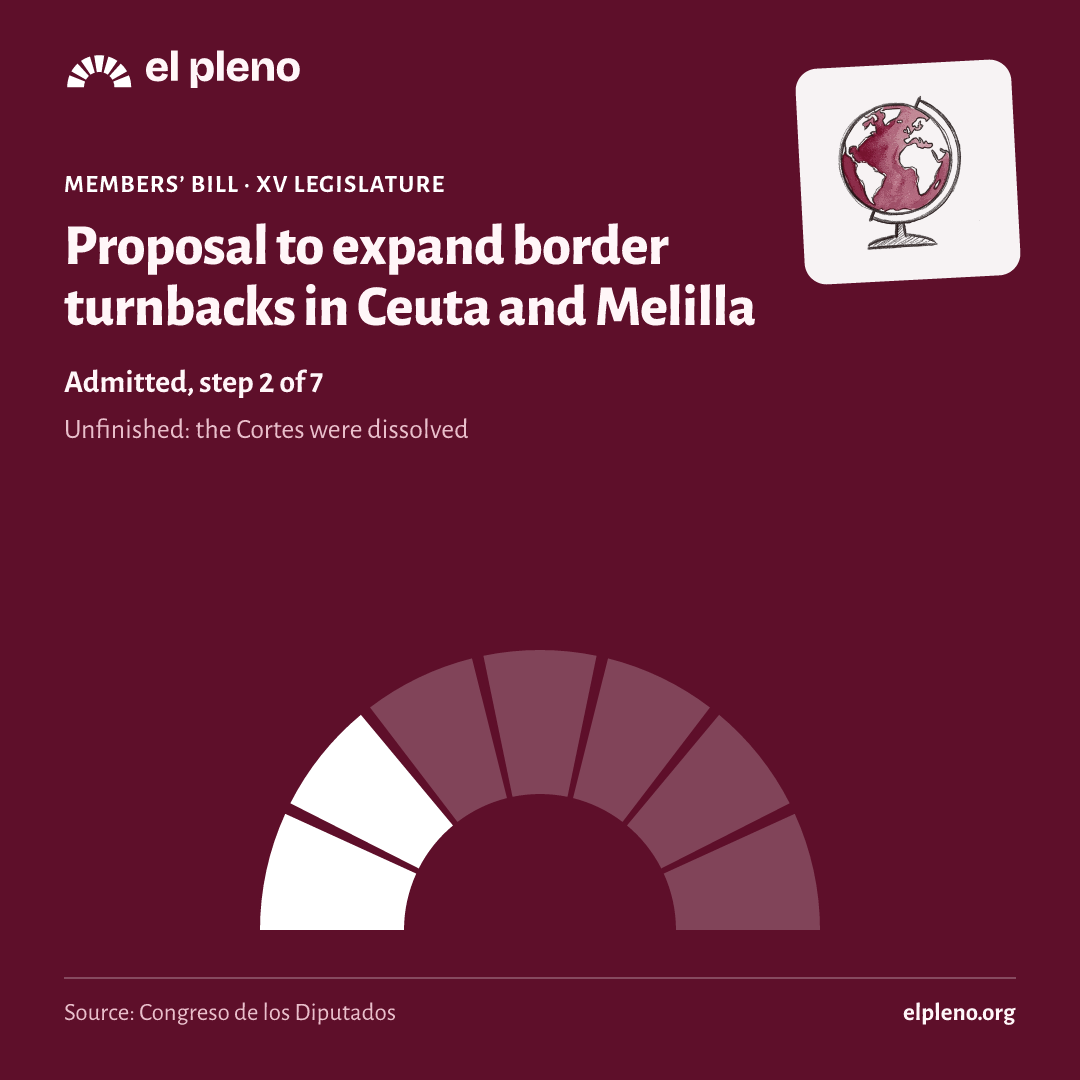
It took 2 of 7 steps. It reached Admitted, and today it is unfinished.
- Introduced16 July 2026Someone registers the text in the Congreso.
- Admitted23 July 2026The Bureau of the Congreso accepts it and, for a members’ bill, the plenary decides whether to consider it.
- Amendmentsnot reachedGroups propose changes.
- Committeenot reachedA committee goes through the text in detail.
- Plenarynot reachedAll 350 deputies vote.
- Senatenot reachedThe Senate can pass it, amend it or veto it.
- BOEnot reachedIt is published in the Official State Gazette (BOE) and comes into force.
See the 6 official steps on a timeline
Was there a plenary vote?
We have no plenary vote linked to this law in the Congreso’s data.
What happens next
What happens now?
The legislature ended before it finished. To go on, someone would have to introduce it again in the new Cortes.
It has not been presented again yet.
The same initiative in the other chamber:
Sources
Where does all this come from?
- Congreso de los Diputados, file 122/000298
Official title, type, author, dates and stage.
Retrieved 11 November 2026
- Congreso de los Diputados, procedure
The date of each step, with its official wording.
Retrieved 13 November 2026
- The data comes from the open files of the Congreso, the Senate and the BOE, unaltered.
- Each deputy’s province is the one of their seat on the day of the vote.
- We only say “passed” or “rejected” when the majority needed is certain; otherwise we say which side had more votes.