What it is
VOX bill would expel foreign offenders and strip their Spanish nationality
It is a members’ bill. Introduced by parliamentary groups, the Senate, regional governments or citizens. It was introduced on 3 July 2026. Introduced by: Grupo Parlamentario VOX.
Official title: Private member's Organic Bill amending Organic Law 10/1995, of November 23, of the Penal Code, regarding the substitution of the fulfillment of the sentence imposed on foreign criminals by their expulsion from national territory and the loss of non-origin Spanish nationality.
Source: Congreso de los Diputados, file 122/000296· updated 11 Nov
Automatic summary, not yet reviewed
- The bill would replace any sentence imposed on a foreigner convicted by a final judgment with expulsion from Spain, regardless of how serious the crime is. Only exceptionally, and if no treaty allows it, could the judge require up to two thirds of the sentence to be served in Spain.
- It removes the possibility of avoiding expulsion based on the convicted person's ties to Spain. The explanatory statement argues that this criterion has been used to block expulsions.
- Expulsion would close any pending procedures to live or work in Spain and would end the right to receive public benefits, allowances or subsidies. The expelled foreigner could not return to Spain for ten to twenty years; if they return earlier, they would serve the replaced sentence.
- For European Union citizens, expulsion would only apply if they pose a serious threat to public order or public safety, with even stricter conditions if they have lived in Spain during the previous ten years.
- It creates a new penalty: loss of Spanish nationality for people who are not Spanish by origin and are convicted of any crime. The Civil Code would be amended in the same sense.
- Within six months, the Government would have to sign agreements with other countries and promote rules in the European Union so that expelled people serve in their home countries the prison sentences imposed by Spanish courts.
Words worth knowing
- Sentencia firme
- A court ruling that can no longer be appealed.
- Arraigo
- A person's ties to Spain, such as family, work or social life.
- Tercer grado
- A prison sentence regime that allows working or living outside prison under supervision.
- Libertad condicional
- Release from prison before serving the full sentence, under conditions.
- Centro de internamiento de extranjeros
- A facility where foreigners are held while awaiting expulsion.
It summarizes the text as it was introduced. It is written by artificial intelligence and may contain mistakes: the official text is what counts. Read the official text · How we make summaries
Where it stands
How far did it get?
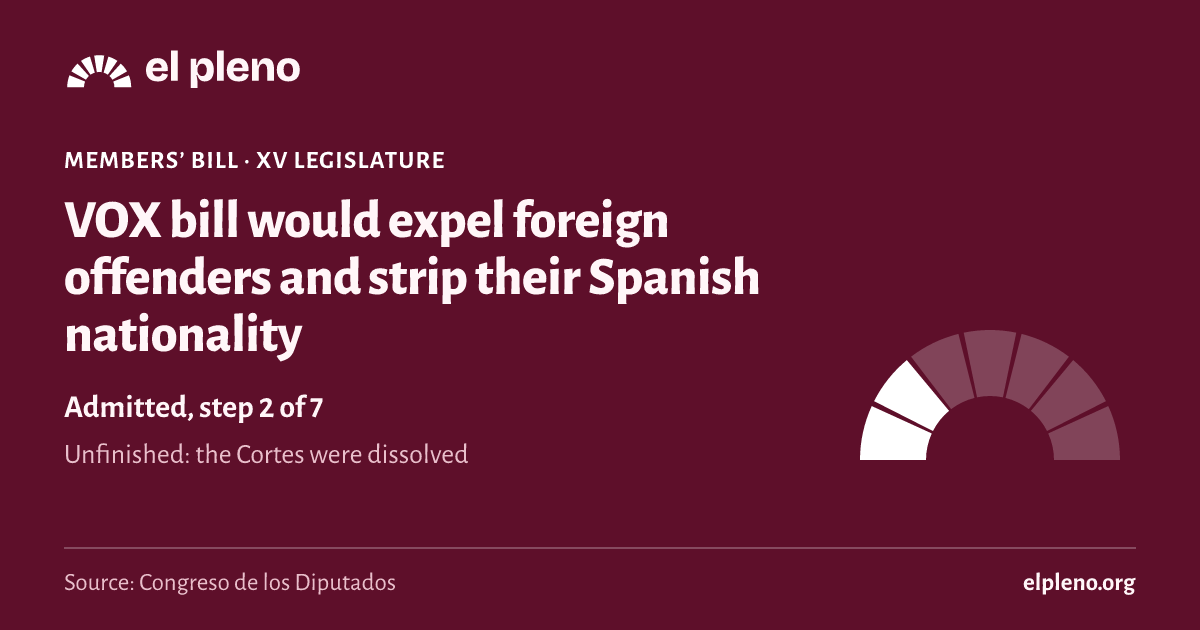
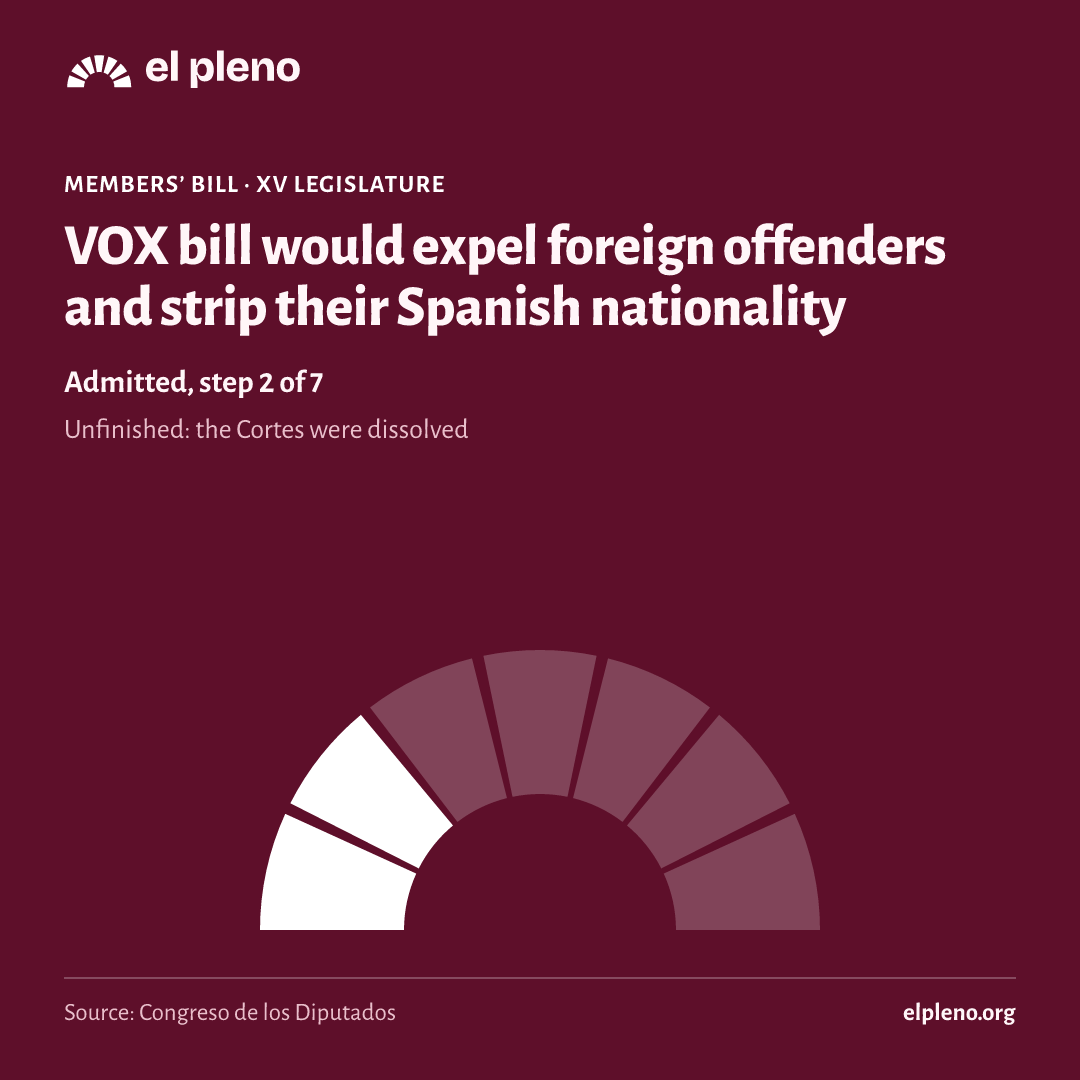
It took 2 of 7 steps. It reached Admitted, and today it is unfinished.
- Introduced3 July 2026Someone registers the text in the Congreso.
- Admitted14 July 2026The Bureau of the Congreso accepts it and, for a members’ bill, the plenary decides whether to consider it.
- Amendmentsnot reachedGroups propose changes.
- Committeenot reachedA committee goes through the text in detail.
- Plenarynot reachedAll 350 deputies vote.
- Senatenot reachedThe Senate can pass it, amend it or veto it.
- BOEnot reachedIt is published in the Official State Gazette (BOE) and comes into force.
See the 6 official steps on a timeline
Was there a plenary vote?
We have no plenary vote linked to this law in the Congreso’s data.
What happens next
What happens now?
The legislature ended before it finished. To go on, someone would have to introduce it again in the new Cortes.
It has not been presented again yet.
Sources
Where does all this come from?
- Congreso de los Diputados, file 122/000296
Official title, type, author, dates and stage.
Retrieved 11 November 2026
- Congreso de los Diputados, procedure
The date of each step, with its official wording.
Retrieved 12 November 2026
- The data comes from the open files of the Congreso, the Senate and the BOE, unaltered.
- Each deputy’s province is the one of their seat on the day of the vote.
- We only say “passed” or “rejected” when the majority needed is certain; otherwise we say which side had more votes.