What it is
Bill would spell out in more detail when police may use firearms
It is a members’ bill. Introduced by parliamentary groups, the Senate, regional governments or citizens. It was introduced on 19 June 2026. Introduced by: Grupo Parlamentario Popular en el Congreso.
Official title: Private member's Organic Bill amending Organic Law 2/1986, of March 13, on Security Forces and Corps.
Source: Congreso de los Diputados, file 122/000292· updated 11 Nov
Automatic summary, not yet reviewed
- The bill would change the current rule in Article 5.2.d of organic law A law on fundamental rights, the electoral system or other matters the Constitution reserves. It needs an absolute majority in the Congreso: 176 votes. 2/1986, which now says when police officers may use weapons, to refer to a new, more detailed set of rules.
- A new article would authorize members of the security forces to use firearms when there is a serious risk to their life, their physical integrity, that of third parties, or public security, following the principles of congruence, opportunity and proportionality.
- Officers would have to give a warning and order the hostile conduct to stop before firing, unless the imminence of the danger makes this impossible or risky. If the officer is not in uniform, no prior identification would be needed in those same cases.
- The bill would treat as absolute necessity the use of firearms against armed people resisting arrest, after two clear warnings, and against boats or vehicles whose occupants refuse to stop, also after two warnings. Warnings could be given with shots fired into the air, or would not be needed if the occupants carry weapons or use the vehicle to attack.
- The explanatory statement justifies the change by the evolution of crime, especially drug trafficking, and mentions as an example the technique of disabling fire, which means shooting to disable the propulsion and steering systems of a boat.
- The law would enter into force the day after its publication in the Official State Gazette (Boletín Oficial del Estado).
Who it affects
- Members of the security forces: They would have more detailed rules on when they may use firearms.
- Armed people resisting arrest: They could be shot by police after two warnings, or without them in some cases.
- Occupants of boats or vehicles who refuse to stop: Police could shoot at the boat or vehicle after two warnings, or without them in some cases.
- The general public: It would be defined more precisely when the police may use firearms.
Words worth knowing
- Proposición de ley
- A bill introduced by a parliamentary group so it can become law. It is not approved yet.
- Ley Orgánica (Organic Law)
- A type of Spanish law reserved for major matters, such as fundamental rights. It needs more votes to pass than an ordinary law.
- Intimación
- A clear, direct order for someone to stop doing something.
- Fuego inhabilitante (disabling fire)
- A technique of shooting to disable a boat's engine or steering, not to hit people.
- Narcolancha
- A fast boat used by criminal organizations to traffic drugs.
- organic law
- A law on fundamental rights, the electoral system or other matters the Constitution reserves. It needs an absolute majority in the Congreso: 176 votes.
It summarizes the text as it was introduced. It is written by artificial intelligence and may contain mistakes: the official text is what counts. Read the official text · How we make summaries
Where it stands
How far did it get?
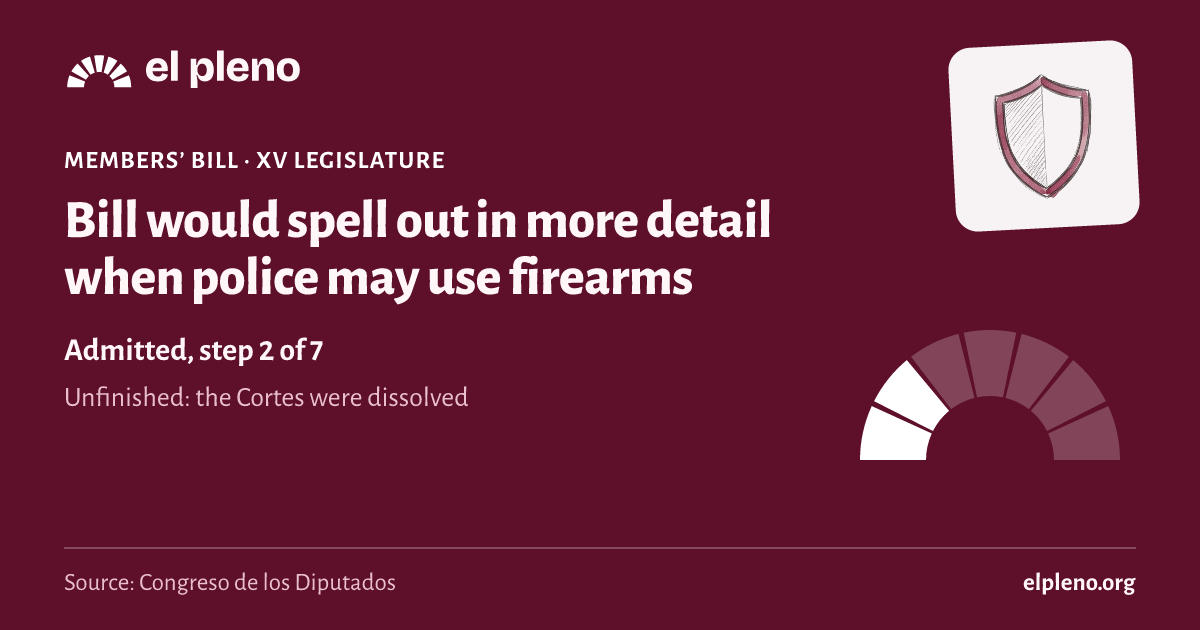
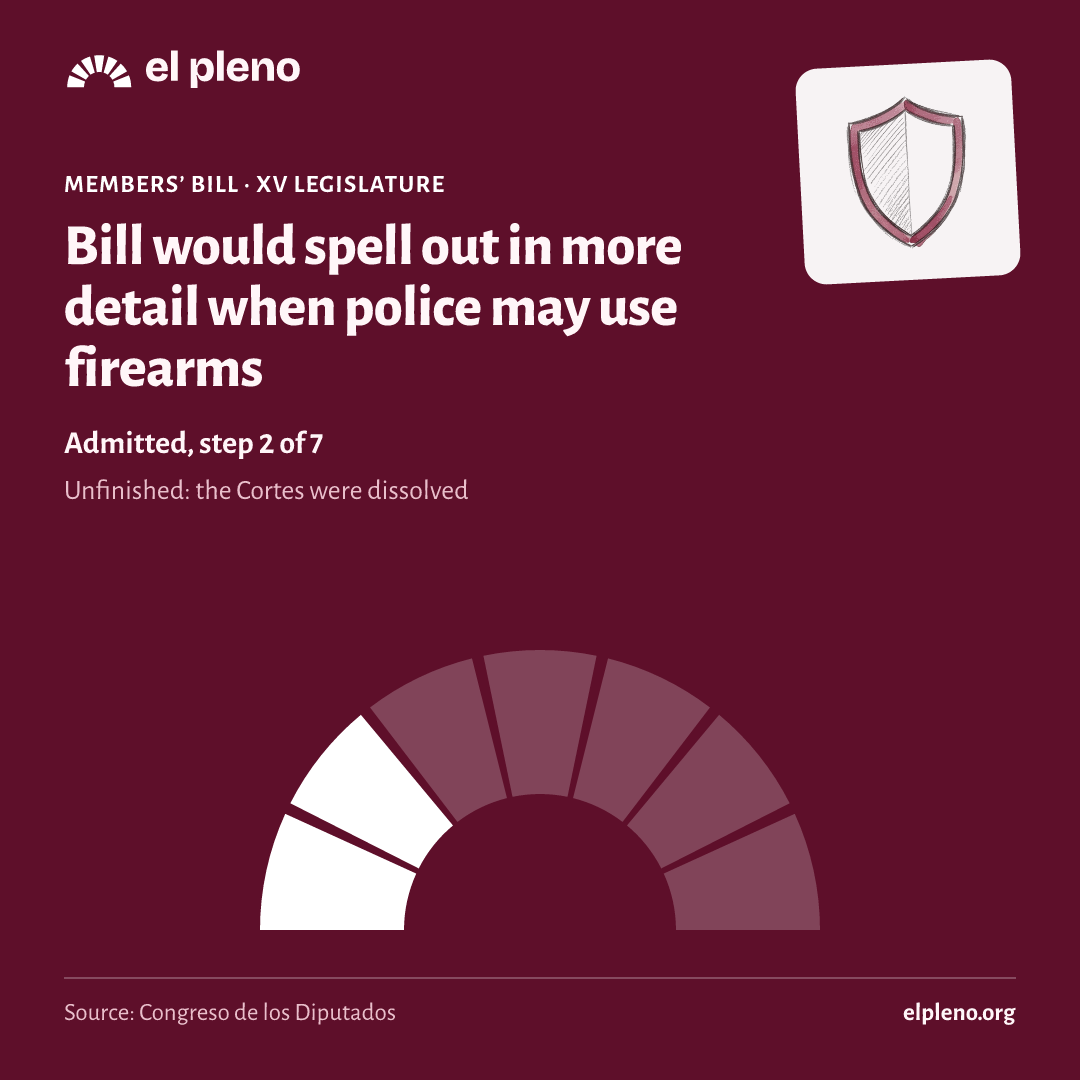
It took 2 of 7 steps. It reached Admitted, and today it is unfinished.
- Introduced19 June 2026Someone registers the text in the Congreso.
- Admitted23 June 2026The Bureau of the Congreso accepts it and, for a members’ bill, the plenary decides whether to consider it.
- Amendmentsnot reachedGroups propose changes.
- Committeenot reachedA committee goes through the text in detail.
- Plenarynot reachedAll 350 deputies vote.
- Senatenot reachedThe Senate can pass it, amend it or veto it.
- BOEnot reachedIt is published in the Official State Gazette (BOE) and comes into force.
See the 6 official steps on a timeline
Was there a plenary vote?
We have no plenary vote linked to this law in the Congreso’s data.
What happens next
What happens now?
The legislature ended before it finished. To go on, someone would have to introduce it again in the new Cortes.
It has not been presented again yet.
Sources
Where does all this come from?
- Congreso de los Diputados, file 122/000292
Official title, type, author, dates and stage.
Retrieved 11 November 2026
- Congreso de los Diputados, procedure
The date of each step, with its official wording.
Retrieved 13 November 2026
- The data comes from the open files of the Congreso, the Senate and the BOE, unaltered.
- Each deputy’s province is the one of their seat on the day of the vote.
- We only say “passed” or “rejected” when the majority needed is certain; otherwise we say which side had more votes.