What it is
Proposal to restrict private-sector work by former prime ministers
It is a members’ bill. Introduced by parliamentary groups, the Senate, regional governments or citizens. It was introduced on 3 June 2026. Introduced by: Grupo Parlamentario Plurinacional SUMAR.
Official title: Private member's bill regulating the statute of former presidents.
Source: Congreso de los Diputados, file 122/000286· updated 11 Nov
Automatic summary, not yet reviewed
- The bill would extend from two to ten years the period during which a former prime minister cannot work for private companies in strategic sectors or sectors regulated by the State.
- Being an ex officio member of the Council of State would require full-time dedication: if the former prime minister takes up paid private activity, that status would be suspended and no pay would be received.
- Starting paid private work would mean immediately losing the public resources of the former presidents' statute (office, car, staff) and the compensatory pension, except for academic, creative or outreach activities. Necessary security services would be kept.
- The new rules would also apply to former prime ministers already receiving the pension, using public resources or sitting on the Council of State when the law comes into force.
Who it affects
- Former prime ministers of Spain: They would have to wait ten years to work in strategic sectors and would lose public resources and the pension if they take paid private work.
- Former prime ministers serving as ex officio Council of State members: The position would require full-time dedication and would be suspended if they do paid private work.
- Companies in strategic or regulated sectors: They could not hire former prime ministers for ten years after they leave office.
Words worth knowing
- Periodo de carencia
- Waiting period after leaving office before you can do something, here work for private companies.
- Consejero nato
- Ex officio member of the Council of State by virtue of having been prime minister, without needing an appointment.
- Pensión indemnizatoria
- Compensatory pension paid to a former prime minister after leaving office.
- Puertas giratorias
- Revolving door: movement of people between public office and private companies, which can create conflicts of interest.
It summarizes the text as it was introduced. It is written by artificial intelligence and may contain mistakes: the official text is what counts. Read the official text · How we make summaries
Where it stands
How far did it get?
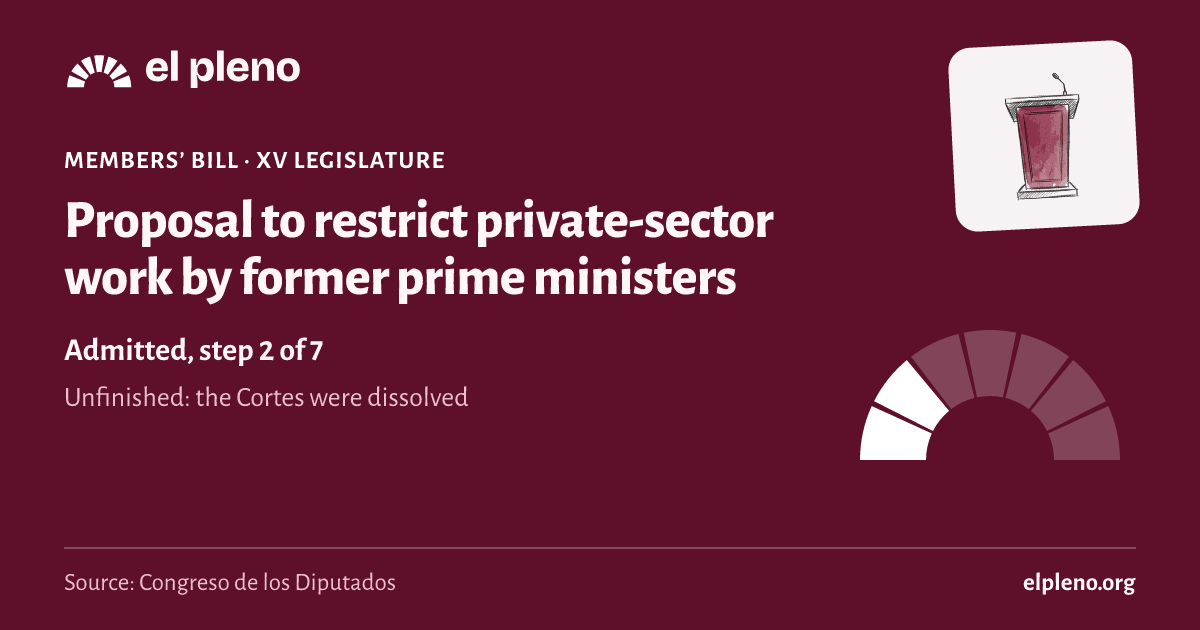
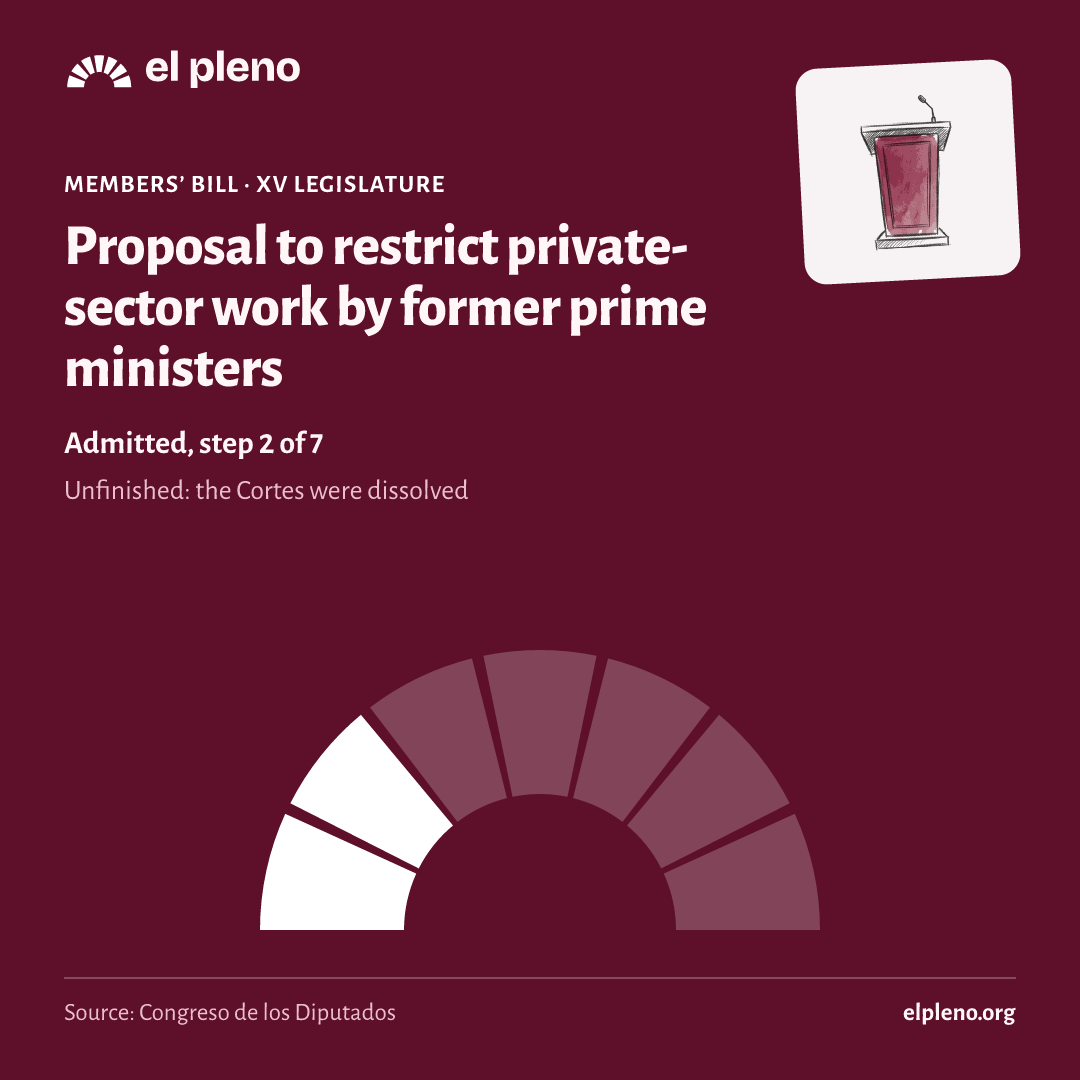
It took 2 of 7 steps. It reached Admitted, and today it is unfinished.
- Introduced3 June 2026Someone registers the text in the Congreso.
- Admitted8 June 2026The Bureau of the Congreso accepts it and, for a members’ bill, the plenary decides whether to consider it.
- Amendmentsnot reachedGroups propose changes.
- Committeenot reachedA committee goes through the text in detail.
- Plenarynot reachedAll 350 deputies vote.
- Senatenot reachedThe Senate can pass it, amend it or veto it.
- BOEnot reachedIt is published in the Official State Gazette (BOE) and comes into force.
See the 6 official steps on a timeline
Was there a plenary vote?
We have no plenary vote linked to this law in the Congreso’s data.
What happens next
What happens now?
The legislature ended before it finished. To go on, someone would have to introduce it again in the new Cortes.
It has not been presented again yet.
Sources
Where does all this come from?
- Congreso de los Diputados, file 122/000286
Official title, type, author, dates and stage.
Retrieved 11 November 2026
- Congreso de los Diputados, procedure
The date of each step, with its official wording.
Retrieved 12 November 2026
- The data comes from the open files of the Congreso, the Senate and the BOE, unaltered.
- Each deputy’s province is the one of their seat on the day of the vote.
- We only say “passed” or “rejected” when the majority needed is certain; otherwise we say which side had more votes.